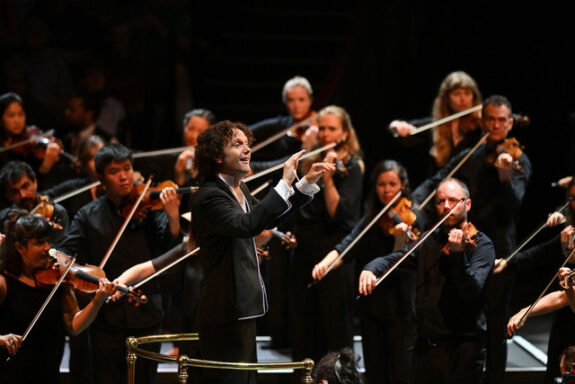
 United Kingdom BBC Proms 2026 [9] – Mahler’s First by Heart: Natalie Lewis (mezzo-soprano), Jack Bardoe and Sarah Twomey (actors), Aurora Orchestra / Nicholas Collon (conductor). Royal Albert Hall, London, 2.8.2026. (LJ)
Mahler – Symphony No. 1 in D major (1889)
Is there a better way to begin a Sunday than by attending a recital of Mahler’s First Symphony at the Royal Albert Hall? The morning began with a theatrical performance depicting the conversation Mahler had with Sigmund Freud towards the end of his life. Then, after the interval, the Aurora Orchestra, conducted by Nicholas Collon, performed the symphony in full.
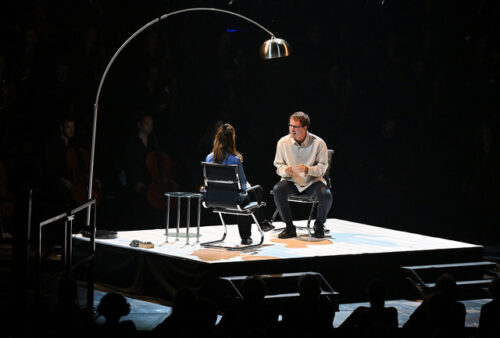
When the lights dimmed, a cacophony of the negative reviews that Mahler received upon premiering his First Symphony in Budapest on 20 November 1989 (then called, à la Liszt, ‘Symphonic Poem in Two Parts’) resounded throughout the auditorium. A spotlight then illuminated two actors sitting across from each other on a minimalist set consisting of two chairs, a large arching lamp, and a small table. Jack Bardoe played Mahler and Sarah Twomey took the part of Freud. A therapy session followed, with Freud coaxing Mahler to talk about his inner thoughts, echoing the meeting that took place between the two on 26 August 1910, not quite a year before Mahler died. The performance of this meeting was as dramatic as it was humorous, particularly with prompts like ‘Tell me about your mother’ raising audible laughter from the audience. Both actors performed well, even if Bardoe’s depiction of Mahler as a ‘mad genius’ was a little overstated.
A dissection of Mahler’s state of mind and the inspiration behind his First Symphony ensued. Interestingly, all of Mahler’s words were excerpted from his letters and diaries – a feat for which writer and director Jane Mitchell (also lead flautist) must be congratulated. The play was well conceived and provided the audience with plenty of food for thought along with listening notes. This educative aspect was further enabled by the orchestra (already positioned on the risers) and Collon, who deconstructed the symphony to link Mahler’s reflections with the inspiration for specific motifs and themes throughout each movement.
For example, when Bardoe enacted Mahler’s repurposing of the ‘Frère Jacques’ melody, the orchestra demonstrated the modulation of this well-known nursery rhyme into a minor key. At this point, Collon invited the audience to quietly sing Mahler’s minor-key version. With the help of clarinettist Timothy Orpen, Collon also explained the sounds of the cuckoo that Mahler repeats throughout the symphony – perhaps inspired by Beethoven’s or Saint-Saëns’s cuckoos, or simply by the birdsong that he so admired. Additionally, we heard sound recordings that contextualised Mahler’s experiences when composing each movement: bicycle bells, birdsong, and marching troops each provided detail for the audience to better understand the piece’s genesis.
When explaining each element of the piece, musicians moved seamlessly around the stage, often using two raised platforms to accentuate different instrumentalists or sections of the orchestra. Stage director James Bonas did a very good job of choreographing these movements, which could not have been easy with cellists, double bassists, and percussionists on the move during the demonstration of Mahler’s klezmer-inspired theme!
But the most entrancing moment from the first half of the concert was when mezzo-soprano Natalie Lewis sung the songs that Mahler recycled in this symphony: ‘Wenn Mein Schatz Hochzeit Macht’, ‘Ging heut’ Morgen übers Feld’, and ‘Die zwei blauen Augen von meinem Schatz’. Mahler originally wrote these songs for Johanna Richter, with whom he was in love at that time. Lewis’s voice was appropriately tender in the lower register, her expression was warm, and her stage presence was subtle yet commanding.
Overall, the first half of this concert was more of an exposition of the First Symphony than a standalone play. It was well written, with entertaining and enlightening moments, and it did make this symphony more accessible to audience members new to Mahler. However, it positioned the performance of the complete symphony in direct relationship to the themes explored in the first half. As such, it risked dissecting the piece a little too much. Indeed, when the symphony was performed after the interval, one could not listen to it as a whole. The elements that Collon so clearly explained during the first half – the A played across seven octaves on the strings, recurring cuckoos, melodies from Mahler’s Lieder eines fahrenden Gesellen, Austrian Ländler, ‘Frère Jacques’, Jewish klezmer – seemed too pronounced at times, and the progression from one theme to another became too clearly demarcated (particularly in the first movement).
Whilst the combination of theatre and recital certainly sparked discussion, with audience members remarking on the experience as they queued to leave the Royal Albert Hall, it overshadowed the Aurora Orchestra’s wonderful performance of the symphony itself. Ben Griffiths (double bass) and Murray Sedgwick (Timpani) performed very well in the third and fourth movements, respectively. Griffiths extracted from the minor-key ‘Frère Jacques’ song its haunting and ephemeral quality. Sedgwick was bold and energised in the opening of the final movement, marked ‘Stürmisch bewegt’ (‘stormily agitated’), with the string section also demonstrating very clear articulation during this section.
The Aurora Orchestra have been performing by heart for twelve years. To watch them play, each without scores in front of them, is impressive. They demand respect and admiration for accomplishing this feat alone. As Jane Mithcell said about the process of memorising: ‘it seems to bring you closer to the composer’, adding ‘it is as if you are spending time seeing their thoughts’. Such familiarity with the score allowed Collon and his orchestra to elevate the more conceptual aspects of Mahler’s piece. In the programme notes, Collon describes this symphony as ‘quite filmic, like a kaleidoscope of different memories woven together naturally and brilliantly’. As a listener, this kaleidoscopic vision was mesmerising, even if the explanations of the first half coloured the scenes of the piece a little too brightly at times.
Lucy Jeffery
Featured Image: Mahler’s First by Heart: Nicholas Collon conducts the Aurora Orchestra © BBC/Mark Allan