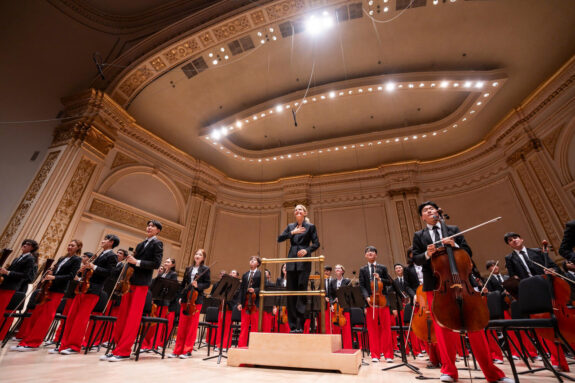
 United States Barber, Gershwin, Bartók: Kirill Gerstein (piano), National Youth Orchestra of the United States of America / Karina Canellakis (conductor). Carnegie Hall, New York, 31.7.2026. (RP)
Barber – Overture to The School for Scandal
Gershwin – Concerto in F
Bartók – Concerto for Orchestra
Encores:
Oscar Levant – ‘Blame It on My Youth’
Gershwin – Overture to Girl Crazy (orch. Don Rose)
What a difference a day makes – and even a few years in age. The previous evening (review here), NYO2 under Mei-Ann Chen had electrified Carnegie Hall with a rhythm-driven explosion of orchestral color. This time, the National Youth Orchestra conducted by Karina Canellakis delivered a different kind of exhilaration: playing of such extraordinary precision, refinement and maturity that, with eyes closed, one could easily have mistaken the ensemble for one of the world’s finest orchestras. It was all the more astonishing knowing that every musician on the stage was between 16 and 19 years old.
The three works by Barber, Gershwin and Bartók spanned the years 1925 to 1943. Bartók may have disrupted the idea of an all-American program but all three works were composed on American soil. He wrote his Concerto for Orchestra in self-imposed exile in the United States after fleeing Europe during World War II as Hungary became increasingly aligned with Nazi Germany.
The first piece was by a young Samuel Barber, then 23 years old. His Overture to The School for Scandal was the student composer’s first major orchestral work, inspired by Richard Brinsley Sheridan’s comic masterpiece satirizing fashionable eighteenth-century London society. Barber captured the play’s urbane wit and social sparkle in a brilliantly scored overture whose lively themes and quicksilver shifts of color and tempo evoke Sheridan’s repartee and intrigue.
Canellakis brought a keen sense of momentum and architecture to the score, her exact, controlled conducting revealing both its rhythmic vitality and deeper expressive currents. The orchestra responded with precision and wit, bringing energy to the short thematic bursts that alternate between lyricism and angularity. The woodwinds, brass and strings engaged in sophisticated dialogue, culminating in a buoyant ending worthy of Sheridan’s comedy. It was the first opportunity to savor the violin section’s superb playing and sumptuous sound which would become a defining characteristic of NYO-USA 2026.
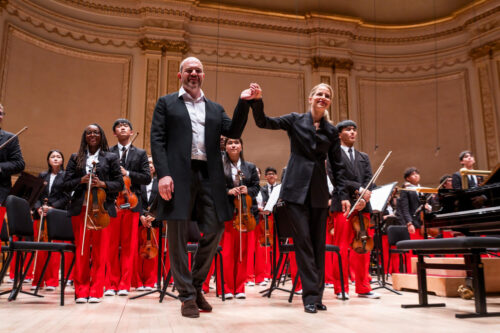
Gershwin’s Concerto in F represents an earlier stage in the development of an American concert style blending jazz and classical traditions. He infused the concerto’s classical architecture with syncopated rhythms, sparkling piano writing and orchestral colors that sizzled in this performance with Kirill Gerstein as soloist. Gerstein brought the natural rhythmic freedom of his early jazz experience to Gershwin’s music while retaining the refinement and structural clarity of his classical training.
Gerstein eschews showmanship, exuding a natural sense of authority – but this pianist can swing. He displayed an instinctive feel for the concerto’s syncopation and jazz rhythms while shaping the blues-inspired melodies of the slow movement with tender warmth. He astounded in the finale with his virtuosic command of rapid-fire passages and technical flourishes. The orchestra proved an ideal partner, matching his sophistication and energy while engaging fully in the concerto’s conversational interplay. Winds, brass and percussion provided radiant color, while the strings contributed warmth and lyricism throughout.
For an encore, Gerstein performed Oscar Levant’s ‘Blame It on My Youth’, a jazz standard by the composer-pianist who was a close friend of Gershwin. Although Levant studied composition with Arnold Schoenberg, he was a master of the urbane, sophisticated ballads of the 1930s. Gerstein brought gentle intimacy and wistfulness to Levant’s evocation of youthful intensity and the emotional vulnerability of first love.
In the Concerto for Orchestra, Bartók turned the traditional concerto form inside out, treating the entire orchestra as a collection of virtuoso soloists. Canellakis struck a finely judged balance between control and spontaneity in the richly colored score with its asymmetrical rhythms, shifting accents and driving ostinatos. She also expertly shaped the transition from its profoundly melancholy passages to its exhilarating ending, unleashing the orchestra’s full power in a final burst of energy. What made the performance so memorable was the exceptional playing of the orchestra’s individual sections, whether as solo voices or in musical dialogue. While the violins’ star never dimmed, the other sections proved their equals in every respect.
The sole encore was Gershwin’s Girl Crazy overture, whose unforgettable tunes – including ‘I Got Rhythm’, ‘Embraceable You’ and ‘But Not for Me – brought a final return to the infectious rhythms, lyrical warmth and urbane sophistication of the Jazz Age. Who could ask for anything more?
Rick Perdian
Featured Image: Karina Canellakis (conductor) with the NYO-USA © Chris Lee