
 United Kingdom BBC Proms 2026 [25] – Kaprálová, Rachmaninov, Janáček: Lukáš Vondráček (piano). BBC Symphony Orchestra / Jakub Hrůša (conductor). Royal Albert Hall, London, 1.9.2026. (CK)
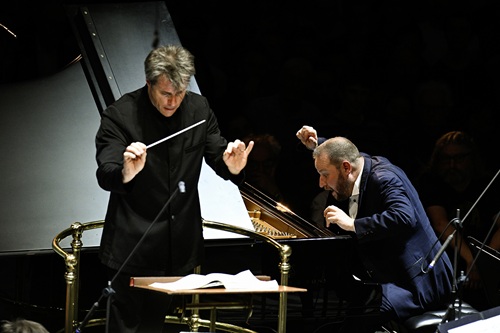
Vítĕzslava Kaprálová – Suita Rustica
Rachmaninov – Piano Concerto No.3 in D minor
Janáček – Sinfonietta
What is it that is so special about Jakub Hrůša? I first encountered him at the BBC Proms two seasons ago when he conducted a pair of concerts with the Czech Philharmonic Orchestra, including performances of Josef Suk’s Asrael Symphony and Janáček’s Glagolitic Mass that I am unlikely ever to forget. I was sufficiently stirred to go to his Covent Garden performances of Jenůfa and The Makropulos Case, and to a fine performance last autumn with the Philharmonia Orchestra of Mahler’s Seventh Symphony (which was, of course, premiered in Prague).
It was also at one of those Proms that Hrůša introduced me to the music of the tragically short-lived Vítĕzslava Kaprálová. Sometimes the unearthing of composers whom history has passed by or discriminated against, or who only lived long enough to give a tantalising glimpse of their powers – including a number of women composers – can look like piety, the righting of a wrong, rather than something done for purely musical reasons. I was talking with an experienced London musician recently who was surprisingly cynical about this aspect of the current musical zeitgeist: ‘We know why we have to play this stuff.’
Well, I am glad they do: certainly in the case of Kaprálová. With the Czech Philharmonic Hrůša performed her graduation piece, the affecting Military Sinfonietta: here with the BBC Symphony Orchestra he performed her Suita Rustica. (Plaudits to Edward Gardner and the London Philharmonic Orchestra, who included this work, along with the astonishing six-minute song Waving Farewell, in their marvellous pair of concerts of music by Central European composers back in February).
The Suita is a most attractive piece. The first Allegro opens boldly and leads to emphatic folk rhythms and an affecting clarinet melody – the contrasts nicely pointed up – and ends with irresistible swagger; the Lento is a pastoral dream – singing cellos, soft horns – punctuated by a rambunctious Vivo; the final Allegro, launched by bass drum and trombones, has all the hallmarks that make us love Czech music. Kaprálová was a fan of Stravinsky – Petrushka is certainly detectable in this music – and there is no doubt that her early death robbed us of a characterful and intriguing modernist composer: but in this performance the music’s vitality seemed to be tapped straight from Dvořák’s Slavonic Dances. Brilliance and heart, both.
The central and most substantial part of this programme – and perhaps the biggest crowd-puller? – was Rachmaninov’s Third Piano Concerto. I have to confess that I was pulled rather by the Czech pieces that flanked it. I have seen it described as the Everest of piano concertos, which may prompt the unworthy question: is it famous because it’s there? Because it is huge, difficult, and needs Rachmaninov-sized hands to play it? Where does it fit between the full-blown Romanticism of the Second Piano Concerto and the steely brilliance of the Rhapsody on a Theme of Paganini?
My doubts surface most in the finale: but I am probably in enough trouble as it is, so I will hastily (and happily) affirm that it was beautifully played and vigorously accompanied. The pianist Lukáš Vondráček (nice to have a Czech thread running through the whole concert) began beautifully, head bowed over the keys as if musing privately; the strings floated the Romantic second theme without lingering over it. After the mighty cadenza the delicate playing of flute, oboe, clarinet and horn brought refreshment and relief.
Vondráček’s playing was consistently engaging, with weight and eloquence in the left hand and crystalline clarity in the right. The performance was ecstatically received, with many getting straight to their feet; the lady behind me gasped ‘I was stunned by that!’ Vondráček’s encore – a Czech Dance by Smetana – was most attractive, contrasting nicely with the concerto’s thunder.
Those new to Janáček’s Sinfonietta may have wondered why so many brass players – hitherto unheard – assembled on the platform in the interval for some informal group photos. In their proper places – 21 of them around the top step, five horns below – they were an impressive sight. Hrůša favoured fast tempi, as Kubelik used to: Janáček’s extraordinary sounds were fleet-footed, sharply etched, no expressive detail missed. Tight brass, pungent woodwind, wiry strings (and, in the second movement, busy harp).
There have been a number of brass-heavy pieces at this season’s Proms (The Pines of Rome and the Berlioz Requiem come immediately to mind). In the former, conductor John Wilson – quite rightly – exhorted his panoply of brass to play as loudly as possible; here, equally rightly, Hrůša went for a rounded, hymnic fullness of tone. The performance was perhaps less viscerally thrilling than Dalia Stasevska’s with this orchestra in the Barbican in March last year: but it did justice to Janáček’s vision, filling the Royal Albert Hall with a bright radiance.
Chris Kettle