
 Hungary Miratone Festival – Beethoven, Janáček: Miranda Liu (violin), László Borbély (piano), V4 String Quartet. Miratone Festival and Academy, Budapest, 23.8.2026. (AK)
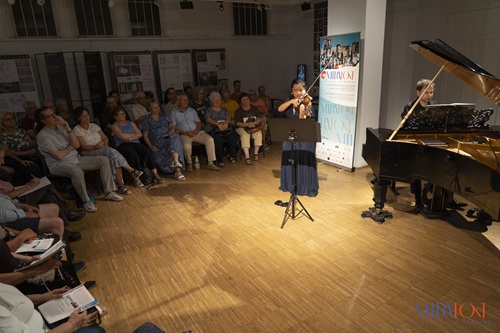
Beethoven – Sonata for Piano and Violin No.9 in A major, Op.47 (‘Kreutzer’)
Janáček – String Quartet No.1 ‘Kreutzer Sonata’
Violinist Miranda Liu is an unassuming but extraordinary force of musical presence. Only 29 years of age, she accomplished more than many of her peers in a lifetime. Born in California of American-Chinese ethnicity, she spent her childhood in Philadelphia and later studied in Salzburg, Budapest and London. At the age of 19 she was appointed as concert master of Concerto Budapest Symphony Orchestra, a post which she still holds (jointly with Zsófia Környei). In the meantime, Liu has given many solo – and chamber music performances and taught violin and chamber music in Bulgaria, the Czech Republic, Hungary, Poland, Romania, Slovakia, and Spain. Apparently, Liu speaks seven languages; I can personally vouch for her astonishing and fluent Hungarian.
In 2019, Liu set up the Miratone Festival and Academy with concerts and masterclasses during the last week of August. Now (2026), in the eight year of the Festival, Liu was again enterprising in repertoire as well as with the choice of the large number of participating artists and students who come from several countries. Liu is the sole (or main) organiser, leaving me wonder if she has much more than 24 hours in a day.
Last but not least, Liu is an excellent violinist with a virtuoso technique and profound musicianship. No gimmicks, no sensationalism; the listener is provided with the composer’s concept whatever composition Liu presents.
The choice of programme for the third concert of this year’s festival (which accommodated twelve concerts during 22 – 30 August) centred on the name Kreutzer.
Beethoven’s composition (from 1803) is known today as the ‘Kreutzer Sonata’. He dedicated the work to Rodolphe Kreutzer, a celebrated French violinist of the time, who found it too difficult as well as too unconventional and therefore never performed it. More than a century later, Lev Tolstoy, inspired by Beethoven’s sonata, wrote his novella The Kreutzer Sonata, a tale of an unhappy marriage in which a wife has an affair with a violinist with whom she is playing Beethoven’s sonata. This novella in turn inspired Leoš Janáček’s First String Quartet (1923).
Both works on the programme require utmost virtuosity and disciplined but strong emotional involvement. All performers delivered with exemplary skills and dedication.
The first four bars of solo violin double stops in the sonata set the scene. Miranda Liu was strong, clear and indicated direction. The composition is specified as for violin and piano, but the material demands equal partners (rather than a violin accompanied by a piano). Without doubt, László Borbély was a strong partner, perhaps a bit too strong at times. For instance, he started the third movement with an incredibly loud chord, making me jump in my seat. In Leó Weiner’s edition this chord is marked ff but I heard ffff or so. Several of the sfp piano chords also sounded as sfffp. On the other hand, Borbély also produced some beautiful cantilena playing like in his eight bars solo at the start of the second movement and in his four bars solo at the start of variation 4. Borbély invested a great deal of emotion in his playing, he seems to have enjoyed some romantic Beethovenian freedom which he may not have in his frequent performances of Bartók, Ligeti, Kurtág.
Virtuosity and high passion, coupled with full respect for the composition, were displayed in the Janáček quartet. The four-movement piece, composed by Janáček when he was 69, is full of cantilena sections but also of highly charged emotion. The composer did not seem to consider the difficulties presented for the players, he even wrote some sections in the six-flat key signature.
I do not know how much rehearsal time the V4 String Quartet had but their ensemble work was exemplary. For instance, in the third movement, the lyrical exchange between first violin and cello, accompanied by the composed cacophony between second violin and viola, was spellbinding. It is of significance that leader Miranda Liu played from the full score (not from the first violin part); quartet leaders, take note. I am not sure about the other three players but from my seat I had a good view of Liu’s iPad.
The four players of the V4 String Quartet come from several countries: Miranda Liu (violin, USA/Hungary), Daniel Rumler (violin, Slovakia/Czech Republic), Tomáš Krejbich (viola, Czech Republic), Bartosz Koziak (cello, Poland). However, as demonstrated at this concert, they do speak the same musical language under Miranda Liu’s expert guidance. May they continue to do so at next year’s Miratone Festival.
Agnes Kory