 United Kingdom Romsey Chamber Music Festival 2025 [4] – Various: Romsey URC Church, 7-8.6.2025. (CK)
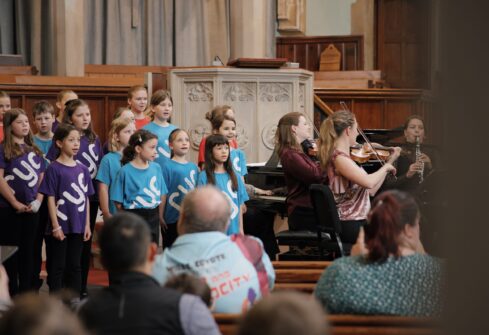
RCMF’s final weekend brought more plums. In a well-attended family concert on Saturday morning, ompèred by Lydia Hillerudh, we were beguiled by a mix of music and poems: highlights were Grieg’s Morning played by string quartet and clarinet, a glorious version of Somewhere Over the Rainbow from Gerbrich Meijer on clarinet and Ziteng Fan on piano, and an arrangement for piano, clarinet and string quartet of The Gift to be Simple, the Shaker tune used by Copland in Appalachian Spring. Romsey Youth Choir chipped in with a song about the moon, preceded by a poem about a child’s imaginary night flight (I liked the line ‘a wisp of cloud tickled my feet’). All performers then joined together for a final song.
Along with this Family Concert, a Masterclass earlier in the week highlighted the work that Laura and her colleagues do away from performance, going into schools and helping talented young musicians to progress. Lydia Hillerudh worked with Ukrainian-born Margaryta Dorosh on the Cadenza from Shostakovich’s First Cello Concerto, and Rainer Crosett helping the Kalla Quartet (Chloe Lui, Rose Gosney, Max Altimira Saura and Megan Clarke – all students at the Royal Academy of Music) bring humour and grotesquerie to their playing of the same composer’s Third String Quartet.
Mustonen – Soul Bird (Ziteng Fan [piano])
Butler – Five Vignettes (world premiere) (Laura Rickard, Emma Roijackers [violins])
R. Strauss – Four Last Songs (Helena Moore [soprano], Emma Roijackers, Laura Rickard [violins], Martin Moriarty [viola], Lydia Hillerudh [cello], Ziteng Fan [piano])
Beethoven – String Quartet in A minor, Op.132 (Goethe String Quartet: Luke Hsu, Laura Rickard [violins], Marthe Husum [viola], Rainer Crosett [cello])
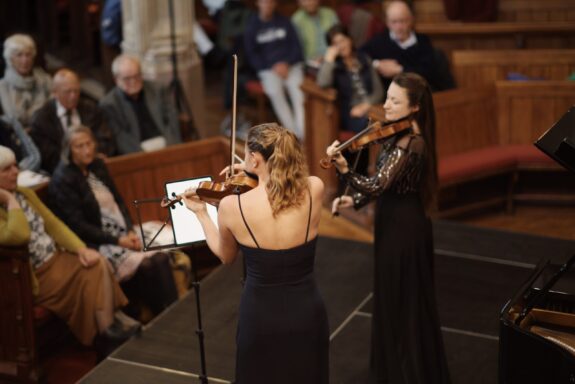
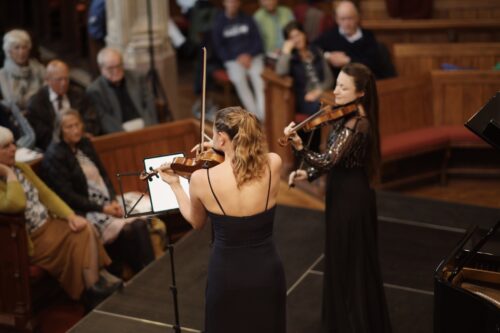
After Ziteng Fen’s performance of pianist and composer Olli Mustonen’s beautiful Soul Bird (a soulmate, perhaps, for her performance of Ravel’s Oiseaux Tristes the previous day), we heard the world premiere of Romsey-born composer Martin Butler’s Five Vignettes for two violins, commissioned by Laura Rickard and George Vass, Director of Presteigne Festival (with which RCMF has close ties). It is a very attractive suite in five short movements: the outer ones mostly delicate and high-lying, the central one feather-light, one violin echoing the other; the second, Slalom, an exhilarating hoe-down; the fourth, White Water, combining agility with a degree of nervous tension – which, in my limited experience of white water rafting, is about right. It ends, wittily, with the music’s sudden disappearance down a chute.
I can see the attraction of including Richard Strauss’s Four Last Songs (written in my lifetime – just) in a festival entitled Coda, but it didn’t quite work: Helena Moore is a fine singer, but I imagine her voice is more suited to opera than to lieder. The same was true, in the Festival Finale, of her performance of Marietta’s Lied from Korngold’s Die tote Stadt (an opera aria, but one that needs to be slightly chilling as well as erotic) and Schubert’s Der Hirt auf dem Felsen. The Strauss songs were finely arranged (especially for this performance) for string quartet and piano by Martin Butler; there were incidental pleasures – Emma’s beautifully poised violin solo in Beim Schlafengehen for one.
The concert culminated in the Goethe Quartet’s magnificent performance of Beethoven’s A minor String Quartet, an utterly sublime Heiliger Dankgesang at its heart. I didn’t take notes; I just listened. It was far and away the finest performance I have heard; as a cellist friend said, ‘You won’t hear it played like that anywhere in the world’.
Bach – French Suite No.3 in B minor
Sofia Gubaidulina – Chaconne
Liszt – Piano Sonata in B minor (Junyan Chen [piano])
Junyan Chen’s lunchtime recital was as spectacular as those of us who had heard her in Messiaen’s Quatuor had hoped. Bach’s French Suite was lively, expressive, fleet-fingered, brilliant, as the five dances required, with an expressive Sarabande at the centre. Gubaidulina’s Chaconne was gritty, angular, intense, almost as if the expressive range of the Liszt Sonata to come had been compressed into its nine minutes. Showers of sparks struck from an anvil rather than tongues of fire, but nevertheless a suitable piece for Pentecost Sunday.
As for the Liszt Sonata, Junyan had the measure of its technical demands and of its panoramic range of expression, from calm to tumultuous; there was beauty as well as power. When the music demands it – in the fugal passage that opens the third movement, for example – her playing was simply staggering. Runner-up in last year’s Leeds International Piano Competition, she is clearly on her way; in December she is booked for a recital at the Wigmore Hall. One for the diary.
Korngold – Marietta’s Lied from Die tote Stadt (Helena Moore [soprano], Emma Roijackers, Alice Ivy-Pemberton [violins], Martin Moriarty [viola], Lydia Hillerudh [cello], Ziteng Fan [piano])
Cheryl Frances-Hoad – My Fleeting Angel (Luke Hsu [violin], Lydia Hillerudh [cello], Ziteng Fan [piano]
Schubert – The Shepherd on the Rock (Helena Moore [soprano], Gerbrich Meijer [clarinet], Ziteng Fan [piano]
Brahms – Piano Quartet No.3 (Ziteng Fan [piano], Laura Rickard [violin], Martin Moriarty [viola], Rainer Crosett [cello])
I have already mentioned the Korngold and Schubert items – but I cannot leave the latter without mentioning the wonderful clarinet playing of Gerbrich Meijer: she is a musician who I very much hope to hear again. Sandwiched between the two vocal pieces was the Festival’s final angelic visitation, in the form of Cheryl Frances-Hoad’s Piano Trio My Fleeting Angel. Derived from a Sylvia Plath short story, we might expect it to be unsettling: and so it is.
The story concerns the growing rift between a husband and wife, seen through the divergence of their dream lives. In the first of three short movements high cello and low violin represent dream colours across which the piano splashes splintering dissonances: violin harmonics in unison with the cello sound distinctly spooky. The second movement, following without a break, brings turbulence; the third brings a waltz on piano, while cello and violin get up to tricks which seem intended not to decorate but to destabilise it. Another intense experience for players and listeners alike.
The Festival closed with one of Brahms’s most substantial chamber works, his Third Piano Quartet in C minor. Brahms jokingly likened it to Goethe’s Werther: but the music has matured far beyond the attitudinising of rejected young love; it is like a fine wine. Ziteng, Laura, Martin and Rainer hurled themselves into it with their trademark intensity and vision. Martin’s viola caught the ear in the first movement; in Rainer’s hands – joined by Laura’s – the melody that opens the Andante sounded ineffable; Ziteng’s piano underpinned the passionate – though still resolutely minor – music of the finale.
So ended ‘an epic week, even by RCMF standards’, as Laura rightly said; and, looking to the future, she reminded us of her governing vision: ‘A festival for the community, not just for a few of us’. Roll on next year.
Chris Kettle