
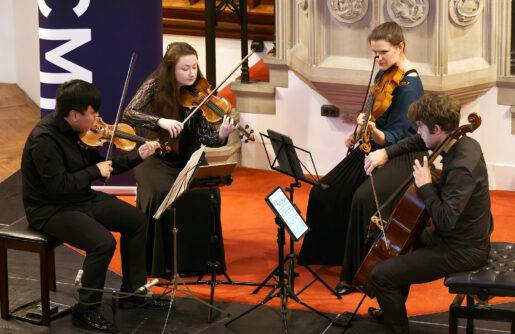
 United Kingdom Romsey Chamber Music Winterfest – Various: Goethe String Quartet (Luke Hsu, Laura Rickard [violins], Marthe Husum [viola], Rainer Crosett [cello]). United Reformed Church, Romsey, 23 & 25.1.2026. (CK)
23.1.2026
Bartók – Romanian Folk Dances for string orchestra
Eleanor Alberga – String Quartet No.2
Ravel – String Quartet in F major
Laura Rickard’s Romsey Chamber Music Winter Festival has made a welcome return; after a week of spreading the joy of chamber music with school visits, workshops and coaching sessions across the Test Valley, her Goethe Quartet – all of them regular participants in the summer festivals – gave two stimulating and absorbing weekend concerts, both of them memorable for superlative musicianship and total commitment.
As in previous years, Laura also used the weekend for publicising the programme for the Summer Festival in late May (23rd to 31st): a wonderfully diverse concentration of 14 events on the theme of Elements – earth, air, water, fire: a perennial source of inspiration for artists of all kinds, and an issue of burning contemporary relevance for our stewardship (or otherwise) of shrinking natural resources.
The fruits of the players’ work with young local musicians were abundantly clear in Bartók’s Romanian Folk Dances, where some of them joined forces with the Goethe String Quartet to form a string orchestra of a dozen players, who brought the six short movements to fresh, vigorous and idiomatic life.
Jamaican-born Eleanor Alberga’s 15-minute String Quartet No.2 was my first encounter with her music, and an utterly delightful one. Its level of dissonance and its rhythmic light-footedness make it as bracing as a salty sea wind. A single movement in a number of sections, it embraces wide contrasts of tempo and expression (there were moments when the players could almost have been a consort of viols); yet it seemed all of a piece. The music took flight immediately and never touched ground.
After the interval, Ravel’s only string quartet. The opening – très doux – was magically done; and the first movement unfolded in such a way that even a non-musician like me could sense Ravel’s blending of fastidious craftmanship and delicacy of feeling. The Spanish-inspired Scherzo was certainly Assez vif – if not more so – and the slow movement unfolded beautifully from the viola’s sad scrap of melody (echoed by the cello an octave higher), demonstrating very clearly that cool Gallic eloquence and depth of feeling – nay, passion – are not mutually exclusive. The finale was exhilarating, such was the energy and luminousness of the playing that the performance seemed a distillation of the things that move and excite us in Ravel’s music; it was a surprise to remember that this quartet is an early work.
25.1.2026
Mozart – String Quartet No.14 in G major, K.387
Bartók – String Quartet No.4 in C major
Brahms – String Quartet No.1 in C minor
Having had to miss Saturday’s events – a Masterclass on Britten’s String Quartet No.2 given by Rainer Crosett with the Florens Quartet, and a discussion of Bartók’s String Quartet No.4 by Luke Hsu (sorry to miss that – Luke is always inspiring) – I was back for Sunday’s feast of music.
Mozart’s String Quartet No.14 – the first of his six great ‘Haydn’ Quartets – was a delight from start to finish: Rainer (who gave an engaging introduction to the work) relishing his off-beat entries in the first movement, and Luke making the most of his off-beat accents in the second. There was characterful playing throughout, fully alive to the music’s quirkiness. The Andante cantabile had both gravity and grace, light and shade, rich sonorities and genuine passion in the more animated sections. Laura launched the Molto allegro finale, its overlapping entries sparking bright and vigorous playing, rhythmically crisp and expressively generous, with bold dynamic contrasts. Mozart’s witty ending had us all momentarily confused!
Bartók’s Third String Quartet is often cited as his most challenging, but the fourth is just as intimidating and considerably longer. It no longer surprises us that these musicians like to meet such challenges head on, nor that they succeed so triumphantly. Their playing of the opening Allegro was intensely committed and dispatched with great precision and energy; the muted scurrying of the Prestissimo put me in mind of the ‘mosquito’ movement in Robert Simpson’s Eighth Quartet. (Perhaps some Simpson in Romsey one day?)
The central slow movement opened quietly like a flower, releasing the wonderful cello solo, played by Rainer with great intensity and depth of tone; later, Luke’s violin emerged too, fluttering like a butterfly from a chrysalis. Concentrated, mysterious sounds, marvellously played by all four musicians. The Allegretto, with its pizzicatos snapping against the fingerboard, had a sense of barely subdued violence; in the Allegro finale the fierce unanimity of their playing was extraordinary, yet – perhaps because of their obvious delight in playing this music – amid the ferocity there was playfulness too. The performance went down a storm.
How to follow that? After a very necessary interval, Brahms’s expansive String Quartet No.1. These players were fully alive to the music’s seriousness, its density of working, and the singing quality of its lyrical flow. The Romanze brought mellow warmth – that Brahmsian sound like burnished mahogany – and some lovely, hushed tone. They found a plaintive undertone in the extensive Allegretto molto moderato e comodo, and a lovely release into the gentle bounce of the major-key music in triple time at the movement’s heart; and they had enough left in the tank for the serious striving of the final Allegro and a strong finish.
Laura Rickard and her musician friends have a large and loyal following here in Romsey and roundabout. They will all be looking forward, as I am, to a mouth-watering series of concerts in May.
Chris Kettle