
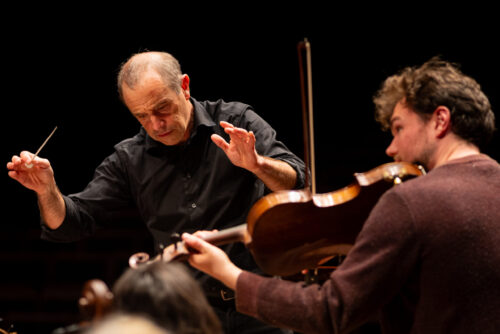
 United Kingdom Howard, Mozart, Dvořák: Stephen Waarts (violin), Timothy Ridout (viola), Bournemouth Symphony Orchestra / Mark Wigglesworth (conductor). Lighthouse, Poole, 15.4.2026. (CK)
Dani Howard – Coalescence
Mozart – Sinfonia Concertante, K364
Dvořák – Symphony No.8
Not all art about climate change – or, more accurately, about the relationship between Nature and Man – is earnest, didactic and doom-laden. The title of Dani Howard’s Coalescence – commissioned by the Royal Liverpool Philharmonic Orchestra and premiered by them in 2019 – suggests a moving together rather than a moving apart: and the tone of the music is bright, eager, even playful. Spitting brass represent, perhaps, those who still discordantly agree with Him Who I Will Not Name (we hear it too often) that climate change is ‘a con job’: but the overall tenor of the music is light, buoyant, even ecstatic – almost an English riposte to John Adams.
Its ringing, glistening opening, full of bell sounds, gives way to a lovely section where the marimba keeps up a mellow vibration like a summer haze over which flute and piccolo chirrup and dart. The sound becomes fuller; enter real church bells – an impressive (and, I imagine, an expensive) sight; the composer tells us that they ‘signify the warning signs given to us by nature’, but in this brilliantly airy context they reminded me of Edward Thomas’s words in his poem March the Third (his birthday): ‘And when it falls on Sunday, bells/Are a wild natural voice that dwells/On hillsides; but the birds’ songs have/The holiness gone from the bells.’ Busy pizzicatos lead to an exciting tutti and a broad, expansive apotheosis, in which the darting flutes and piccolo could still be heard.
Coalescence required the largest orchestra of the evening: it shrank dramatically for Mozart’s winning Sinfonia Concertante, written in Salzburg in 1779, and a forerunner of Mozart’s maturity rather than a pendant to the violin concertos he wrote while still in his teens. It was given a superb performance; both soloists were outstanding. The opening movement has the marking maestoso, and the music does indeed have an innate majesty: but the performance was all about lightness, lyricism, poise, with sprightly interplay between the solo instruments. From time to time one or both would turn their back on the other to play with their orchestral section; elsewhere they chased each other playfully or engaged in intimate converse.
The Andante seems to walk a fine line between serenity and heartbreak. It would take a bold critic to link Mozart’s music to his life; disappointment in love, a failure to make his mark in Paris, the death of his mother – any of these may or may not have affected the composition of this movement. Its profundity emerged naturally from the depth and richness of the sound of Ridout’s viola, matching the beauty of Stephen Waart’s violin. The concluding Presto was all smiles, both soloists taking their chances to shine. There were cheers for them both, and also – rightly – for Mark Wigglesworth and the reduced band of strings, oboes and horns.
‘The world would be a better place if it heard more Dvořák.’ The words of George Hurst, quoted by Wigglesworth in dedicating this concert to Hurst’s memory at the centenary of his birth.
Known to most of us as a conductor (he was in charge of the first BBC Prom I ever went to, in 1966), he was revered in the music profession as a teacher of conducting; he ran a summer school for half a century. When a young Wigglesworth asked Simon Rattle if he knew a good teacher – so he told us – Rattle said ‘Go and find George Hurst’.
I am wholeheartedly in agreement with Hurst’s remark about the therapeutic properties of Dvořák’s music; and the performance of the Eighth Symphony that closed the concert provided all the evidence one could need. In his thoughtful programme note Wigglesworth implied a connection with Howard’s Coalescence, opining that in the opening movement Dvořák ‘subjugates symphonic structure into something more personal, a message which suggests that an idealistic balance between nature and humanity is possible.’
The performance was lovingly shaped by Wigglesworth – conducting from memory – and the orchestra responded by giving him (and us) everything he asked for, from mellow warmth to raw excitement. The brass revelled in Dvořák’s wonderfully bright writing for them; the woodwinds seemed an irrepressible fountain of lyrical and natural ideas. In the first movement development the whole orchestra built up a fine head of steam, the trumpets riding over everything; the Adagio brought lovely quiet playing from the strings (and sweetness from Amyn Merchant’s solo violin), the dynamic contrasts expertly managed; the Scherzo had all the lilt one could wish for. The finale was launched by the trumpets with irresistible élan, pursuing its delightful course to its brilliant conclusion (strings digging deep, exuberantly braying trills from the horns).
It was a big-hearted performance, ideally capturing the symphony’s inexhaustible freshness, a vindication, too, of George Hurst’s words. Dvořák’s music is good for our spiritual health.
Chris Kettle