 United Kingdom BBC Proms 2026 [12] – Weber, Oberon: Monteverdi Choir, Orchestre Révolutionnaire et Romantique / Sir Mark Elder (conductor). Royal Albert Hall, London, 6.8.2026. (KMcD)
The eminent musicologist Donald Tovey famously wrote that Weber poured his ‘last and finest music into a pig-trough’, neatly capturing the enduring paradox of Oberon. Few operas contain music of such radiant invention allied to a drama of such persistent absurdity. Two hundred years after its premiere at Covent Garden, and in the bicentenary year of Carl Maria von Weber’s death, the Monteverdi Choir and the Orchestre Révolutionnaire et Romantique brought their own semi-staged production to the BBC Proms, giving the opera its first complete Proms performance. Conceived, cast and produced by the company before its invitation to the festival, it made a compelling case for Weber’s final masterpiece. Ironically, it was the evening’s attempt to improve the drama that came closest to undermining it.
James Robinson Planché’s libretto for the sung numbers remained untouched. Instead, his spoken dialogue was replaced by a newly commissioned narration by Timothy Knapman, delivered by Tamsin Greig. It was a perfectly sensible idea in principle. John Eliot Gardiner demonstrated on his acclaimed 2002 recording that replacing the dialogue can successfully clarify the opera’s notoriously unwieldy dramatic structure. Here, however, the narration seemed oddly embarrassed by the work it was intended to support. Rather than helping the audience navigate the fantastical plot, it repeatedly stepped outside the drama with knowing asides, self-conscious humour and in-jokes that invited us to laugh at the opera rather than become absorbed in it. There was simply too much of it. Instead of serving the opera, it repeatedly interrupted it.
Greig committed herself wholeheartedly to the task, but she was constantly hampered by the decision to surtitle her narration alongside the sung text. The audience frequently read the punchlines before she delivered them, blunting what comic effect they might otherwise have had. The result was messy, distracting and increasingly exasperating. It was also unnecessary, because Emma Doherty’s semi-staging demonstrated that Oberon needed remarkably little additional explanation.
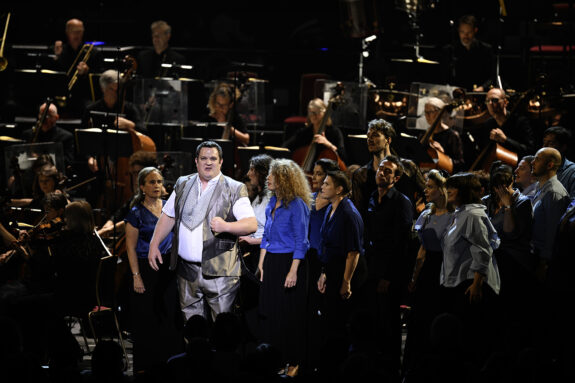
With every principal and the Monteverdi Choir performing entirely from memory, Doherty created a production that felt genuinely theatrical rather than merely semi-staged. Working within the practical limitations of the Royal Albert Hall platform, she occasionally extended the action into the arena itself, with Huon and Sherasmin threading their way through the Prommers during their search for Reiza, further dissolving the boundary between audience and performers. She established convincing relationships between the characters through simple, carefully judged movement and made excellent use of the chorus as active participants in the drama. The storytelling was consistently clear without ever becoming fussy or over-directed. Doherty trusted Weber’s opera. The narration did not.
Once the music took centre stage, objections rapidly evaporated. Hearing Oberon performed on period instruments was one of the evening’s greatest pleasures, revealing a score of extraordinary colour and imagination. The woodwind sparkled, the natural brass brought thrilling bite to Weber’s martial writing and the strings combined remarkable transparency with warmth. Sir Mark Elder was in his element, conducting with complete authority while balancing theatrical momentum with lyrical generosity. He never attempted to disguise the score’s dramatic eccentricities, instead allowing Weber’s astonishing invention to make its own case. The result was a performance of tremendous conviction that reminded us just how unfairly neglected this remarkable score has become.
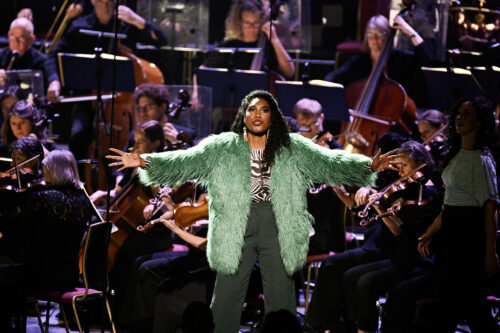
The cast responded with singing of uniformly high quality. Jennifer Davis was outstanding as Reiza, combining gleaming tone with effortless security and real emotional warmth. Her great scena, ‘Ocean! Thou mighty monster’, was one of the evening’s musical highlights, thrillingly sung yet never merely showy. Nicky Spence brought his customary intelligence and verbal acuity to the title role, creating an engaging Oberon whose authority was matched by an appealing sense of mischief. John Findon, a late replacement for Charles Castronovo, was a tireless Huon, negotiating Weber’s demanding writing with stamina and ringing tone. Yannick Debus’s personable Sherasmin and Rachael Wilson’s warmly sung Fatima provided excellent support, while J’Nai Bridges made a striking Puck, bringing commanding stage presence and a richly coloured mezzo-soprano to every appearance. The Monteverdi Choir, central to the conception of the entire project as well as its musical success, sang magnificently throughout, while the Orchestre Révolutionnaire et Romantique played with all the flair, refinement and stylistic assurance one has come to expect from this remarkable ensemble.
If this bicentenary performance proved anything, it was that Oberon requires advocates rather than apologists. Sir Mark Elder, Emma Doherty, the Monteverdi Choir and the Orchestre Révolutionnaire et Romantique trusted Weber’s score and were richly rewarded. The newly commissioned narration, intended to solve the opera’s dramatic shortcomings, merely created fresh ones. Tovey may never have been persuaded about the pig-trough, but this superb bicentenary performance left no doubt about the richness of what it contained.
Keith McDonnell
Featured Image: John Findon (Sir Huon of Bordeaux) and the Monteverdi Choir © BBC/Chris Christodoulou
Creatives:
Semi-staged performance (sung in English)
Stage director – Emma Doherty
Narration – Timothy Knapman
Cast:
Oberon – Nicky Spence
Reiza – Jennifer Davis
Sir Huon of Bordeaux – John Findon
Sherasmin – Yannick Debus
Fatima – Rachael Wilson
Puck – J’Nai Bridges
Mermaids – Charlotte Bowden, Jessica Cale
Narrator – Tamsin Greig
I fully agree with Keith McDonnell’s assessment but I would like to add that Emma Doherty’s staging was highly musical. Furthermore, in contrast with the embarrassing narration, she and conductor Mark Elder presented Weber’s humour with understanding and respect.