
 United Kingdom Lammermuir Festival 2026 [1]: (SRT)
9.9.2026 – Marian Consort, Rory McCleery (director). Our Lady of Loretto, Musselburgh
Gabrieli – Jubilate Deo, omnis terra
Palestrina – Missa sine nomine; Nunc dimittis a8
Hassler – Pater noster a8
Schütz – Selig sind die Toten; Sehet an den Feigenbaum
Handl – Media vita
Stabile – Nunc dimittis a8
J.S. Bach – Komm, Jesu komm
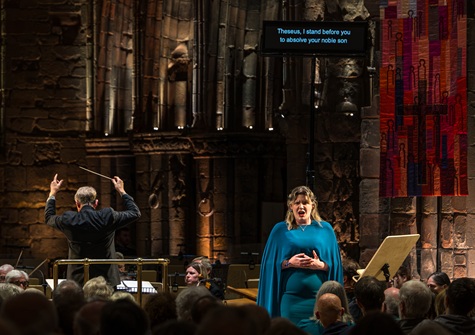
11.9. – Charlotte Jane Kennedy, Avery Lafrentz (sopranos), Charlotte Clapperton (mezzo-soprano), Orchestra of Scottish Opera / Douglas Boyd (conductor). St Mary’s Church, Haddington
Pärt – Cantus in memoriam Benjamin Britten
Britten – Les Illuminations; Phaedra; Our Hunting Fathers
Vocal music has always been a strong part of East Lothian’s Lammermuir Festival. The churches that serve as the festival’s main venues lend themselves to it, and the festival has built up a strong relationship with some excellent choral groups that keep returning.
One of those is the Marian Consort, who came back to the 2026 festival with a programme that explored J.S. Bach’s love for the music of the Renaissance. The centrepiece of their programme was Palestrina’s Missa Sine nomine, a work that Bach rated so highly that he copied it out in his own hand for use with the choir of the Thomaskirche. The scoring is for the 8-strong voices of the consort supplemented by the English Cornett & Sackbut Ensemble (3 cornetts, 3 sackbuts, if you are curious), and the first thing that struck the audience in Musselburgh’s church of Our Lady of Loretto was how beautifully balanced they’d managed to make the sound. There was a lovely ‘spread’ to it when it was in full bloom, with pearly sopranos ringing clearly in the acoustic, basses that were clearly present without ever being dominant, and the earthy ring of the sackbuts resonating with the chamber organ and balancing the reedy piping of the cornetts.
It made for a remarkably satisfying whole, particularly in the mass setting, which sounded surprisingly rich as directed by Rory McCleery. He had put together a clever programme which interspersed the mass movements with German music that demonstrated Palestrina’s influence, including a quietly luminous Pater noster by Hans Leo Hassler, a disarmingly limpid Media via by Jacob Handl, and two pieces by Heinrich Schütz, one instrumental and one vocal, which had a gentle majesty to them, perhaps reflecting Schütz’s time studying in Italy.
The real achievement of the musicians is that, when we finally heard from Bach in his motet Komm, Jesu, komm, this familiar music sounded freshly minted after the Mediterranean company it had been keeping. The addition of the instruments added an extra, keening edge of mourning to the vocal line, and its match of choral intensity and instrumental atmosphere created a marvellously satisfying culmination of a dashed clever piece of programming.
Friday evening’s concert focused on solo vocal music, in this case chosen to commemorate the fiftieth anniversary of the death of Benjamin Britten. It was performed by Scottish Opera, who have been regular partners for the Lammermuir Festival over the last few years, but focusing on song cycles rather than a staged drama is a departure for them here.
There was still drama aplenty, though, from both orchestra and soloists, particularly in Phaedra, his monodrama based on Racine that he wrote towards the end of his life. Charlotte Clapperton sang it with intense focus and a marvellously intense mezzo-soprano voice, redolent with emotion while making every word count. You could say the same about Avery Lafrentz, who sang Our Hunting Fathers with vivid colour and astonishing technique, particularly in the bizarre coloratura trilling of the falconry song.
The orchestra matched the singers with pictorial intensity, particularly in the dusky string chords which mirror the poison taking over Phaedra’s body, and the virtuoso swoop and swirl of the flight sequence of Our Hunting Fathers, before the eerie ticktock of the xylophone that ushered in the icy weirdness of its final song. The strings were also full of exhilarating vigour in Les Illuminations, playing the opening fanfare, in particular with terrific confidence. That confidence wasn’t quite reflected in the singing of Charlotte Jane Kennedy, who sang it all pretty ‘straight’, missing much of the doubleness of the text. However, she eventually found some of that in Parades, and she achieved beautiful delicacy in the final highwire sigh of Phrase.
Appropriately, the concert began with Arvo Pärt ‘s Cantus in memoriam Benjamin Britten, the strings emerging from the silence under Douglas Boyd’s direction in a way that made the music seem to melt and re-form, to fracture and coalesce before our ears.
Simon Thompson
The Lammermuir Festival runs until 20 September, for more information click here.