
 Romania George Enescu Competition 2026 [2] – Various: Nemanja Radulović (violin), Laure Favre-Kahn (piano). Romanian Atheneum, Bucharest, 10.9.2026. (ES-S)
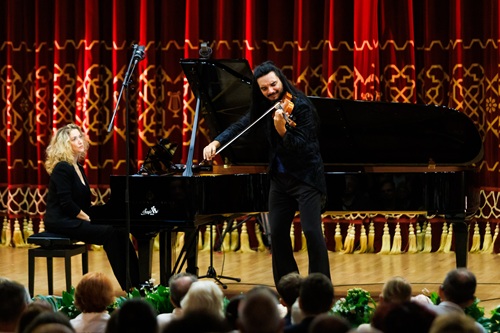
Bartók – Romanian Folk Dances, Sz.56 (arr. Zoltán Székely)
Franck – Sonata in A major for Violin and Piano
Prokofiev – Selections from ballets: ‘Montagues and Capulets’ from Romeo and Juliet, Op.64, ‘Grand Waltz’ from Cinderella, Op.87; Sonata for Solo Violin, Op.115
Ravel – Tzigane, M.76
Encore: Vittorio Monti – ‘Csárdás’
Twenty-five years after winning first prize at the George Enescu International Violin Competition, Serbian-French violinist Nemanja Radulović returned to Bucharest as a member of the jury for its 20th edition. His presence in Bucharest was also the occasion for a recital at the Romanian Athenaeum with French pianist Laure Favre-Kahn, with whom he has performed for more than two decades.
There is an intriguing contradiction at the heart of Radulović’s playing. His rock-star appearance and effervescent, highly physical stage presence suggest spontaneity and abandon, yet few violinists sound more technically secure. Immaculate intonation and precise articulation coexist with substantial rhythmic flexibility, a wide dynamic range and a striking freedom of phrasing. Such exactitude seemed to give him license to reshape a score according to the demands of the moment.
Opening the performance, Bartók’s Romanian Folk Dances, heard in Zoltán Székely’s arrangement for violin and piano, proved well suited to Radulović’s interpretative style. He resisted turning the six dances into polished concert miniatures, emphasizing their earthy, incisive rhythmic character. Each acquired a distinct profile through subtle alterations of pulse and articulation, while the final two were dispatched with dazzling assurance. The result suggested folk performance without lapsing into picturesque mannerisms.
The assurance born of Radulovic and Favre-Kahn’s long collaboration was evident throughout the evening. Their coordination was virtually faultless, even when Radulović took considerable liberties. Yet the partnership did not always seem one of equivalent temperaments. Favre-Kahn was the more contained musician, extraordinarily responsive to Radulović’s shifts of tempo and dynamics but frequently appearing to inhabit his interpretative orbit rather than providing a counterweight to it.
Franck’s Sonata in A major proved to be the evening’s high point. The opening movement unfolded with restraint, Radulović allowing the long phrases to breathe naturally while Favre-Kahn gave the piano’s flowing lines a corresponding suppleness. The Allegro combined fire with clarity, and the Recitativo-Fantasia seemed particularly suited to Radulović’s temperament, its searching lines acquiring a genuine improvisatory quality. In the finale, the two passed the canonic theme between them with complete ease, building convincingly towards the sonata’s close.
Radulovic, however, occasionally overemphasized the sonata’s emotional intensity. Generous rubato in such moments obscured its cyclic architecture: individual phrases were shaped exquisitely but their immediate rhetorical force sometimes mattered more than their place within the whole.
Two transcriptions from Prokofiev’s ballets followed: ‘Montagues and Capulets’ from Romeo and Juliet and the ‘Grand Waltz’ from Cinderella. Radulović emphasized their lyricism and Romantic sweep, transforming them into brilliant violin showpieces. Magnificently performed as they were, both seemed to lose something of Prokofiev’s distinctive sardonic edge.
Prokofiev’s Sonata for Solo Violin, originally conceived for a group of violinists playing in unison, offers little of the harmonic abrasiveness and mordant wit so closely associated with his style. Radulović nevertheless sustained the work’s tension throughout. Intonation and chordal playing were immaculate while subtle variations of color and pulse brought some variety to the musical argument. Even his persuasive performance could not entirely disguise the work’s relatively anonymous character.
Ravel’s Tzigane, by contrast, seemed an ideal vehicle for Radulović. The long unaccompanied opening had a compelling sense of spontaneity, with slides, harmonics, pizzicatos and double stops incorporated seamlessly into the musical line. Sensuality alternated with moments of deliberate rawness, while his elastic treatment of rhythm seemed entirely at one with the music. With Favre-Kahn’s entrance, the performance gathered momentum towards a conclusion both wild and unabashedly theatrical which was greeted with prolonged applause.
Vittorio Monti’s ‘Csárdás’, with its alternation of languor and headlong virtuosity, was a fitting encore, bringing the recital to an exuberant close.
Edward Sava-Segal