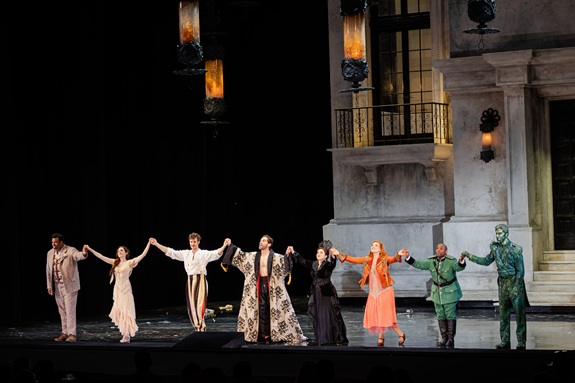
 United States Mozart, Don Giovanni: Soloists, Chorus and Orchestra of Lyric Opera of Chicago / Enrique Mazzola (conductor). Civic Opera House, Chicago, 30.10.2026. (JLZ)
As the first opera performed by Lyric Opera of Chicago (then Lyric Theatre of Chicago), Mozart’s Don Giovanni holds a special place for the company. The Robert Falls production from the 2014–2015 season (reprised in the 2019–2020 season) is an opportunity for the company to return to this iconic work at the beginning of the current season. In fact, the production benefits from two performers in the title role, Christian Van Horn and Kyle Ketelesen, with the latter appearing in the last two performances of the run.
Kyle Ketelsen gave the role vitality that commands attention, as he deftly shaped the text to fit the music. His fluid lines and facile technique added to the performance and were particularly evident in Act I in ‘Fin ch’han dal vino calda la testa’ (the ‘Champagne’ aria). Similarly, the serenade in Act II, ‘Deh, vieni alla finestra’, had an ease of delivery and showed the character’s ardor. In the latter, the balance with the orchestra was effective in allowing the audience to enjoy Ketelsen’s persuasive lyricism within the generally overt brashness of his character. He was able to convey the intensity needed to make his character convincing, which was essential in the climactic scene with the Stone Guest. Ketelsen showed his character’s strength to the very end in refusing to reform, even if meant damnation in hell. All in all, it was a masterful reading of the famous role.
Tommaso Barea as Leporello brought out the comic and dramatic elements in a role he clearly knows well. His musical sensitivity was evident throughout and perhaps strongest in ‘Ah taci, ingiusto core’ in Act II which sets up the confusion of Leporello for Don Giovanni. Likewise, Lawrence Brownlee brought his finesse to the role of Don Ottavio for his character’s ‘Dalla sua pace la mia dipende’ and ‘Il mio tesoro’. The phrasing in Brownlee’s interpretation of ‘Dalla sua pace’ added to his characterization of Don Ottavio by emphasizing his devotion to Donna Anna. With the second aria, Brownlee’s ornamented performance gave those unfamiliar with his voice a sense of his consummate technique and capacity for expression.
A similar dimension was evident in Mané Galoyan’s Donna Anna, with her extroverted presence underscoring the text as she sought her father’s murderer while building her case for revenge. Galoyan was impressive as she let her character’s conflicting emotion find expression in two ensembles, the duet ‘Non sperar’ and the trio ‘Ah, vendicar’. Galoyan also gave a fine reading of ‘Non mi dir’ in the second act that received deserved applause.
It was difficult to hear some of the details in the solo passages by Nina Solodovnikova as Donna Elvira, and this may be the result of blocking or seating. However, her lyrical passages in the first part of Act II showed her voice to good effect. The rage and anger that propel her actions emerged in her acting as she sought vengeance for herself and others. In this production, the emotions culminate in her shooting Don Giovanni before the arrival of the Stone Guest.
As Zerlina, Anna El-Khashem took her character through various emotional states as she rejected Don Giovanni’s empty promises and ultimately confirmed her love for Masetto, played by Christopher Humbert, Jr. The familiar ‘Batti, batti’ showed the focus and drive that support the text as she defers to her fiancé, and El-Khashem balanced Ketelsen effectively in the duet ‘Là ci darem la mano’. Her interactions with Christopher Humbert, Jr. were similarly strong, and Humbert’s resonant voice added musical interest to Masetto. As the Commendatore, David Leigh brought a kindred resonance to his role, especially in the climactic scene where his delivery matched the explicit insistence in the text that brings the opera to its conclusion.
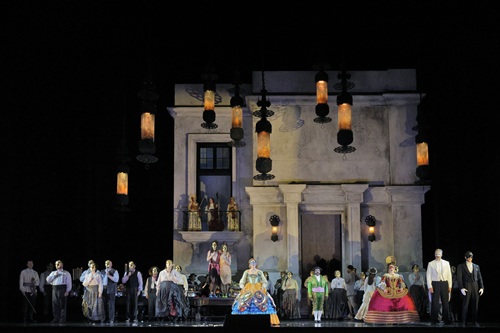
The Robert Falls production shifts the setting of the opera to 1920s Spain to draw on that era’s instability in presenting the class struggle in the Da Ponte’s libretto. It is clever but some details raise questions, like the use of guns instead of swordplay and, in each instance, a single shot hitting the mark. Another detail in the updating offers an innovation in presenting the quotations of music by other composers as ‘dinner music’ in the last scene by changing stations on a large radio, and it worked well. (The director’s note in the program includes some useful perspectives on the opera and the rationale for his updated staging.)
Conductor Enrique Mazzola gave a solid reading of the score. While some tempo modulations blurred for brief moments during the overture and the first-act finale, the phrasing and style worked well. He was served well by Michael Black’s preparation of the Lyric Opera Chorus which brought Act I to a full-bodied conclusion as ‘Viva la libertà’ rang through the hall.
James L. Zychowicz
Featured Image: Kyle Ketelsen (centre, Don Giovanni) and the Cast of Don Giovanni © Andrew Cioffi
Production:
Director – Robert Falls
Sets – Walt Spangler
Costumes – Ana Kuzmanic
Lighting – Duane Schuler
Choreographer – August Tye
Chorus director – Michael Black
Cast:
Don Giovanni – Kyle Ketelsen
Donna Anna – Mané Galoyan
Donna Elvira – Nina Solodovnikova
Don Ottavio – Lawrence Brownlee
Leporello – Tommaso Barea
Zerlina – Anna El-Khashem
Masetto – Christopher Humbert, Jr.
Commendatore – David Leigh