
 United Kingdom Beethoven, Mahler: Alice Sara Ott (piano), London Philharmonic Orchestra / Karina Canellakis (conductor). Royal Festival Hall, London, 6.11.2026. (AV-E)
Beethoven – Piano Concerto No.4 in G major, Op.58
Mahler – Symphony No.1 in D, ‘Titan’ (including ‘Blumine’)
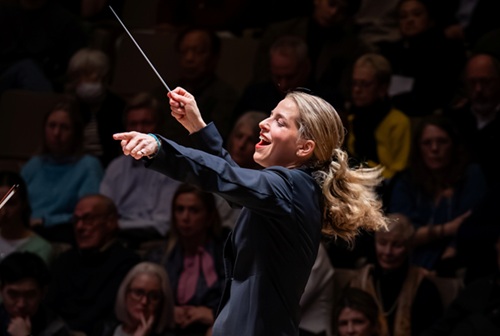
The London Philharmonic Orchestra’s evening opened with Beethoven’s Fourth Piano Concerto, with Alice Sara Ott as soloist and Karina Canellakis conducting. Canellakis knows her Beethoven backwards, as her recent account of the Fifth Symphony made abundantly clear. Ott, by stark contrast, had absolutely no idea how to play him.
Ott’s performance was an assembly-line production, pounded out on autopilot, without a single shred of interpretative individuality or instinctive insight. AI would easily have performed this sublime concerto much more musically. Wholly absent throughout the proceedings, Ott was utterly devoid of presence; ontologically, she was not there, being totally lacking in what Martin Heidegger termed Dasein.
The opening piano chords were smudged and fudged, an inauspicious beginning to what became the most excruciatingly awful performance by a pianist I have experienced in concert. Ott’s excessively loud playing was brash, coarse and metallic, with passages hammered out at punishing volume, producing a harsh, hard-edged sound. There was no evidence of sonic subtlety, musical musing or emotional engagement. Rather than entering into Beethoven’s intimate, conversational exchanges with the orchestra, Ott bulldozed her way through them, her bludgeoning attack repeatedly overwhelming the orchestral texture. What should have developed into an animated musical dialogue between the piano’s lyrical opening material and the orchestra instead became a succession of blunt, uninflected interventions. Ott and Canellakis were frequently out of sync, revealing an evident lack of rapport between soloist and conductor. This reached its nadir in the great cadenza towards the end, before the orchestral coda, which was particularly aggressive and far too loud.
The Andante con moto was equally unsatisfactory. Beethoven’s inventive dialogue between the stern, unison strings, with their insistent dotted rhythms, and the piano’s lyrical, legato responses should have created a compelling dramatic confrontation, the piano gradually softening the orchestra’s initially implacable resistance. Instead, Ott failed to find the necessary tenderness, suppleness or expressive intimacy. Those poignant exchanges were rendered emotionally inert, with little sense of dramatic progression. The transition into the finale offered no convincing release.
Beethoven’s Rondo: Vivace, with its buoyant recurring refrain, playful rhythmic energy and contrasting, more lyrical second theme, should have brought a welcome change of character. Instead, its rhythmic vitality was reduced to relentless battering, its wit and lightness sacrificed to brute force. Even the exhilarating Presto coda was skated over with Ott’s customary clangour, robbing the music of its excitement and rhythmic sparkle. It was an ordeal from beginning to end. I legged it as soon as the final chords struck, keen to avoid the inevitable encore, which proved to be Arvo Pärt’s Für Alina.
Canellakis shaped the opening movement of Mahler’s First Symphony, ‘Titan’, with broad, unhurried pacing, steadily building tension while maintaining a compelling sense of forward momentum. She gave Langsam. Schleppend a compelling sense of unfolding drama, allowing the introduction to rise almost imperceptibly out of the hushed string harmonics and steeping the music in an extraordinary atmosphere of mystery and expectancy. The distant brass calls emerged from the orchestral texture with an evocative sense of space, while the woodwind were pointed and forward, their birdlike figures sharply etched against the hushed strings. This contrast created the impression of an orchestra gradually awakening to the natural world. When the movement burst into life, Canellakis relished its exuberant contrasts: the swaggering, rustic Ländler rhythms, the surging string passages and the great, sweeping lyrical phrases that brought a striking contrast to the movement’s rustic exuberance.
In the reinstated Blumine movement — originally composed as an Andante serenade for Mahler’s incidental music to Der Trompeter von Säckingen — the principal trumpet carried the lyrical opening and closing solo melody over muted strings and harp; Paul Beniston played this exquisitely. Canellakis allowed its understated simplicity to speak without a hint of maudlin sentimentality. While this introverted interlude is quite quaint, I can see why Mahler axed it: its meandering, melancholic and languid lyricism does not aesthetically synchronise with the symphony.
The ensuing Scherzo had the requisite muscularity and rhythmic bite, its earthy dance character sharply defined, while the Feierlich und gemessen funeral march was darkly atmospheric, its muted trumpet and double bass-led entrance establishing an unsettling stillness. Canellakis maintained a sure sense of proportion throughout, allowing the music’s shifts between grotesquerie, irony and melancholy to register without exaggeration.
The finale, Stürmisch bewegt, was the culmination of a remarkably coherent interpretation. Its turbulent opening gave way to passages of searching lyricism, before the music gathered force towards the great breakthrough into D major and its triumphant chorale. Near the close, the strings rose in a deeply moving, yearning swell, their expressive lines surging and unfurling as Simon Carrington’s perfectly graduated timpani roll gradually gathered force beneath them, crowning the orchestral climax. The two timpanists then launched into a thunderous exchange of rolls, each answering the other in turn, before joining forces as the music surged into its closing pages.
The orchestra erupted with the force of a volcanic torrent, a molten river of sound surging towards the final chorale. The standing horns blazed out in burnished chords, combining with the thundering timpani and rumbling bass drum in a colossal cacophony that brought the symphony to a climactic close.
Caught up in the aftershock of that exultant climax, the audience erupted into ecstatic applause, some springing to their feet in a surging standing ovation. On the strength of this peerless performance of Mahler’s First Symphony alone, Canellakis established herself as an intuitive and incisive interpreter of the composer. One can only deeply regret that Deutsche Grammophon chose Andris Nelsons, rather than Canellakis, to record the Mahler symphonies.
Alexander Verney-Elliott