 Austria Donizetti, La fille du régiment: Soloists, Chorus and Orchestra of Vienna State Opera / Evelino Pidò (conductor). Streamed live (directed by Dominik Kepczynski) from the Vienna State Opera, 7.11.2026. (JPr)
The less said about world events the better, so La fille du régiment is the perfect antidote. It is an enjoyable comic opera where there is nothing to muddle the brain or be taken seriously, apart from the arc of a central Marie and Tonio love story. Everything is played for laughs whilst showcasing the opera’s many vocal fireworks. Laurent Pelly’s production has toured the world since The Royal Opera in London first staged it in 2007; proving popular with audiences not only there but in New York, San Francisco, Paris, Milan, Barcelona, Beijing, and possibly elsewhere, as well as in Vienna (since 2007). Truthfully, the sets and some of the costumes indeed looked like they had been around the world a few times. So, it is understandable that while I have seen La fille du régiment significantly less than some other operas, those performances I have seen have been in this Pelly production.
Donizetti was approached by the Opéra-Comique in Paris in August 1839 and commissioned to compose La fille du régiment as a comic opera with dialogue. Jules Henri Vernoy de Saint-Georges and Jean-François-Alfred Bayard’s libretto had a typically absurd operatic plot: a young foundling Marie, is raised from childhood by her ‘daddies’ of the French army’s 21st regiment and she loves Tonio, a young Tyrolean, who joins the regiment to be with her. As the plot unfolds, Marie is shocked to discover that she is really an heiress abandoned as a baby by her mother (the Marquise of Berkenfield) but now reunited is made to marry someone of her ‘own’ social class – until love wins out in the end of course. Donizetti finished La fille du régiment – his 55th opera – in only two months and it was premiered on 11th February 1840. It was the first of his operas in French to reach the Paris stage and the composer obviously pays tribute to French pride and nationalism, whilst gently making fun of army life. There is so much dialogue in this opera that I was very grateful for the subtitles: although I do not speak much French what I heard sounded idiomatic; especially since there was not a native French speaker in the cast I believe.
Pelly updates the opera from the time of Napoleon to Chantal Thomas’s often two-dimensional postcard-inspired Tyrol setting at the time of World War I. We first see a raggle-taggle gaggle of refugees fleeing the advance of the French soldiers and who have brought cartloads of their belongings with them. They invoke help from God in their struggle. With any metal utensils they can find on their heads and anything with a longish wooden handle, such as a garden hoe, to wield in their hands to defend themselves, they reminded me of British TV’s Dad’s Army home guard. Truthfully some of silliness here, particularly with the first encounter with Stephanie Houtzeel’s rather stilted Marquise de Berkenfield and her butler, Hortensius (Marcus Pelz), trying to get to Austria, made me wonder if I was going to enjoy coming back to the opera, but yes, soon enough I did.
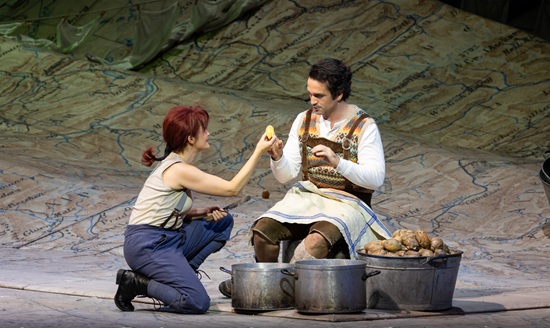
Travel maps and postcards are recurring visual motifs and also much fun is had with (mis)pronunciation of Berkenfield, including ‘Birkenstock’ at one point. In Act I Marie (Erin Morley) irons maniacally, peels potatoes and looks wretchedly tomboyish in dirty vest, army trousers and braces. Her singing is intermittently interrupted by clothes lines of long johns stretching across the entire stage. Tonio (Xabier Anduaga) is – not surprisingly – wearing lederhosen. In Act II Berkenfield castle is simply the outline (skeleton?) of a wood-panelled salon, initially being dusted by four Monty Pythonesque men-dressed-as-women cleaners.
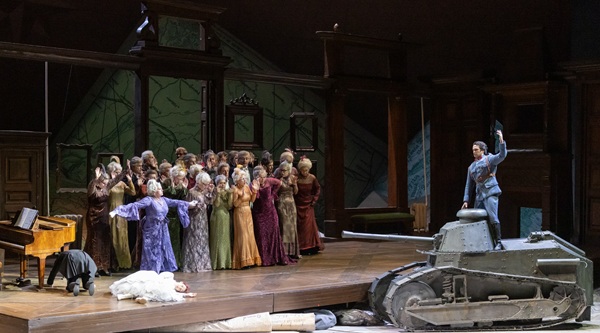
Leading Austrian actress Brigitte Kren appeared in the non-singing role of the aristocratic snob, the Duchesse de Crackentorp, who has come to oversee the advantageous marriage of her son (absent on ‘Olympic obligations’) to Marie and is shocked to discover she was a vivandière and ‘daughter of the regiment’. There is an amusing crowd of elderly drunken wedding guests (with the women looking like the much-missed Barry Humphries’s Dame Edna Everage) whilst near the end there is a coup de théâtre as Tonio returns to claim back Marie on top of an – admittedly now rickety – three-dimensional tank. A giant postcard of a French rooster (which eventually crows) descends as all sing the final chorus of ‘Salut à la France!’ and the opera ends. Incidentally, that song was an enormous hit for Donizetti and when sold separately became enshrined as an unofficial French national anthem, second only to La Marseillaise.
Erin Morley proved a delightfully natural comic actor in all the tomboy antics, physical comedy and all the posturing, gesticulating, and willingness to sing pin-sharp coloratura in every possible position, including being carried aloft horizontally in the raised arms of her ‘daddies’ in the second act. Morley’s voice has all the vocal agility a Marie needs in reaching to a stratospheric high F (first at the end of the military song ‘Chacun le sait, chacun le dit’ in Act I) with consummate ease; and also impressing in her two more reflective arias; the poignant ‘Il faut partir’ (Act I) and a melancholic ‘Par le rang et l’opulence’ (Act II).
I have seen and heard Juan Diego Flórez as Tonio but cannot remember him being quite as good as young Spanish tenor Xabier Anduaga in Vienna. The ovation he received after ‘Ah! mes amis’ was of a magnitude I have not heard before either in the theatre, cinema or online. He posed for a long time trying not to react to the acclamation and it seemed the conductor might just go on with the music; yet when he did it was to encore the cabaletta ‘Pour mon âme’ and so we heard 18 perfectly placed high Cs as evidence of Anduaga’s secure technique and vocal stamina. Equally impressive was his expressive, more lyrical romanza ‘Pour me rapprocher de Marie’ which requires an entirely different vocal style rather than all the pyrotechnics. The jury’s out on how good an actor Anduaga might ultimately prove to be but here it did not matter as his Tonio was suitably gangly, gauche and ultimately heroic in fighting for the woman he loved.
With all the dialogue and encounters between Marie and Tonio, the supporting cast are given little to sing by Donizetti but they are crucial to the ongoing comic shenanigans. They all were very good, and this included Stephanie Houtzeel as the Marquise who is revealed near the end to be Marie’s mother. Houtzeel entered in Act I every much as the ‘Grand Dame’ yet for me she seemed to take a while getting into the spirit of it all. Ultimately the Marquise was portrayed as Margaret Dumont who is remembered from the films of the Marx Brothers; stolid, incredibly dignified and somewhat blissfully unaware of the chaos around her. Peter Kálmán singing with his brawny bass-baritone voice revealed great comic timing as the rotund, gruff, slightly pompous, over-protective, yet deeply paternal Sergeant Sulpice.
The leading singers were well supported by Marcus Pelz’s Hortensius, Ferdinand Pfeiffer’s Corporal, Juraj Kuchár’s Farmer and Philippe Aubault’s Notary and no one overstayed their welcome on the stage. They all sang well and gave – often laugh-out-loud – funny performances. Adding to that was the enthusiastic chorus and the Vienna State Opera Orchestra (a fluffed opening horn call notwithstanding) on exceptional form for Evelino Pidò. I thought the overture was never going to end but after that the opera sped by. La fille du régiment is an opera that would be difficult to spoil and Pidò certainly didn’t. It was once again all so tremendously light-hearted and from the thunderous applause in the Vienna State Opera much fun was clearly had by everyone.
Jim Pritchard
Featured Image: Closing scene of Vienna State Opera’s La fille du régiment © WS/Stephan Brückler
Cast:
Marie – Erin Morley
Tonio – Xabier Anduaga
La Marquise de Berkenfield – Stephanie Houtzeel
Sergeant Sulpice – Peter Kálmán
Hortensius – Marcus Pelz
Corporal – Ferdinand Pfeiffer
La Duchesse de Crakentorp – Brigitte Kren
Farmer – Juraj Kuchár
Notary – Philippe Aubault
Creatives:
Staging and Costumes – Laurent Pelly
Sets – Chantal Thomas
Lighting – Joël Adam
Choreography – Laura Scozzi
Chorus director – Jozef Chabroň
Dialogue version – Agathe Mélinand