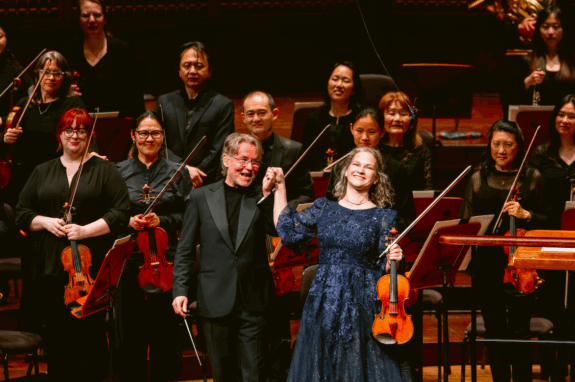
 United States Beethoven: Hillary Hahn (violin), San Francisco Symphony / Esa-Pekka Salonen (conductor). Davies Symphony Hall, San Francisco, 30.5.2025. (HS)

Beethoven – Symphony No.4 in B-flat major; Violin Concerto in D major
Although Beethoven is not necessarily a composer in conductor Esa-Pekka Salonen’s wheelhouse, it turns out that the combination can be intoxicating when you add violinist Hillary Hahn to the equation.
Salonen is always worth paying serious attention to, of course, but he is better known for bigger Romantic, twentieth-century and contemporary works. In an all-Beethoven program, the second of a series of four concerts wrapping up his five-year tenure as San Francisco Symphony’s music director, Salonen matched Hahn’s elegance and clarity to produce a compelling performance of the composer’s Violin Concerto. In the second of three performances, the dynamic balances, the subtlety of phrasing and vital sense of rhythm dovetailed seamlessly between the orchestra and soloist. There was no attempt at radical interpretation from either soloist or conductor, only a palpable devotion to what the composer meant.
Hahn recently had to cancel performances for seven months to heal a double pinched nerve. And yet the soloist embraced the music with her usual command of all aspects – bowing, fingering, intonation at the highest reached of the instrument, all in the service of the maturity of musicality she has shown since her first performances with major orchestras in the early 1990s as a young teenager.
There was nothing particularly showy about her delivery, which always focused on how to shape a phrase in the most elegant way. That was evident in the first movement, as Salonen found a pace to Beethoven’s Allegro that allowed the melodic adornments in the solo line to come through clearly. Hahn had both refinement and energy but never went over the top. The first movement’s cadenza was especially refined, even after the bold chord from the orchestra that preceded it. Hahn was in no hurry. She made the standard-issue cadenza feel like an improvisation.
The second movement Larghetto unfolded gracefully, the tunes handing off between the soloist and individuals within the orchestra with a welcome and natural feel. It kept moving nicely, and the transfer to the finale emerged with more grace than one might expect from the sudden change in tempo to Allegro. Hahn made the bouncy rondo theme emerge organically from the wistful slow movement, and the finale moved along briskly, even if it felt sprightlier than the rollicking thing we usually hear. This tempo made all the adornments, filigrees and bravura flashes from Hahn’s violin come through clearly. The pace made it all delicious.
Encores followed up the galloping finale of the concerto with a soft-edged, sweet rendition of the Loure from J. S. Bach’s Partita No.3. When the audience wouldn’t give up, Hahn turned to same partita’s Gigue and made it as charming as can be.
In the first part of the performance, Salonen revved up a lively opening movement to Beethoven’s Symphony No.4. After the serious Adagio opening pages (which always make me suspect it is going to be a Mahler symphony), he brought out rhythms in the Allegro vivace that had a springy bounce.
The second movement Adagio was lovely if not particularly heartfelt. The Scherzo followed at a breakneck pace that burst with energy but blurred some of the quicker tutti phrases. At times, when everyone was playing fast at once, all the reverb in Davies Symphony Hall’s 2,743-seat space made it feel like a pianist using too much pedal. Possibly, deploying sound-deadening wall curtains built into the hall’s walls might balance the lively acoustics.
Although the Allegro ma non troppo finale was fine enough, similar problems took the edge off several passages which, at times, felt even faster than the Scherzo had.
Harvey Steiman
Featured Image: Esa-Pekka Salonen and Hillary Hahn take bows after the Beethoven concerto © Kristen Loken