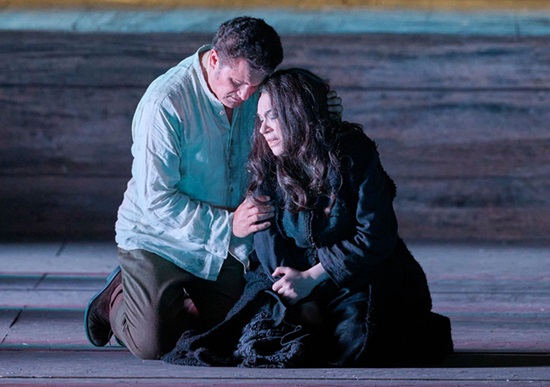
 Austria Verdi, Il trovatore: Soloists, Chorus and Orchestra of Vienna State Opera / Marco Armiliato (conductor). Broadcast live (directed by Anna Gettel) from the Vienna State Opera, 30.5.2025. (JPr)

Needs must and I begin once again with the memorable quote from Enrico Caruso declaring how Il trovatore needs ‘the four best singers in the world’ to succeed. These days the casting certainly never gets anywhere near to that in the UK. I try and resist dwelling on who I have heard over the years – particularly because the past is receding faster at the moment than I would wish – nevertheless among those as Leonora and Manrico were Katia Ricciarelli, Elizabeth Connell, Rita Hunter, Jane Eaglen, Plácido Domingo and the unforgettable Franco Bonisolli infamous for interpolating ‘high Cs’ whenever possible! They were supported by some compelling singers as Ferrando, Azucena and Count di Luna; and I assure you I do not listen very much to CDs so most of what I recall, I heard live under some great conductors.
Daniele Abbado’s production updates the action – such as it is – to the 1930s of General Franco and the Spanish Civil War. Manrico’s fellow partisans – formerly Verdi’s gypsies – are fighting Count di Luna’s Nationalists. (There will be no anvils, seen or heard, during the wonderful Act II chorus as the freedom fighters scour a church for weapons and a huge cannon is lowered down onto the stage.) Abbado’s staging was first put on in Vienna in 2017 and whether there was greater Personenregie than we saw in this livestream would be for those who were there then to let me know. What this revival of Il trovatore got was four great singers – ‘best’ can be very subjective – parking and barking. This extended to the dependable Vienna State Opera Chorus, who in their various guises and whilst sometimes moving furniture, waving rifles or holding flags, simply entered singing lustily to line up behind the principal singers standing centre stage – individually or in a line too – arms wide or otherwise emoting. Overall, it was rather like a costumed semi-staging.
Truth be told, I suspect my interest in Il trovatore began with its crucial role in the classic 1935 Marx Brothers film A Night at the Opera. It is very debatable whether Il trovatore can be considered a masterpiece, even if that word was easy to define. This musically-excellent – though otherwise static – performance confirmed for me that it is little more than a ‘numbers’ opera. It allows for many wonderful moments for the soloists and chorus with some typical Verdi hokum about anti-clericalism, a romantic hero (Manrico), confused parenting (the gypsy Azucena), unrequited passion (Count di Luna for Leonore, Manrico’s inamorata) and Leonora’s subsequent sacrifice – not forgetting the added plot contrivance of the ‘wrong’ baby having been thrown on a pyre! As performed in Vienna Il trovatore is a histrionic operatic romp worth sitting through again because of all the vocal fireworks of those four principal singers, its choruses which are undoubtedly stirring and its very dramatic music.
There is a single set (from Graziano Gregori) which isn’t too much of a problem since it is a relatively short – albeit four-act – opera. We are in a grand hall of a castle which looks as if it has seen better days; there are balconies and pillars to the sides (ladders give it the appearance of a gymnasium) and to the rear are two small alcoves on either side of a large central one. In the later and on the platform in front of it we see played out some of the events we hear sung about and it allows the setting to change to suggest a convent or dungeon. Also at the back, we see a hint of the flames which engulfed Azucena’s mother; something so pivotal to the events of Il trovatore. (At the end Manrico is despatched with a bullet to the head which happens almost unnoticed.) Throughout there are some atmospheric lighting changes from Alessandro Carletti which are quite spooky whenever the supernatural is alluded to. The costumes – military or otherwise – are mostly dark with lots or black, greys, blues, or browns and Manrico sports a beige safari jacket.
Perhaps reflecting Vienna’s well-known lack of rehearsal time for its repertory system revivals there wasn’t much chemistry between the four leads of this Il trovatore. Krassimira Stoyanova is clearly a vastly experienced Verdian but although she acted well with her voice she didn’t particularly brings her character to real life and fully engage us – through Anna Gettel’s closeup camerawork – in Leonora’s plight. Stoyanova’s singing was unduly introspective, though clearly, she has a wonderfully secure coloratura technique. After a plaintive ‘D’amor sull’ali rosee’ (‘Go forth sad sigh on the rosy wings of love’) Stoyanova was at her best when combining with Manrico for a deeply affecting ‘Miserere’, the lamenting offstage chorus.
Piotr Beczała was singing Manrico for the first time in Vienna, and I have rarely heard this very demanding tole sung better or so effortlessly. The tenor is currently in rich vein of form in the wide range of repertoire he sings. He can pare down his voice for the refinement necessary for the third act’s ‘Ah sì, ben mio; coll’essere io tuo’ (‘Ah yes, my love; when I am yours’) and then lets it soar heroically over chorus and orchestra at full cry as he thrillingly meets the challenge of Manrico’s ‘Di quella pira’ as he sets off to save his mother from the flames.
Ekaterina Semenchuk – who I had admired as Azucena at Covent Garden in 2016 – was almost as good as Beczała. She has an incredible mezzo-soprano voice which is even throughout its wide range from deep down to high up and her steely top notes. Allied to this Semenchuk is a compelling stage animal so ‘Stride la vampa!’ (‘The flames are roaring’) – which tells of the burning of her gypsy mother – was dramatically convincing and viscerally intense. (Most readers will know that Manrico is really the Count di Luna’s brother and Azucena is not his mother: she had cast her own son into the flames and not the Count’s abducted brother.)
Following Dmitry Ulyanov’s overly-melodramatic, dark-hewn Ferrando, worthy of superlatives – equal to those for Beczała and Semenchuk – was Luca Salsi who perfectly personified Count di Luna’s threatening droit de seigneur objective, with all the character’s vehement jealousy, burning lust or vengeful fury. Salsi’s voice has true Verdian legato for ‘Il balen del suo sorriso’ (‘The light of her smile’) and clearly he is one of the finest villains on today’s operatic stages.
Marco Armiliato has few peers in Italian ‘blood and thunder’ operas and remarkably appeared to conduct Il trovatore without a score. As heard though my speakers, Armiliato brought out all the ghostly horrors and night-terrors of the first scene before encouraging from the wonderful Vienna State Opera Orchestra a fine, brooding, superbly-paced account of Verdi’s music which had a grand sweep, crackling energy, thrilling climaxes; yet notably, an expressive flexibility often sympathetic to his singers. Conducted and sung as it was in Vienna, Il trovatore is indeed the essence of a great night at the opera!
Jim Pritchard
Cast:
Count di Luna – Luca Salsi
Leonora – Krassimira Stoyanova
Azucena – Ekaterina Semenchuk
Manrico – Piotr Beczała
Ferrando – Dmitry Ulyanov
Ines – Maria Zherebiateva
Ruiz – Carlos Osuna
An Old Gypsy – Oleg Savran
A Messenger – Wolfram Igor Derntl
Creatives:
Director – Daniele Abbado
Sets – Graziano Gregori
Costumes – Carla Teti
Lighting – Alessandro Carletti
Assistant Director – Boris Stetka
Stage design collaboration – Angelo Linzalata
Chorus master – Thomas Lang