 United States Pärt, Janáček, Shostakovich: Ensemble Connect. Carnegie Hall, New York, 28.10.2025. (RP)
Pärt – Da pacem Domine, Quintettino
Janáček – Mládí
Shostakovich – Piano Quintet in G minor, Op.57
Carnegie Hall was bustling on this particular evening. In the main hall, Marin Alsop was leading the Philharmonia Orchestra. Baritone Benjamin Appl and pianist James Baillieu brought To Dieter: The Past and the Future, a recital honoring the late baritone Dietrich Fischer-Dieskau, to Zankel Hall. Perhaps closest to Carnegie Hall’s core mission, however, was the first concert of the 2025 cohort of Ensemble Connect in Weill Recital Hall.
Ensemble Connect’s importance lies in its bent to the future. The program is a collaboration of Carnegie Hall, The Juilliard School and the Weill Music Institute in partnership with the New York City Department of Education. Every two years, exceptional, multifaceted performers embark on an experience that integrates education, community engagement, advocacy and entrepreneurship into their performing lives. Carnegie Hall concerts are just the tip of the iceberg of their activities.
Audience building is another of Ensemble Connect’s endeavors. It partners with 14 New York City public schools across the five boroughs in residencies where each Ensemble Connect fellow is paired with an instrumental music teacher, bringing a professional musician’s perspective to students. As is the norm, these students were in the audience. If anything makes a musical experience come alive, especially a chamber music concert, it is teenagers.
Ensemble Connect contributed to the global celebration of Pärt’s 90th birthday with two short, contrasting works. The first was Da pacem Domine performed by violinists Coco Mi and Laurel Gagnon, violist Abby Smith and cellist Elena Ariza. It was originally conceived as a short choral work: Pärt’s response to the 2004 terrorist attack on Madrid’s commuter rail system which left 191 dead and more than 1,800 injured. He later made multiple arrangements of it, including the one for string quartet heard at this concert.
Da pacem Domine is a prime example of Pärt’s tintinnabuli style and his interest in Renaissance choral music. It consists of elongated tones that move at a glacial pace, with subtle harmonic and dynamic shifts. The four musicians played the musical lines with pure, stringent tone that heightened the piece’s emotional impact. The prevailing mood was poignant but never despondent, and the performance was imbued with a sense of hope.
Quintettino shows the lighter side of Pärt’s musical personality, which one might not expect from this early 12-tone work. Flutist Cameron Cullen, oboist JJ Silvey, clarinetist Anoush Pogossian, bassoonist Marty Tung (an Ensemble Connect alum) and hornist Will Sands relished Quintettino’s inherent wit while digging into its more stringent moments. The opening chords were followed by what sounded like car horns, after which came the layered entrance of each instrument on long, sustained notes. There was some wonderful jagged playing from Cullen in the stratosphere of the flute’s range, and Sands’s sendoff on the horn left everyone smiling.
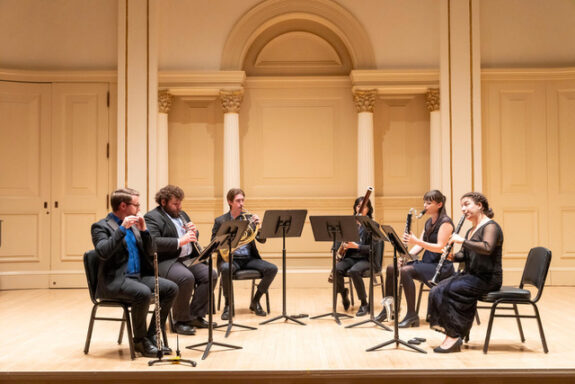
Janáček was 70 when he composed the woodwind sextet Mládí, but it bubbles with youthful zest. The title, which in English means youth, gives it all away, as does the composer’s jaunty musical representation of the words ‘Youth, golden youth!’ which punctuate the piece. Bass-clarinetist Nicole Martin joined Cameron, Silvey, Pogossian, Tung and Sands in a performance that alternated between the whimsical, profound and sentimental, reveling in Janáček’s virtuosic flights of fancy. Sands produced some wonderful blats from the French horn in the second movement and played the melody of the next with a rich, honeyed tone. Martin beguiled in Janáček’s melodies with the mellow sounds she summoned from the bass clarinet, and Tung’s broad smile in the work’s closing measures telegraphed just how much fun it all was.
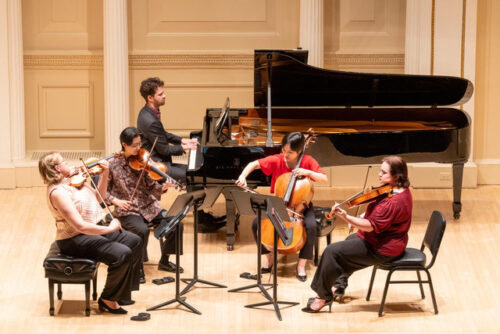
Shostakovich composed his Piano Quintet in G minor in 1940 when the Soviets and Nazis were busy carving up Eastern Europe, Stalin and Hitler were guessing what the other might do next and World War II consumed Western Europe. The reaction to its first performance summed up the composer’s conundrum – the public embraced it and the Quintet won the Stalin Prize, but the Soviet dictator was suspicious of its popularity.
Gagnon, Mi, Smith, Ariza and pianist Jospeh Vax produced a sound of remarkable depth suffused with a muscular grandeur. Throughout, Gagnon impressed with her impassioned playing on the violin, especially the singing, throbbing tone she employed in Shostakovich’s melodies. Ariza impressed equally with her intensity and the marvelously rich sound she drew from the viola. On the piano, Vaz was particularly wonderful in the madcap Scherzo and the flourishes in the final movement.
Such a superb, high-spirited performance definitely would have irked Stalin and maybe the composer too. Shostakovich requested ‘emotional restraint’ when performing the Quintet – advice that these five players, thankfully. chose to ignore.
Rick Perdian
Featured Image: [l-r] Cameron Cullen (flute), JJ Silvey (oboe), Will Sands (French horn), Marty Tung (bassoon), Nicole Martin (bass clarinet) & Anoush Pogossian (clarinet) in Janáček’s Mládí © Richard Termine
2025-2027 Ensemble Connect fellows: Elena Ariza (cello), Cameron Cullen (flute), Laurel Gagnon (violin), Nicole Martin (clarinet), Coco Mi (violin), Grace O’Connell (trumpet), Anoush Pogossian (clarinet), Will Sands (French horn), David Seder (trombone), JJ Silvey (oboe), Abby Smith (viola), Joseph Vaz (piano)