 United Kingdom Britten, Unsuk Chin, Schubert: Faustine de Monès (soprano), Hallé / Elena Schwarz (conductor). The Bridgewater Hall, Manchester, 23.10.2025. (MC)
Britten – Four Sea Interludes from Peter Grimes
Unsuk Chin – Le Silence des Sirènes (The Silence of the Sirens) for soprano and orchestra
Schubert – Symphony No.9 in C major, D.944, ‘The Great’
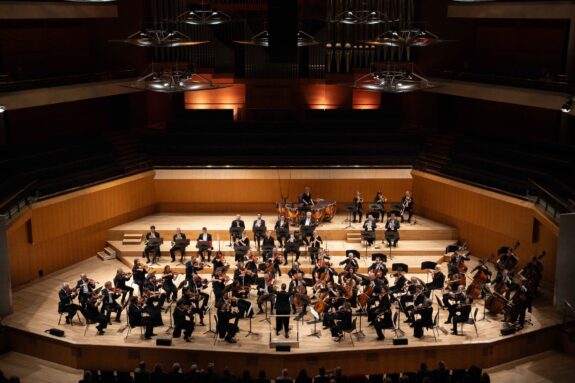
For some fifty years I have been attending Hallé concerts. This was my first concert since Hallé music director Sir Mark Elder stepped down in 2024 after twenty-four years with the orchestra and was appointed conductor emeritus. The concert had not been underway too long before it was patently clear just how magnificent the Hallé sounded. Certainly, the best I ever recall. This was a feeling that lasted throughout the concert.
Guest conductor for this midweek concert was Elena Schwarz, a Swiss-Australian who was making her Hallé debut. I notice Schwarz is currently conductor in residence at Klangforum Wien, an Austrian chamber orchestra based at Konzerthaus, Vienna.
Britten’s opera Peter Grimes is a twentieth century masterwork a tragedy from which the composer drew the Four Sea Interludes consisting of Dawn, Sunday Morning, Moonlight and Storm. Fisherman Peter Grimes is suspected of murdering his apprentices and is a mistrusted outcast in the isolated coastal town of the Borough. Much admired, this is likely Britten’s most regularly played orchestral work, and I am always delighted to hear it.
I am not sure how often Schwarz had conducted the Four Sea Interludes but whatever the case she handled the large orchestral forces so adeptly. The atmosphere of tenebrious suspicion that accompanies the protagonist was never far away. Integral to everyday life in the Borough is the sea and the gigantic seascape was depicted so convincingly by the orchestra. Standing out were solo flute that opened Dawn and the excellence of the tangy violin section. In Sunday Morning the horns rang out like church bells while, following on, the entire brass section just gleamed. Serving as a nocturnal scene Moonlight in the hands of Schwarz contained a shimmering but sinister and unsettling undertow. Concluding the Four Sea Interludes was the Storm of great intensity and one could almost feel the power of the gale force winds and rain coming down like stair rods. Several times the storm force winds waned with Schwartz revealing short sections showing a glimpse of consolation before the thunderously stabbing climax. I admit disappointment that the Passacaglia wasn’t included as I enjoy its dramatic writing.
Currently featured composer with the Hallé for the 2025/26 season Seoul born Unsuk Chin was in the audience for the UK premiere of her Le Silence des Sirènes for soprano and orchestra. In 1984 Chin attended a Seoul concert given by the Berlin Philharmonic and remarked she could not imagine a day when the Berlin Philharmonic would perform her music. She has since collaborated frequently with the Berlin Philharmonic who have released The Unsuk Chin Edition a box set of recordings of all Chin’s works performed by the orchestra over a period spanning 2005-22.
Achieving considerable success as a composer Chin has had her works performed extensively worldwide. A commissioned work Le Silence des Sirènes (The Silence of the Sirens) for soprano and orchestra received its world premiere at the Lucerne Festival in 2014 with soprano Barbara Hannigan as the soloist under Sir Simon Rattle. After Lucerne Chin undertook some changes with the revised version first performed in Berlin.
Chin has described Le Silence des Sirènes as a ‘psychological monodrama’ using a theatrical approach. Deciding on a theme of classical and contemporary sirens she was inspired by Franz Kafka’s German short story Das Schweigen der Sirenen (The Silence of the Sirens) and adopted Kafka’s title for the score. Le Silence des Sirènes is a work embracing the interaction between conceptual intent and dreamlike thinking. Reminding me of negotiating a maze Chin has assembled a collection of small pieces of texts by ancient Greek poet Homer and Irish writer James Joyce. With a strong oceanic influence from the epic poem Odyssey attributed to Homer, sirens are the mythical female creatures that use both their beautiful looks and voices to lure sailors and their ships to peril. In stark contrast, from Joyce’s novel Ulysses his sirens were pub barmaids who attract men with strong drink.
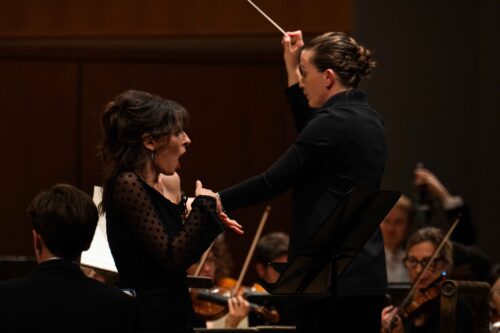
A new name to me, Parisian soprano Faustine de Monès met the considerable challenges of the music successfully and communicated the text with remarkable passion and high-level drama. Not just about singing Le Silence des Sirènes has an important theatrical requirement and de Monès commenced singing whilst slowly moving into view onto the stage. Wearing a stunning floor length robe together with her innate stage presence de Monès gave the acting element of the score extra kudos. There was a most positive reaction by the audience to the work, despite the frustration of no sung texts being available. Clearly well-rehearsed the players of the Hallé excelled, revelling in Chin’s atmospheric writing.
Following the interval Schwarz conducted Schubert’s Symphony No.9 ‘The Great’. Fate ensured that at Schubert’s death in 1828, aged just thirty-one, he had not heard this masterwork performed. Fortuitously some ten years later Robert Schumann unearthed the C major score in the Schubert archives that Franz’s brother Ferdinand Schubert presided over. The symphony was premiered posthumously in 1839, eleven years after the composer’s death when Mendelssohn conducted the Leipzig Gewandhaus. Generally known as ‘The Great’, this title distinguishes the Symphony No.9 in C major from his Symphony No.6 also in the key of C major.
Perennially popular with audiences and musicians this much admired work is one that I have seen and heard in concert several times in recent years. The last performance I attended was in Dresden with the orchestra using historically informed performance practice, seeking to replicate as close as possible the original sound when the work was first given. Very soon after the Hallé commenced the performance I was struck by the increased power and focus the sound had over the period instrument orchestra.
In this expansive and demanding work, the Hallé under Schwarz demonstrated the staying power to maintain momentum, concentration and control. In the opening movement admirable were the transitions between calm and lyrical writing and the stimulating fortissimo declarations. Marked Andante con moto the warm and glowing movement exuded the varying disposition of the countryside including the ebullient rhythms. Principal oboe Stéphane Rancourt had some generous music that he rendered quite gloriously. At this point it was easy to get firmly drawn into the performance. An energetic, dance-like movement, the Scherzo with a Trio section felt like an exhilarating day in the Alpine region with a few stops to take in the scenery. Under Schwarz the playing was stirring yet never overwrought. With the bit firmly between their teeth in the landmark Finale the Hallé provided playing that exuded both excitement and drive, creating a magnificent performance.
On her Hallé debut Elena Schwarz conducted a compelling concert, as each orchestral section displayed its unique character yet came together as a coherent whole. In truth I don’t remember hearing the Hallé play better.
Michael Cookson
Featured Image: Elena Schwarz conducts the Hallé © David Hughes/Hallé