 Germany Kálmán, Die Csárdásfürstin: Soloists, Ballet and Chorus of Bremerhaven Municipal Theatre, Bremerhaven Philharmonic Orchestra / Hartmut Brüsch (conductor). Bremerhaven Municipal Theatre, 4.12.2025. (DM-D)

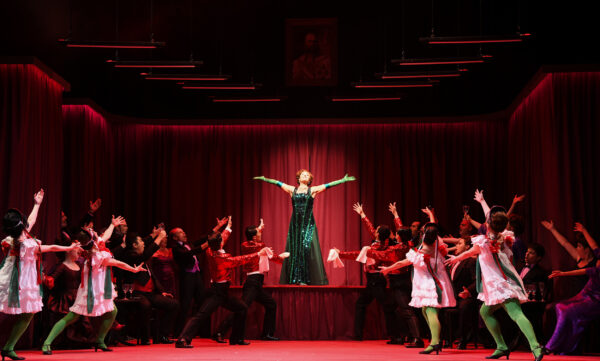
Die Csárdásfürstin is about the aristocrat Edwin and the chansonnière Sylva, who are in love and end up getting married despite opposition from his parents, Leopold Maria and Anhilte, because of the difference in their social standing. For this production, Bremerhaven Municipal Theatre recruited artists and extras from across the company’s opera and dance sections so as to be able to cast as many characters as needed. Choreographer Katharina Glas ensured there was an abundantly lively and consistent overall movement structure. The rich and colourful set and matching costumes combined with the liveliness of that movement created the idyllic world typical of operetta.
There were some hints, which became clearer with hindsight, of cracks in this seemingly ideal image of the world: the ceiling for the variety theatre space was fairly low, creating a slightly restricted impression despite the red plush splendour, and when lit accordingly, the plush turned rather less impressively pale. For the scene change from Act I (the theatre interior) to Act II (the stately abode of Leopold Maria) the performers tore down that red plush to reveal Schönbrunn Castle as the reference to the aristocratic home. This hint was picked up fully in the shift from Act II to Act III. In a clever development introduced by director Sebastian Kranner, a full-blown brawl broke out involving all on the stage. In its course, pieces of cloth with the images of Schönbrunn painted on them were torn down, revealing the bare grey walls they had been covering. This broken environment became the scene representing the deterioration of the long-established boundaries between the aristocracy and the rest of the world – in this case it was no longer impossible for the aristocrat Edwin to marry Sylva the artiste. In the process of events, it was revealed that Edwin’s mother Anhilte had been an artiste long before she married Leopold Maria: he did not know about this aspect of her past, since he married her on the basis of her aristocratic title from an earlier marriage.
Hartmut Brüsch led the Philharmonic Orchestra Bremerhaven to another peak performance of operetta. Together they relished the broad and sweeping strokes of the music, the imaginatively handled rise and fall, ebb and flow of the rhythms, the intricate combination of Hungarian flare and Viennese elegance, the juxtaposition of wild exuberance and more subtle, withdrawn and delicately intimate moments.
The singers were clearly inspired by this approach and blended in smoothly, neatly and elegantly. They were comfortable overall with the choreography, because it clearly took their needs for singing into account. Meredith Hoffmann-Thomson (Sylva) displayed the grandeur of the artist as well as the more vulnerable woman. Her voice was soaring with the full orchestra and movingly subtle in more intimate passages, warm, rich and well positioned. Alexander Geller was particularly good at showing the signs of conflict his character, Edwin, feels between aristocratic upbringing in a military context (in terms of being physically rigid, stiff, inflexible), and freeing himself from those boundaries (at times awkwardly funny attempts of more liberated movement, as if shedding a skin). His voice sounded youthfully bright, firm and agile.
Andrew Irwin as Boni has worked hard on his spoken German, on which much of his character’s comedic impact in this operetta relies; he managed to come across as a meaningful character in his own right, rather than just a rather ridiculous foil to Edwin, and much more than a toy for Stasi, whom he falls in love with. He sang with considerable passion as well. Timothy Edlin made the character of Feri fully his own, acting with conviction and singing with a very firm, sonorous voice. Victoria Kunze was spiritedly coquettish as Stasi, acting with her customary gusto and singing with a remarkable range of vocal nuances for her relatively short numbers. James Bobby was funny as Leopold Maria, Iris Wemme-Baranowski successfully added Anhilte to her growing slate of supporting roles in Bremerhaven over the years, and Róbert Tóth was a forthright army officer.
Daniel Meyer-Dinkgräfe
Featured Image: Meredith Hoffmann- Thomson (centre, Sylva Varescu) in Die Csárdásfürstin © Heiko Sandelmann
Production:
Director – Sebastian Kranner
Set and Costumes – Anna Kreinecker
Lighting – Katharina Konopka
Choreography – Katharina Glas
Dramaturgy – Torben Selk
Chorus master – Edward Mauritius Münch
Cast:
Sylva Varescu – Meredith Hoffmann-Thomson
Edwin – Alexander Geller
Boni – Andrew Irwin
Stasi – Victoria Kunze
Feri – Timothy Edlin
Leopold Maria – James Bobby
Anhilte – Iris Wemme-Baranowski
Von Rohnsdorff – Róbert Tóth
Mädis – Ines Mayhew-Begg, Yvonne Blunk, Elena Zehnoff