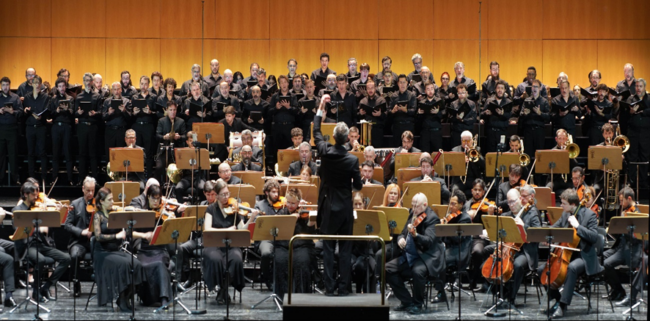
 Spain Verdi, I masnadieri (concert version): Chorus (chorus master: José Luis Basso) and Orchestra of Teatro Real / Francesco Lanzillotta (conductor). Teatro Real, Madrid, 14.2.2026. (JMI)
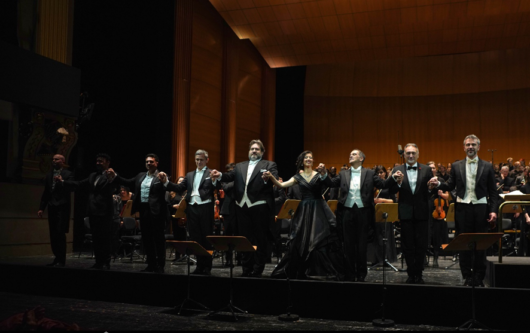
Cast:
Massimiliano – Alexander Vinogradov
Carlo – Piero Pretti
Francesco – Nicola Alaimo
Amalia – Lisette Oropesa
Arminio – Alejandro del Cerro
Moser – George Anguladze
Rolla – Albert Casals
I masnadieri is an opera that perfectly embodies the aria and cabaletta style of the era, which means that its success requires exceptional soloists. That is precisely what Teatro Real offered on this occasion, and I will especially remember two truly outstanding ARTISTS (yes, in capital letters): Lisette Oropesa and Nicola Alaimo.
This concert was led by Francesco Lanzillotta who was making his debut at Teatro Real. His conducting was competent, meticulous and always supportive of the soloists – a fine interpretation though not exceptional, but well-suited to a concert version. The Teatro Real Orchestra did very well – brilliant in the overture – and the Teatro Real Chorus was superb.
Among the soloists, the performances of Amalia and Francesco, sung by Lisette Oropesa and Nicola Alaimo, were particularly noteworthy. Both soared to great heights, surpassing their fellow cast members.
Lisette Oropesa has become a magnificent lyric soprano, with a high-quality voice and an extraordinary facility for singing and moving the audience, overcoming any difficulty she may encounter. In my opinion, she and Nadine Sierra occupy the throne of the new generation of sopranos, and it is a privilege to attend their performances. She sang the role of Amalia and triumphed like few others. In the cabaletta ‘Carlo vive’, she brought the house down and had to perform an encore of the second part.
Francesco Moor is the opera’s villain, and the role was sung here by baritone Nicola Alaimo; he replaced Mattia Olivieri who canceled a few days before the opera’s opening at this theater. In fact, Alaimo had just triumphed in the same role in a concert in Marseilles. For once, the substitution proved to be a stroke of luck and a genuine find: Alaimo was magnificent from beginning to end. The ovation he earned after his great final scene could easily have led to an encore, but that scene is more complex than a cabaletta and the encore didn’t materialize. Today, Alaimo possesses the voice of a true Verdi baritone, and his quality as a singer and artist is undeniable.
Carlo Moor was sung by tenor Piero Pretti who did very well though he was somewhat overshadowed by the aforementioned pair. His vocal range presents no problems, but his voice is noy particularly powerful nor he is very expressive. Finally, Massimiliano, the father of the Moor brothers, was sung by bass Alexander Vinogradov. He is a fine singer and deserved the audience’s applause after his excellent scene.
In the supporting roles, George Anguladze did well as Moser in Francesco Moor’s final scene. Alejandro del Cerro was well-suited to the part of Arminio, as was Albert Casals as Rolla.
José M. Irurzun
Featured Image: Conductor Francesco Lanzillotta and the Teatro Real Chorus and Orchestra © J. del Real