
 United Kingdom JS Bach, Schubert, Mozart, Debussy, Tailleferre, Ravel, Lutoslawski: Mariam Batsashvilli and Martin James Bartlett (pianos). Wigmore Hall, London, 9.2.2026. (CSa)#
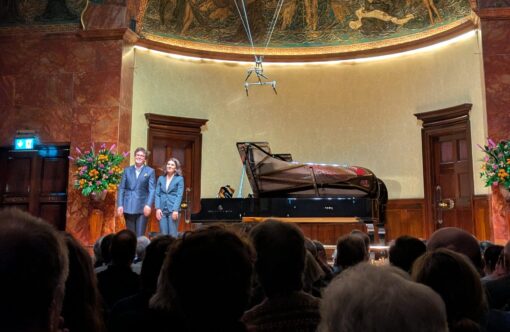
JS Bach – Sonatina from Gottes Zeit ist die allerbeste Zeit, BWV2028 (transcribed by György Kurtàg); ‘Schafe können sicher weiden’ (Sheep may safely graze) from Was mir behagt, ist nur die muntre Jagd! BVW208 (transcribed by Leonard Duck)
Schubert – Fantasie in F minor, D940
Mozart – Sonata in D for 2 pianos, K448
Debussy – Petite Suite
Germaine Tailleferre – Valse Lente from Deux Valses pour deux pianos
Ravel – Rapsodie espagnole
Lutoslawski – Variations on a Theme of Paganini
As the old musicians’ adage goes, two pianos can mean four hands and eight opinions. Yet in Mariam Batsashvili and Martin James Bartlett’s smoothly melded and nicely balanced Wigmore Hall recital, disagreement was largely absent. Tbilisi-born Batsashvili, 33-years-old and the winner of multiple European competitions, is an artist of technical brilliance and expressiveness whose repertoire ranges from the Baroque to the late Romantic and early 20th century. Bartlett hails from Essex. A former BBC Young Musician of the Year, this still boyish, bespectacled and elegantly suited 30-year-old plays with masterful control, youthful energy and interpretive sophistication. Both are Warner Classics recording artists, but when and how the two first met, and when they first decided to play together is unknown. In what could easily have become a display of competitive virtuosity, their two-keyboard adjacent piano Wigmore Hall debut proved to be an evenly weighted and generously collaborative musical conversation.
Their chosen programme was broad and fell into two very distinct parts. The first half took us to Leipzig and Vienna and concentrated on contemplative masterpieces by three great eighteenth and early 19th century composers: JS Bach, Mozart and Schubert. The evening began with György Kurtág’s calming adaptation of the Sonatina from Bach’s sacred cantata Zeit ist die allerbeste Zeit, BWV106 – an unfolding sequence of timeless melodic fragments and responses on one piano. Sitting cheek by jowl, and appearing almost to breath together, Batsashvili expounded the upper register in Primo with Bartlett providing the harmonies and weighty bass lines in Secondo. Then, a luminous, reflective account of ‘Schafe kõnnen Sicher weiden’ (Sheep May Safely Graze), vividly articulated.
The players swapped positions for Schubert’s Fantasie in F minor, D940. Its quietly monumental opening – a dark, inexpressibly sad Allegro – was played with great tenderness, the players frequently crossing hands and exchanging glances. The second movement Largo – a death-like march – was poignantly expressed. After a tense, restless Scherzo, came the dramatic Finale – delivered with raw intensity which some might argue was a shade too heavy handed, leading to a final, fatal downward plunge to F minor. One felt it was insufficiently restrained, but the impact of that final unified cadence resonated across the auditorium in a wholly convincing way.
Mozart’s bright and energetic three-movement Sonata in D provided a joyous antidote to Schubert’s heart-breaking melancholy. Played on two pianos, Batsashvili and Bartlett skilfully interwove and echoed the main themes of the opening Allegro in a lively dialogue. A graceful account of the Andante provided a moment of calm reflection before the galloping momentum of the Finale.
After the interval, the atmosphere changed as we moved to France and to the pastel, sensuous and exotic sound worlds of Debussy, Germaine Tailleferre and Ravel. Debussy’s charming Petit Suite was played on one keyboard with grace and refinement, and Tailleferre’s wistful Valse Lente was given an elegantly understated reading. After a sometimes shimmering, sometimes sultry performance of Ravel’s Spanish flavoured Rapsodie espagnole, the recital ended back in Central Europe and a return to two pianos with barnstorming rendition of Witold Lutoslawski’s Variations on a Theme of Paganini. Virtuosity of the highest order was called for as Paganini’s familiar melody threaded its way through eleven tightly constructed transformations. Some players read into the piece an implied invitation to compete in increasingly dangerous antiphonal exchanges, but the duo were careful to put rhythmic unity, clarity and precision at the heart of their performance. The result was electrifying.
Chris Sallon