 United Kingdom Wayne McGregor’s Woolf Works – a triptych: Dancers of The Royal Ballet, Students of The Royal Ballet School, Orchestra of the Royal Opera House / Koen Kessels (conductor). Broadcast live (directed by Ross MacGibbon) from the Royal Opera House to Cineworld Basildon, Essex, 9.2.2026. (JPr)
The Royal Ballet’s Woolf Works was Sir Wayne McGregor’s first full-length work and was created in 2015. McGregor has been their Resident Choreographer since 2006 and his triptych draws on three of Virginia Woolf’s novels: Mrs Dalloway, Orlando, and The Waves. It has proved (an unlikely?) success ever since and now is coming to the end of its third revival. I had seen it once when a 2017 performance was livestreamed in 2020 at the height of the pandemic. Many of my initial thoughts then were confirmed by now seeing it again, though this time on a big screen rather than a laptop.
I doubt any regular readers of my reviews will be astonished to discover that I came to Woolf Works in 2020 with little knowledge of the author’s oeuvre, despite some idea about her life and suicide, the Bloomsbury Group, as well as her relationships with her husband Leonard and Vita Sackville-West. Apart from any research I did then – or again in the run-up to this broadcast – I know little more now than back then. Indeed, I can only apologise for my ignorance about Virginia Woolf; but even those with degree-level knowledge of her life and writings would have difficulty, I suspect, following some of McGregor’s reimaginings.
I pondered again on what McGregor expected those watching for a first time – or even a second like me – to have ‘got’ from watching his three ballets if they were not familiar with Virginia’s writings. Interviewed now in 2026 McGregor said that if he ‘had any recommendation for anybody who has not read any of the novels, and is watching the piece for the first time, is just to kind of be open to your senses and just navigate your way and just see what emerges. Instead of asking what does everything mean, just notice what you see, and meaning will emerge from that.’
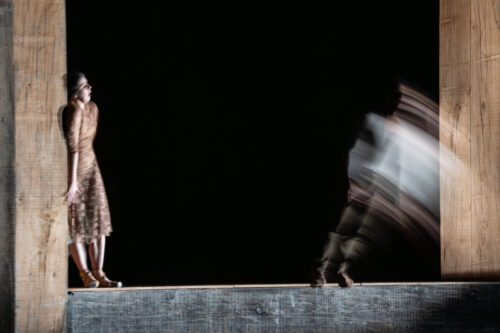
It all begins with projected handwritten words accompanying Virginia’s own voice discussing language and the beauty of words which is initially embodied by the remarkable Natalia Osipova at the start of I now, I then (inspired by the 1925 Mrs Dalloway). I believe the novel begins with London society host Clarissa Dalloway organising a party. Ciguë’s set – such as it is – has three huge wooden frames which determine the performance space and there is appropriate use of video projections (from Ravi Deepres) to show London, and later some garden scenes, including possibly Monk’s House, Virginia and Leonard Woolf’s East Sussex home for 20 years.
McGregor attempts a literal depiction of events in Mrs Dalloway which in itself is not a literal tale and is mostly within the characters’ minds and there are too many of them for its relatively short 40 minutes. Osipova is Virginia and the older Clarissa with Patricio Revé as her husband Richard. Sae Maeda is Clarissa’s younger self with Leticia Dias as Sally with whom she has a brief flirtation and William Bracewell as Peter, Clarissa’s spurned suitor. Marcelino Sambé is Septimus Warren Smith a traumatised soldier reliving the war and the death of his close friend Evans (Marco Masciari) on the battlefield with Akane Takada as Lucrezia or ‘Rezia’, Septimus’s wife.
You get too little of this from what you see and it is too episodic with the relationships blurred. Repressed sexuality was significant to Virginia and the young Clarissa (observed by her older self) longs for something deeper with Sally and perhaps – for McGregor – Septimus was also more than just ‘good friends’ with Evans. I understand Clarissa and Septimus never actually met but here they get a poignant duet. The highlight of I now, I then was Marcelino Sambé’s agonising depiction of the haunted Septimus’s PTSD.
Max Richter’s score has the perpetuum mobile – i.e. minimalist and repetitive – musical familiarity of Arvo Pärt, Philip Glass or Ludovico Einaudi with occasional mournful strings, assorted electronic music, soundscapes and silences. Kudos once again to Koen Kessels and the Orchestra of the Royal Opera House for their accomplished performance of Richter’s eclecticism. Also, somewhat repetitious is McGregor’s dance language since what we see in I now, I then will be seen again in Becomings and Tuesday. The tropes included: semaphoring, contorted, arms which are often raised; legs hyperextended, hooked, or extravagantly splayed at any opportunity; particularly exaggerated forward and back bends; much spinning, some off-axis movement; as well as lots of embracing. It is difficult to take one’s eyes off Osipova when she is dancing and there is something deeply affecting in the way one by one characters leave her alone centre stage as I now, I then ends.
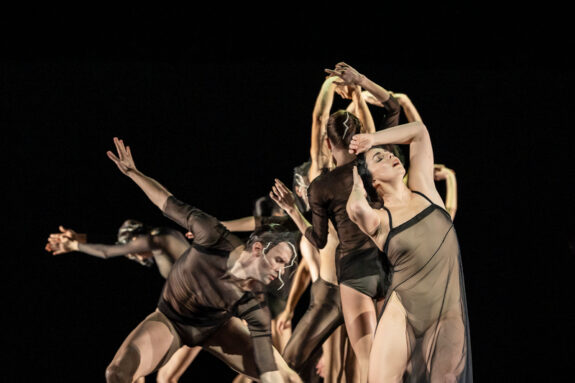
Becomings – based on Woolf’s 1928 Orlando – apparently is about a male poet travelling through time from the Elizabethan era to the twentieth century, with a mysterious sex change along the way. It is almost entirely abstract and on a bare, dark stage with a variety of laser beams and lots of dry ice. It has a Virginia Woolf-appropriate sci-fi feel to it and the dancers begin in the dark as if part of an Elizabethan tableau and Moritz Junge has them dressed accordingly. Their original gold lamé costumes deconstruct with the increasing gender fluidity of what we see to leave some with basically just a ruff or a tutu over flesh-coloured leotards. The choreography is very frenetic and Becomings goes on much too long. Richter’s ‘music’ – a loop with variations on a 17th-century theme La Folia – is pulsating and proved rather unbearably loud in the cinema. The 12 dancers remain largely anonymous throughout and there is no one Orlando figure; ballerinas (Fumi Kaneka especially) appear boneless at times with all the bending and stretching McGregor asks of them and Marcelino Sambé makes another strong impression by whirling through it all with consummate ease.
Woolf Works ends with Tuesday (based on Woolf’s 1931 The Waves) and it is the best of the triptych for me thanks to Osipova’s searing portrayal of a doomed Virginia. McGregor addresses her suicide in 1941 when she drowned herself in the River Ouse near her home. We hear a recording of Virginia’s suicide note to Leonard and see a backdrop of gently rippling waves. The music is slower (and more viscerally engaging as a result), yet the movement is much the same albeit also slower. Marianna Hovanisyan’s disembodied intoning deepens the sadness of what we see. Osipova is a magnetic stage presence as her character’s end approaches. She engages in a deeply sad pas de deux with a bare-chested William Bracewell (Leonard?) who is somewhat like a ‘Messenger of Death’ as in Kenneth MacMillan’s Song of the Earth. There is also Claire Calvert (her sister Vanessa?) and six young children (the characters from the novel?) cavorting and playing with skipping ropes. Soon a larger group of dancers swirl around as the waters that will eventually engulf her (though I am still not sure what they were wearing to partly cover their faces).
The entire ensemble slowly drifts back into the all-pervading darkness as the music surges to leave Osipova and Bracewell in a pool of light and he gently lays her down on the stage as the curtains close. Sadly though, Virginia’s weighed-down body was actually swept away and not discovered for three weeks. Thanks to the expressive Osipova living every final moment of Virginia’s life I found Tuesday to be profoundly moving.
Jim Pritchard
Featured Image: Natalia Osipova in Wayne McGregor’s Tuesday © 2026 Johan Persson
Production:
Music – Max Richter © Mute Songs Ltd 2014
Direction and Choreography – Sir Wayne McGregor
Designers – Ciguë, We Not I, Sir Wayne McGregor
Costume designer – Moritz Junge
Lighting designer – Lucy Carter
Film designer – Ravi Deepres
Sound system designer – Chris Ekers
Make-up designer – Kabuki
Dramaturgy – Uzma Hameed
Principal Coaching – Edward Watson
Casts:
I now, I then (from Mrs Dalloway)
Virginia Woolf / Older Clarissa – Natalia Osipova
Richard – Patricio Revé
Young Clarissa – Sae Maeda
Peter – William Bracewell
Sally – Leticia Dias
Septimus – Marcelino Sambé
Rezia – Akane Takada
Evans – Marco Masciari
Becomings (from Orlando)
Luca Acri, Harris Bell, Liam Boswell, Claire Calvert, Leticia Dias, Fumi Kaneko, Sae Maeda, Marco Masciari, Taisuke Nakao, Marcelino Sambé, Francisco Serrano, Akane Takada
Tuesday (from The Waves)
Natalia Osipova, William Bracewell, Claire Calvert, artists of The Royal Ballet, students of The Royal Ballet School and Marianna Hovanisyan (soprano). Voiceover from a letter by Virginia Woolf spoken by Gillian Anderson