
 United Kingdom Dvořák, Kaprálová, Martinů: Scottish Chamber Orchestra / Jonian Ilias Kadesha (conductor/violinist). City Hall, Glasgow, 17.4.2026. (GT)
Vitêzslava Kaprálová – Suite en miniature, Op.1
Martinů – Violin Concerto No.2, H293, La revue de Cuisine, H161
Dvořák – Czech Suite in D major, Op.39
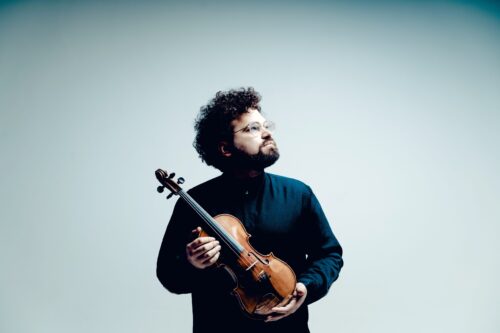
Headlined as ‘Bohemian Rhapsodies’, this evening of Czech music offered works by two well-known composers and one outstanding talent who is gaining long-deserved recognition. Three of the works performed were directed by the Athens-born violinist and conductor, Jonian Ilias Kadesha, a musician whom I have not encountered before. On this evidence, it will not be long before he returns to Scotland.
Vitêzslava Kaprálová’s creativity has only become recognised in recent years, and indeed even in her homeland, her creativity was ignored for many years after she died in 1940. The loss of this outstanding composer is a tragedy for 20th-century music and for Czech music. Unlike her compatriots Ullmann, Haas and Schulhoff, who were murdered at Auschwitz, Kápralová died of typhoid in France at the age of 25. Her String Quartet impressed me greatly at the Janáček Festival in 2024 in Brno, and this first opus offered a further taste of her remarkable talent.
The Suite en miniature is in four movements and was originally a Suite for Piano in 1931, when she was at Brno Conservatoire, yet she orchestrated the piece four years later, when she was 20 years old. The Praeludium opening movement is for strings, opening with a rather hesitant theme on the double basses, cellos and violas. The theme was overwhelmingly sad, yet the mood quickly rose to an almost ecstatic tension with more passion coming from the basses. The second movement, Pastorale, was written exclusively for the woodwind, introducing a graceful idea, almost springlike, with especially fine expression from the clarinet of Maximiliano Martin.
In the third movement – with the whole orchestra involved plus a harp – Ukolebavka or Lullabye, the oboe of Sofia Zamora Meseguer introduced a bright, upbeat idea, followed by the flute, inspiring a beautiful, elegiac mood. In the Menuetto, the whole orchestra, now added to by trumpet and percussion, played a bright, inventive theme rising in passion, and the woodwind introduced a characterful theme rising to a celebratory finale.
Martinů’s Second Violin Concerto proved the main piece in this programme of Bohemian Rhapsodies; now the violinist Kadesha directed from the floor. The concerto opened with the Andante-Poco allegro, with a blast from the whole orchestra, loud and shuddering, the strings led to the solo violin of Kadesha in unison with the orchestra of an extended, tentative idea on the violin and supported by the bassoon of Cerys Ambrose-Evans and developed to a glorious climax. Then an extensive build in tension, prior to a chirpy idea shared across the orchestra, was infused with more intensity from the violin and orchestra, before the thoughtful and intimate cadenza from Kadesha.
The Andante moderato opened with a light, gay and reflective subject, a tuneful and melodic elegy, and on the cadenza of a pleasant and light upbeat rhythm, backed by the flutes with a high, lilting harmony. The Poco allegro opened on the brass, bursting with bright harmony, fast flowing, and with dancing jazz rhythms. An exciting, new idea from the woodwind led to an upbeat rhythm, faster tempo, in celebrative mood, before a final cadenza followed by lovely sounding oboe, flute, and clarinet leading to the upbeat climax.
In Martinů’s piece La revue de Cuisine, written for ballet, a sextet of piano, cello, trumpet, bassoon, flute and clarinet took the stage; following the jazzy opening in the Prologue by the trumpet of Peter Franks, the playing switched between piano, cello, and trumpet, and the bassoon was almost comic, epitomising the experience of a luncheon in Paris. In the second movement, the contributions by the clarinet and bassoon were extraordinary in their mixture of riotous rhythms and folky sequences. The Tango was magnificent, followed by Charleston and ending with the hilarious Finale. Especially of note was the passage shared between the piano of Aaron Shor and the cello of Philip Higham for its exquisite musicality.
Dvořák’s nostalgic Czech Suite rounded off the evening of bohemian music perfectly, with the opening Preludium, richly swelled with elaborately decorated folk themes on the bassoon and the strings, with a lovely evocative theme from the oboe bringing a pastoral mood.
The Polka sparkled with buoyant Czech harmonies invoking country dances (the piece was influenced by the Slavonic Dances); while in the Sousedská, a minuet, there emerged a busy atmospheric mood, at the centre of which was a brisk, attractive theme, and another lovely dance, invoking a cheerful and joyful mood. This led to the Romance, led by the clarinet, supported by the lively, exuberant strings, of a tuneful folk melody. The mood of country festivals and airy Bohemian exuberance continued with the lively furiant in the Finale, highlighted by the flute, clarinet and bassoon, singing a lovely romantic tune evoking memories of the last symphonies by Dvořák and of his nostalgia for the Czech homeland.
Gregor Tassie