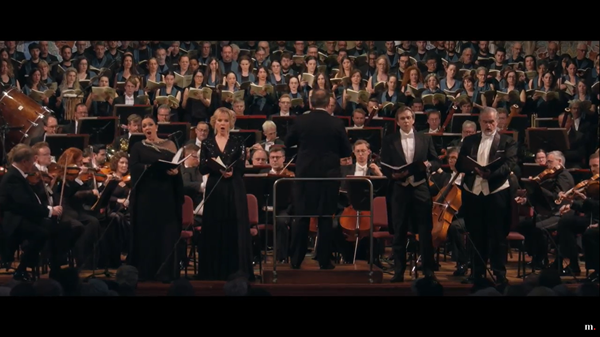
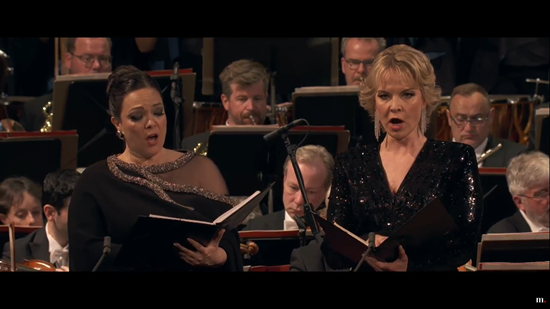
 Spain Verdi, Requiem: Eleonora Buratto (soprano), Elīna Garanča (mezzo-soprano), Benjamin Bernheim (tenor), Riccardo Zanellato (bass), Orfeó Català (chorus director: Xavier Puig), Staatskapelle Dresden / Daniele Gatti (conductor). Livestreamed (directed by Marc Pasteau) on medici.tv from the Palau de la Música Catalana, Barcelona, 19.5.2026. (JPr)
A performance of Verdi’s Requiem at the Verona Arena on 7 August 1980 was in tribute to those who lost their lives or were injured in the infamous Bologna train station bombing five days earlier. It had Riccardo Muti conducting a stellar cast of soprano Montserrat Caballé, mezzo-soprano Brigitte Fassbaender, tenor Veriano Luchetti and bass Ruggero Raimondi. I was in Verona at that time and it was the first Verdi Requiem I saw and heard. I have come back to it occasionally over the intervening 45½ years but rarely have a heard a performance which matched that first Verona one for sheer power, profound reverence, theatricality and pathos. That was until now, when in the ornate, sculptural splendour of Barcelona’s Palau de la Música Catalana the combined forces – including soloists and conductor – proved the equal of that Verona night in 1980 and delivered a Verdi Requiem for the ages.
Requiems, by their very nature, contain a lot of soul-searching and a need to make good with your ‘Maker’ from one side of the grave or the other. In Verdi’s 1874 Requiem we hear the lamentations of those on the brink of death and who are railing against it and so have not yet passed through the gates of Heaven. Verdi’s deeply religious work is a monument to the Italian novelist and poet Alessandro Manzoni whom Verdi revered and had died in 1873. Verdi began completing the requiem after his opera Aida and a few years before Otello, so he was at the height of his operatic powers. The cliché is that this mass is regarded as Verdi’s ‘greatest opera’ and there are arguments to say that this is not very far from the truth since the Lacrymosa was recycled music from Don Carlo and the beginning of the fearsomely hellish Dies irae brings us the soundworld of the Anvil Chorus from Il trovatore. Other operatic influences include looking back with the Aida-like choruses and large brass choir and looking forward to the Act I storm (Dies irae) and Iago’s evil (Tuba mirum), as well as other dramatic moments in his forthcoming Otello score.
However, whilst undoubtedly concerned with dying and death, Verdi makes this requiem into a celebration of life. As the late David Cairns once wrote Verdi’s music seems to exclaim his wish to transcend death as he recalled Arrigo Boito’s comments after seeing Verdi on his deathbed: ‘Never have I had such a feeling of hatred against death, of contempt of that mysterious, blind, stupid, triumphant and craven power … He hated it, for he was the most powerful expression of life that it is possible to imagine’. Therefore, it is this ‘powerful expression of life’ which is the essence of the Verdi Requiem. This choral masterpiece begins with a whisper and becomes increasingly loud and astonishingly complex. Even online through tempered loudspeakers the sound was often overwhelming and mind-numbing (in a good way), especially in the Sanctus; though I suspect this was precisely the impact Verdi desired. The excellent and totally involved Orfeó Català (a local Barcelona choir) were sorely tested throughout but rose to the challenge magnificently, even if not all of the liturgical text could be heard, and it was a heroic sound that they made. The ferocious intensity of the Dies irae was more terrifyingly concentrated with each recapitulation; from the opening pianissimo right through to the Libera Me at the very end, punctuated as it was by the thwacks on the gran cassa (big bass drum). The choir’s discipline was a credit to their director Xavier Puig.
What was evident in Marc Pasteau’s closeup camerawork for the livestream was how much Daniele Gatti – conducting without score – micromanaged the contributions of soloists, choir and orchestra (the near-incomparable Staatskapelle Dresden) to ensure a masterfully-executed performance with heightened drama, depth of emotion, yet seemingly unlimited reserves of shattering power and passion. Within all the tumult, Gatti still managed a number of quieter more refined, introspective and emotional moments which allowed for – albeit fleetingly – poignant reflection.
The work requires four soloists with big voices and Gatti had the support of a formidable quartet. There are two to single out though this is something of an injustice to the others; they are mezzo-soprano Elīna Garanča and tenor Benjamin Bernheim. Garanča sang peerlessly from her opening declamatory soliloquy ‘Liber scriptus proferetur’ to uniting with soprano Eleonora Buratto for the haunting, unaccompanied melody in the Agnus Dei. Garanča’s rich, resonant chest voice rose to some impressive top notes and frequently had visceral power. The highpoint of Buratto’s glorious singing was – as it must be – the concluding Libera me with a range which included a pianissimo B-flat to soaring over a rampant orchestra and full choir before the quiet resignation of a final spoken plea for deliverance. Mellifluous tenor Bernheim revealed his seamless legato and delicate high phrasing in a serene ‘Ingemisco’ of profound inner peace and his hushed ‘Hostias et preces tibi’ in the Offertorio. The part for the bass soloist in Verdi’s Requiem is not large, but Riccardo Zanellato sang with genuine conviction and suitably sepulchral tones. His noble-sounding bass was heard at its best in his opening unaccompanied ‘Mors stupebit et natura’ and his plea for mercy in the Confutatis.
In duets, trios and when singing all together – especially in some almost transcendental a cappella moments – the four soloists were also remarkably impressive; passages like ‘Domine Jesu Christe’ were radiant and they made the ending of the Offertorio very moving.
The Staatskapelle Dresden were impeccable with the strings shimmering at times, the woodwind warm and expressive and the bass blazing. The musicians thoroughly deserved their own acclaim in the standing ovation all those involved received. Thankfully this Verdi Requiem has an afterlife of its own and is currently available to see on medici.tv.
Jim Pritchard
Featured Image: Daniele Gatti conducts four soloists, Orfeó Català and the Staatskapelle Dresden in the Verdi Requiem
This Verdi Requiem will be repeated – same soloists, conductor, orchestra, but different choirs – in Vienna (23 and 25 May), Paris (30 May), Hamburg (3 June) and Prague (4 June).