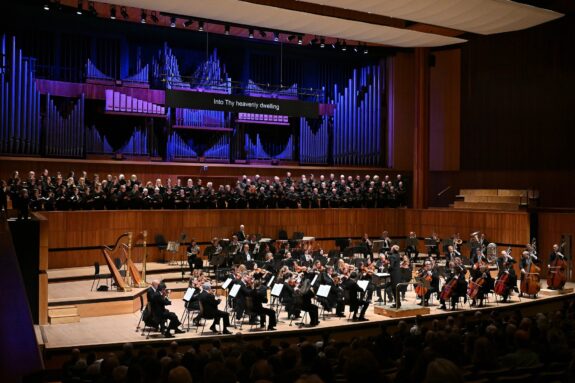
 United Kingdom Mozart, Taneyev, Wagner: Philharmonia Chorus (chorus master: Gavin Carr), Royal Philharmonic Orchestra / Vasily Petrenko (conductor). Royal Festival Hall, London, 17.5.2026. (CK)
Mozart – Overture, The Magic Flute
Sergei Taneyev – John of Damascus
Wagner – Parsifal: Orchestral Suite
This was another fine concert from Vasily Petrenko and the Royal Philharmonic Orchestra. If I had to enter a small cavil it would be about Petrenko’s fondness for a spoken introduction: he is witty and charming, easy to listen to, and gave us a valuable insight into the unfamiliar work by Sergei Taneyev: but his explanation of the ways in which the three pieces were connected was probably unnecessary and doubled the length of his speech. ‘Our most mystical concert’, he called it; and it wasn’t too difficult to see that all three pieces have to do with ritual and redemption in one way or another. There was something wickedly tongue-in-cheek in his expression as he finished: ‘We will start with a smile (Mozart), and then…we will elevate ourselves.’
After its solemn opening chords, the Overture to The Magic Flute was indeed music to make us smile; light-footed, fleet and spry, it was a perfect six-minute demonstration of the synergy between conductor and orchestra. Taneyev’s Opus 1 (he was nearly 30 and apparently highly self-critical) was a different matter. He is something of a missing link: pupil of Tchaikovsky and Rubinstein, teacher of Scriabin and Rachmaninov, and the only person Tchaikovsky would allow to criticise his work. His cantata, inspired by a poem by Aleksey Tolstoy, concerns acceptance of death and an afterlife in the limitless love of God: at the risk of sounding flippant, the music takes us on the same journey as Mahler’s Second Symphony, Richard Strauss’s Tod und Verklärung and Elgar’s Gerontius.
The opening movement – I walk a path unknown to me – began with a sombre minor-key chant on the woodwind, very Russian-sounding, taken up by the strings. The women’s voices entered first, joined by the men in a long crescendo towards a powerful, almost overwhelming climax. Petrenko built a performance of considerable intensity from his singers and players: and what a sound the Philharmonia Chorus makes!
The second movement – But whilst I sleep the eternal sleep – was brief, quiet and a cappella, a resting-place before the final movement (And on that day, when the trumpet’s blast) bursts in: fortissimo shouts of Gospod! herald a vigorous and confident fugue and a mighty climax before the quiet ending, a hushed prayer for voices alone.
The performance was very warmly received, and it made quite an impact. I will be surprised if the work suffers the fate indicated in a rather cruel critic’s headline (reviewing an English opera): ‘Thank you, now back to obscurity’. It was a fine performance, though there can be no doubt that the collective hero of the hour was the Philharmonia Chorus, singing with dramatic immediacy and stinging force.
The orchestra came into its own after the interval, with Erich Leinsdorf’s orchestral suite drawn from the music of Parsifal. For those who, like me, find Parsifal a strangely repellent opera with wonderful music, this was a painless way of enjoying some of its great moments. It also appeared to inaugurate a concert-hall Wagner season: Sir Simon Rattle and the London Symphony Orchestra are about to perform two concerts of excerpts from Götterdämmerung at the Barbican, and Sir Antonio Pappano follows in a month or so with complete performances of Tristan und Isolde (and for south-westerners like me, it is worth noting that the Bournemouth Symphony Orchestra will open their new season with The Ring: An Orchestral Adventure).
I know that for some people serving up Wagner in this way is anathema; I can only assume that they were not in the hall. For those of us who were, there was a beautifully burnished Act I Prelude, leading into a truncated but effective version of the Act I Transformation Music (with offstage bells) and Finale. Petrenko shaped Wagner’s oceanic surges with a sure instinct, allowing space in the Prelude and building the Transformation Music majestically. The orchestra responded superbly, producing a rich Wagner sound individually and collectively.
Nothing from Act II (which would have displeased the gentleman sitting near me at a complete performance who announced that ‘Kundry has all the best music’). The Act III Prelude, and a noble account of the Good Friday Music: then Titurel’s Funeral March, the double basses and the lower brass conjuring the oppressive atmosphere of Montsalvat, that doomed, all-male enclave, the Bell motif baleful on two sets of timpani and offstage bells. Assuagement came, perhaps, with the glowing Act III Finale, complete with rippling harps.
Forty minutes or so of prime-cut Wagner. Why not? I thought of Puck: ‘I’ll put a girdle round the earth In forty minutes’. This whistle-stop tour of Parsifal wasn’t quite up to that, but who knows? It may have been, for some in the audience, an introduction to a uniquely majestic and troubling opera. And, as Petrenko pointed out (‘no Valkyries, no anvils’), by Wagner’s standards, a relatively quiet one.
Chris Kettle
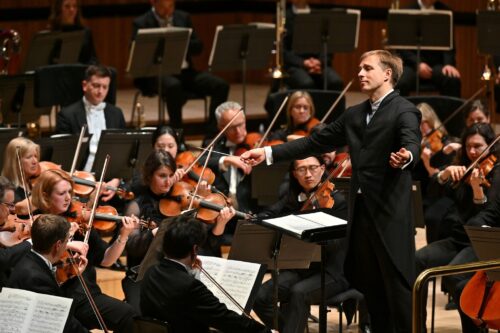
Featured Image: Vasily Petrenko conducts the Philharmonia Chorus and the Royal Philharmonic Orchestra © Mark Allan/RPO
I totally agree with Chris Kettle concerning serving up forty minutes or so of vocal-free ‘prime-cut Wagner’ – and why not indeed? After all, Toscanini and Stokowski did this in concert by bringing Wagner to many who could not afford the prices of opera house tickets. Maazel also served up so-called ‘bloody-chunks’ of Wagner in concert. Many of us actually prefer to hear Parsifal without having to hear Kundry screaming in hysterics! Give me Wagner without voices any day – though I will probably lose friends for saying that! So be it. And how many people do you know who actually sit down at home and listen to a complete Wagner opera in one sitting? One, two… three at the most?