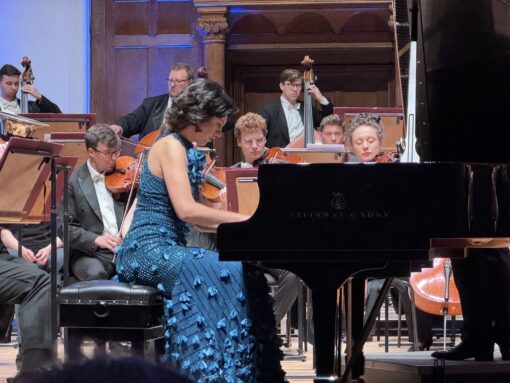
 United Kingdom Bacewicz, Chopin, Tchaikovsky: Alexandra Dariescu (piano), Warsaw Philharmonic Orchestra / Krzysztof Urbański (conductor). Cadogan Hall, London, 19.5.2026. (AV-E)
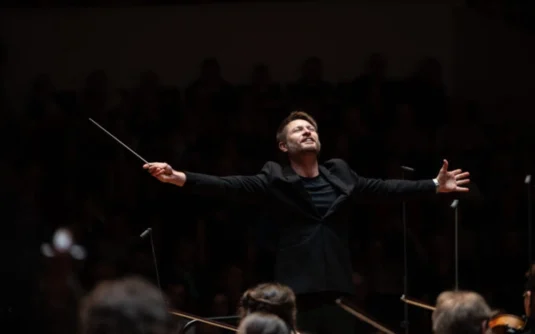
Grażyna Bacewicz – Scherzo
Chopin – Piano Concerto No.2 in F minor, Op.21
Tchaikovsky – Symphony No.6 in B minor ‘Pathétique’, Op.74
At Cadogan Hall the programme opened with a fizzing account of Grażyna Bacewicz’s Scherzo, in which the urbane Krzysztof Urbański conducted the Warsaw Philharmonic Orchestra with incisive clarity and structural poise, drawing playing of a distinctive dark-grained sonority with a visceral verve.
Bacewicz’s compact orchestral writing can sound merely energetic in lesser performances, but here there was real character in the sharp dynamic contrasts, abrupt rhythmic pivots and agile textural shifts. The string articulation was wonderfully rugged and muscular, ideally suited to the work’s earthy, rough-hewn character. The well-projected woodwind interjections brought wit and a touch of whimsy to the work, while Urbański kept the music moving purposefully, yet allowed enough space for the playful exchanges between sections to register fully.
There was an appropriately rugged edge to the dark and earthy orchestral sound, which prevented the performance from becoming overly polished and suited the work’s restless vitality perfectly. Indeed, the Warsaw Philharmonic’s dark-grained sonority recalled an older Central and Eastern European orchestral tradition — closer to the Czech Philharmonic and the Leningrad Philharmonic than to the hyper-polished and often overly sanitised orchestral sheen cultivated by many pristine Western ensembles today. (Having lived in Warsaw in 2017, I recall hearing a dilapidated orchestra that was then frankly substandard in consistency, with persistent issues of precision and intonation.) Rhythmic accents were crisply pointed without ever sounding heavy-handed, and the Warsaw Philharmonic’s performance captured the work’s characteristic mixture of athletic drive and sly irony. The final pages were dispatched with exhilarating panache, providing a spirited and thoroughly engaging opening to the evening.
The altitudinous Alexandra Dariescu confirmed herself a consummate artist in Frédéric Chopin’s Piano Concerto No.2, the unquestionable centrepiece of the evening: a performance of remarkable poise, refinement and emotional economy. From her first entry, Dariescu played with impressive crystalline clarity, a Bach-like purity of tone and line and naturalness: nothing was mannered or exaggerated, nothing underlined for rhetorical effect, yet every phrase emerged with unforced immediacy, allowing Chopin’s writing to speak with disarming directness and fragile poetic radiance.
The opening Maestoso unfolded with luminous poise, the piano’s opening figurations projected lucidly above a finely balanced orchestral foundation, the orchestral texture remaining transparent and weightless throughout. Dariescu shaped the long lines with effortless control, while Urbański and the Warsaw Philharmonic responded with finely judged sensitivity, never obscuring the solo line.
The celebrated Larghetto was simply unforgettable. Its opening pages were played with extraordinary stillness and refinement. Dariescu sustained the long melodic spans with such control that the music seemed to breathe without effort. The stillness she achieved here created an almost suspended sense of time, the natural purity of her sound intensifying the emotional impact without recourse to exaggeration.
By contrast, the finale danced with buoyant physicality, its passagework thrown off with effortless ease, yet was at once earthbound and airborne.
The audience responded with evident exuberance, followed by an encore of the Romanze from Clara Schumann’s Piano Concerto in A minor, Op.7, performed in its intimate original guise as a duet for piano and solo cello. Alexandra Dariescu was joined by the Warsaw Philharmonic’s principal cellist, Aleksandra Ohar-Sprawka, and together the two women formed an ideally balanced partnership, closely matched in tone, colour and expressive restraint.
The cello’s warm, vocal line and the piano’s finely shaded clarity intertwined seamlessly, creating a single, unified musical perspective. Phrasing was carefully attuned throughout, with an instinctive sense of shared pacing and dynamic nuance, the exchange unfolding as a true chamber dialogue. At its conclusion, they embraced, beaming, amid appreciative applause from the packed Cadogan Hall audience.
The intensely incisive Krzysztof Urbański approached Pyotr Ilyich Tchaikovsky’s Pathétique Symphony with clear structural focus and controlled expression, conducting the work almost entirely ‘straight’, in the best sense of the term. There were none of the agogic exaggerations, rhetorical distortions or emotionally over-inflated mannerisms that conductors sometimes impose upon this abused score. Urbański recognised that Tchaikovsky’s writing is already rhetorically charged, requiring no additional tarting-up with excessive emotional emphasis.
Indeed, the classical interpretation was closer in spirit to Arturo Toscanini than to the more self-indulgent late-Romantic tradition associated with the flamboyant Leonard Bernstein, in its refusal to indulge in laboured emotional overstatement, instead allowing Tchaikovsky’s structure to generate its own ineluctable emotional inevitability through forward-moving clarity. Tempos were generally on the brisk side, yet transitions and climaxes were tightly proportioned within a clearly articulated structural span.
Particularly striking was the precision and economy of Urbański’s conducting technique, every gesture precisely functional and expressive. His left hand, in particular, functioned almost sculpturally throughout the performance: shaping entries, balancing orchestral layers and controlling dynamics with remarkable exactness. Each individual articulation of his fingers possessed its own exacting morse code of incisive expression, every minute movement shaping phrasing, balance and dynamic contour with extraordinary precision. During quieter passages of the Allegro con grazia, he occasionally ceased beating time altogether, allowing the orchestra to sustain the line with chamber-like concentration and remarkable softness.
The third movement march was taut, alert and rhythmically incisive, propelled forward with muscular energy but never allowed to become bombastic. Urbański maintained exceptional control of orchestral balance and momentum, ensuring that the movement’s cumulative excitement emerged organically from the score rather than through exaggerated rhetoric. The audience’s appreciative applause at its conclusion felt entirely understandable, even if the true emotional destination of the symphony still lay ahead.
Most refreshing of all was the finale, free from the mannered, laboured dragging out of emotional overstatement that so often ruins it. Beginning in a state of subdued inwardness, Urbański allowed the tension and emotional gravity of the Adagio lamentoso to accumulate gradually and inexorably. Climaxes possessed tremendous intensity without ever lapsing into hysteria, the orchestral textures remaining clear, dark and perfectly moulded throughout.
The final descent into exiled silence was extraordinary: the mournful music dissolved seamlessly between being and nothing, unfolding organically, ending without end. It was a profoundly affecting conclusion precisely because it remained ‘additive-free’ from wilful-indulgence, trusting entirely in the unflinching eloquence of Tchaikovsky’s greatest score.
Alexander Verney-Elliott
Featured Image: Pianist Alexandra Dariescu plays Chopin with the Warsaw Philharmonic at the Cadogan Hall © BP