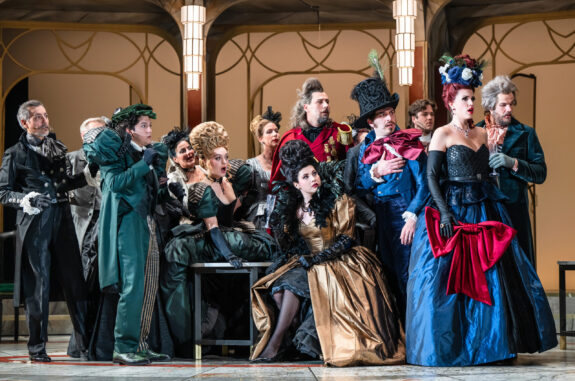
 Switzerland Puccini, Gianni Schicchi and ddditional music by Johann Strauss, Lehár, Kálmán and Verdi: Soloists, Zurich Opera Chorus, Musikkollegium Winterthur / Ustina Dubitsky (conductor). Theater Winterthur, 8.5.2026. (MF)
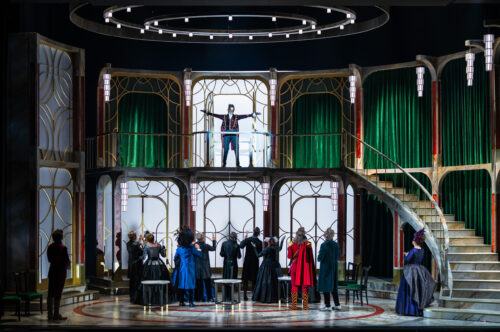
This year, Zurich’s International Opera Studio (IOS) presents Puccini’s opera buffa Gianni Schicchi. Premiered in 1918, the work is the third part of Il trittico, which also includes Il tabarro and Suor Angelica.
The plot centres on the death of the wealthy Buoso Donati. His greedy relatives discover that Donati’s will names a monastery as the sole heir, leaving them nothing. Appalled, the family calls on the cunning peasant Gianni Schicchi for help. Schicchi agrees to impersonate the dead man and dictate a new will to the notary. He reminds the family that the penalty for such fraud is exile and the loss of a hand. Unsurprisingly, Schicchi outwits them all: while dictating the new will, he – acting as the deceased Donati – bequeaths the most valuable assets to ‘his dear friend Gianni Schicchi’. The family is empty-handed once again.
The protagonists Gianni Schicchi and Buoso Donati are based on characters from Dante’s Divine Comedy. Dante confines Schicchi, a fraudster, to the eighth circle of hell among the ‘impersonators’, while Buoso burns with the thieves.
This connection led director Lilli Fischer to depart from the traditional approach of pairing Gianni Schicchi with one of its usual counterparts. Instead, she imagines the life of Buoso Donati before his death, staging a prequel to the opera as the evening’s first part.
The set is a two-storey arena, its grand doors and curtains evoking an Art Nouveau ballroom, doubling as Donati’s bed and death chamber. Its circularity recalls Dante’s architectural concept of the inferno and purgatorio. The protagonists move down the stairs, and occasionally up them.
Director Fischer invites the audience to an extravagant ball displaying Donati’s life of greed and gluttony, set as a raucous party orchestrated by Gianni Schicchi. This first act consists of a sequence of chart toppers by Puccini’s contemporaries, including ‘Alle maskiert’ from Johann Strauss’s A Night in Venice, ‘Ich lade mir gern Gäste ein’ from Die Fledermaus, Lehár’s ‘Meine Lippen, sie küssen so heiss’, and the Verdi über-hits ‘Libiamo ne’ lieti calici’ and ‘La donna è mobile’. As the ball comes to an end, Donati attempts to save his soul by writing the will that leaves his possessions to the monastery. Although Fischer’s concept is intriguing it felt slightly arbitrary, despite an exuberantly playful cast. In my view, a separate work would have better served Puccini’s piece.
The second part, the opera itself, was a different matter altogether. The music, singing, acting and set all came together seamlessly. Dynamic narration, comedic timing and a joy of performing drove the show, and Mahshad Safaei created multi-coloured costumes worthy of any Moulin Rouge production.
The IOS was out in full force with a 15-strong cast. In the first part, Marie Lombard and Tomislav Jukic were a particularly strong pair in ‘Pst, pst, Nanetta’ from Verdi’s Falstaff. Lombard demonstrated stunning control over her dynamic soprano, and her ‘O mio babbino caro’ in the second part was beautifully phrased. Thalia Cook-Hanson impressed with ‘Sempre libera’ from La traviata, while Evan Gray’s rendition of ‘Auch ich war einst’ from Kálmán’s Gräfin Mariza was touchingly tragicomical. In the second part, Max Bell’s comedic talent and the vocal heft of his resounding bass voice deserve special mention. As Ser Amantio di Nicolao, Felix Gygli had the self-important gravity of a man who believes the law is only as dignified as he is. Last but not least, Steffan Lloyd Owen’s Gianni Schicchi was a charismatic lead with gravitas and wit – though even he seemed surprised when the closing gates trapped him at the bottom of the arena at the very end.
The second part in particular is a jolly affair, with conductor Ustina Dubitsky allowing the orchestra and cast to merge into well-coordinated and entertaining unity.
Michael Fischer
Featured Image: Zurich’s International Opera Studio’s Gianni Schicchi © Toni Suter
Production
Director – Lilli Fischer
Set – Danila Travin
Costumes – Mahshad Safaei
Lighting – Dino Strucken
Choreography – Mlindi Kulashe
Dramaturgy – Fabio Dietsche
Cast
Gianni Schicchi – Steffan Lloyd Owen
Lauretta – Marie Lombard
Zita – Cashlin Oostindië
Rinuccio – Tomislav Jukic
Gherardo – Salvador Villanueva
Nella – Thalia Cook-Hansen
Betto di Signa – Evan Gray
Simone – Lobel Barun
Marco – Guram Margvelashvili
La Ciesca – Natália Tuznik
Maestro Spinelloccio – Max Bell
Ser Amantio di Nicolao Felix Gygli
Buoso / Orlovsky – Karima El Demerdasch
Una donna – Maria Stella Maurizi