 Germany Gurlitt, Wozzeck: Soloists, Chorus of Oldenburg State Theatre, Oldenburg State Orchestra / Vito Cristofaro (conductor). Oldenburg State Theatre, 23.6.2026. (DM-D)
Manfred Gurlitt (1890-1972) conducted the world premiere production of his opera, for which he had also written the libretto, on 22 April 1926. This was about four months after the world premiere of the opera of the same title by Alban Berg, inspired by and based on the same literary predecessor, Georg Büchner’s dramatic fragment. Stylistically, there was no competition between the two, with Gurlitt’s work created in the context of Neue Sachlichkeit (Hindemith, Weill). The opera has been performed only rarely since then.
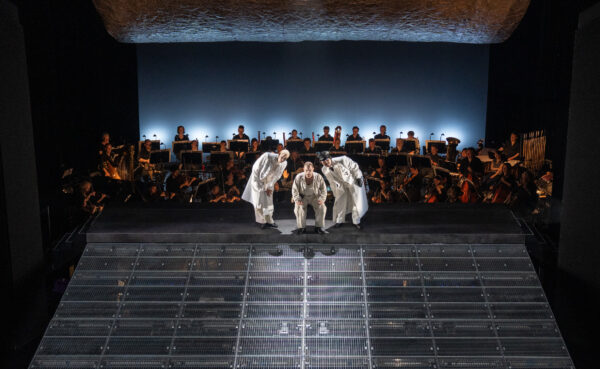
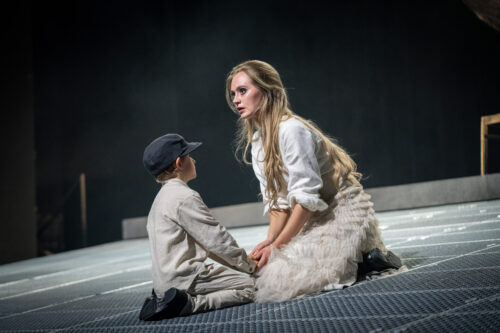
Oldenburg State Theatre’s artistic director Georg Heckel directed this production. His design team created a metal grid floor sloping up from the front stalls across the orchestra pit; it extended to well beyond the middle of the stage area. The orchestra was seated behind that slope, at the back of the stage, visible from the first tier, possibly not from the stalls. Thanks to an intriguing design, the grid was lit from below and above. A single chair served as the only item of furniture on the stage. Gurlitt’s music was descriptive rather than emotional, and the production matched that approach well – it presented the events of the plot as if from a distance, detached, allowing the plot itself to create empathy in the audience without the need for additional triggers from the music. The abstract set and lighting added to that effect. Characterisation was very nuanced and detailed, both when singers engaged in monologues and interactions.
Arthur Bruce was very strong as the title character. With his well-grounded, flexible baritone, he explored the long arcs of singing Gurlitt has composed for his Wozzeck. Without straining, Bruce brought out his character’s simplicity, his sorrow and grief, his love for Marie, his perturbed state of mind, and the extent to which he was a victim of his circumstances. His character lacked any sense of complexity of feelings: instead, there was frequently a sudden snap transition from one position to the next, each at 100% without overlap. Stephanie Hershaw was equally agile of voice as Marie, expressing the depth of her character’s range of emotions, sadness and despair, the love for her child and for Wozzeck, and her hopes for a better life. Hershaw demonstrated a great sense of awareness of Gurlitt’s musical idiom, her voice sounded bright and fresh. Aksel Daveyan and Johannes Leander Maas were much more than mere caricatures as the Captain and the Doctor who take pleasure in treating Wozzeck badly. Daveyan impressed with his sonorous bass-baritone, while Maas enriched the lyrical material for the Doctor with some excellent helden-emphasis. Gurlitt composed the role of the drum major for a high baritone (as opposed to the heldentenor role in Berg’s Wozzeck), and it was sung here by Paul Brady. Dorothee Bienert sang both Margaret and the Old Woman (a character in Büchner’s play but not in Berg’s Wozzeck, who narrates a very dark fairy tale about loss and despair), differentiating well between the roles. Seumas Begg was convincing as Wozzeck’s only friend, Andres. The chorus, led by Thomas Bönisch, sang with full commitment.
Heckel’s production provided a vivid image of the characters and their society as depicted in the opera, and under Vito Cristofaro’s baton, the orchestra brought Gurlitt’s music to life with much clarity of line. Perhaps this production can serve as an inspiration for further productions.
Daniel Meyer-Dinkgräfe
Featured Image: Johannes Leander Maas (Doctor), Arthur Bruce (Wozzeck) and Chanhee Cho (Captain) © Stephan Walzl
Production:
Director – Georg Heckel
Set and Costumes – Timo Dentler, Okarina Peter
Lighting designer – Steff Flächsenhaar
Chorus director – Thomas Bönisch
Dramaturgy – Anna Neudert
Cast:
Wozzeck – Arthur Bruce
Marie – Stephanie Hershaw
Drum-major – Paul Brady
Andres – Seumas Begg
Captain – Aksel Daveyan
Doctor – Johannes Leander Maas
Margaret / Old Woman – Dorothee Bienert
Jew (peddler) – Benjamin Park
A Girl – Clara Capperucci
First citizen – Volker Röhnert
Second citizen – Sandro Monti
Soprano – Xueli Zhou
Marie’s child – Denys Salo