 United Kingdom Grange Park Opera 2026 [1] – Verdi, Don Carlo: Soloists, Grange Park Chorus, Orchestra of English National Opera / Gianluca Marciano (conductor). Grange Park Opera, West Horsley, 6.6.2026. (CR)
Even in the reduced four-act Italian version of 1883/4 presented here, Verdi’s Don Carlo is a magnificent epic – dramatic but never sprawling in its narrative. Jo Davies’s compelling 2016 production for Grange Park Opera creates an austere, solemn sublimity that is rooted in the late 16th century, with refreshingly few complicated concepts imposed on it. It also serves as a creditable follow-up to David Pountney’s equally gloomy, streamlined Simon Boccanegra at the same venue last year.
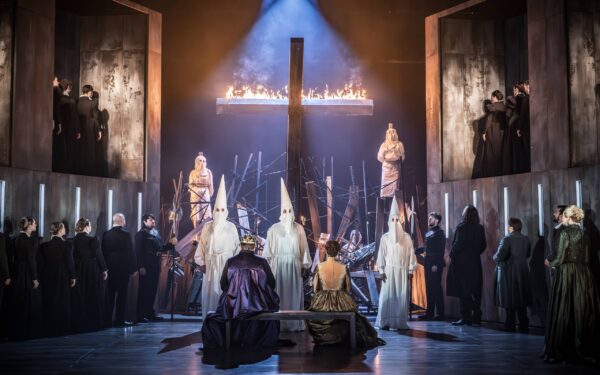
The set broodingly maintains the same basic shape of two plain wooden edifices with slits and niches higher up, ranging backwards in perspective as though funnelling the action into certain doom. In the meantime, the characters are all virtually imprisoned in the space enclosed on the stage; the rear opening is blocked in by the candlelit watch at Charles V’s tomb at the beginning and end, a glass-boxed tree for Queen Elisabeth’s garden, a cross with its horizontal arms aflame as the backdrop to the auto-da-fé, or a cage-like grille for the prison scene. Tellingly, Rodrigo languishes on our side of the latter screen in the scene of his death, inciting maximum sympathy for him, rather than keeping him at a distance.
Appropriately sombre lighting by Ann Watson and adapted historical costumes by Gabrielle Dalton fill out the ominous atmosphere, with minimal distracting fuss – that would seem to be the reason for the men’s wearing modern trousers and footwear instead of baggy breeches. The sanbenitos and capirotes of some attendants at the execution of heretics is more likely to register as the costume of the Ku Klux Klan rather than the historically accurate dress worn by penitents of traditional Catholic confraternities and at an auto-da-fé as witnessed here. But the connection with reactionary oppression is essentially valid, as King Philip calmly sits to watch the burning victims. There is a grim irony, however, when he is next seen sitting in his study in melancholy solitude, before a row of flickering candles. As with the watch at Charles’s tomb, light and fire here are no hopeful contrast with darkness, but simply another means of torture and destruction in the name of a warped religion and morality.
The vocal soloists waver between subdued and declamatory, rather than more rhetorically nuanced. Otar Jorjikia sings powerfully in the title role for tenor, often sounding more like a lyrical baritone, though he can reach the role’s upper register without strain, but there could be more differentiation in tonal colour. Michel de Souza’s Rodrigo is softer voiced, even mellifluous, but one misses a greater strain of urgency in his close relationship with Carlos and in his persuading the King to be lenient with the people of Flanders.
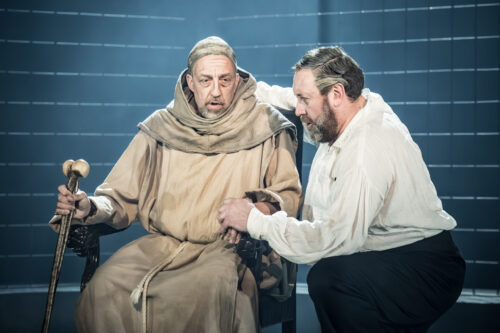
Matthew Rose is not the sternest, weightiest Philip there could be, but his more ashen, hollow sonority expresses a wearied, indecisive monarch, leaving room for the more sonorous, almost yelled imprecations of Julian Close’s horribly entrancing Grand Inquisitor. He suffers no crisis of confidence, inching forwards boldly on the stage – despite blindness and walking sticks – even pushing Carlos on at the end into the deathly embrace of the ghostly figure of Charles V.
Elin Pritchard brings warm gravitas to the role of Elisabeth, firm but moving in the emotional trials she has to undergo. Ruxandra Donose as Carlos’s supposed lover is just as forceful, maybe a touch neutral in temperament, and with a steely upper range that leads to some raw swoops in Eboli’s ‘Veil Song’ which sound more like a Valkyrie than a princess. Harrison Chéné Gration is quite a retiring Monk, but there is a vividly soaring Voice of Heaven from Rosa Sparks, casting a very immediate song of consolation over the auto-da-fé.
Gianluca Marciano takes a fairly broad view of the score with the Orchestra of English National Opera, without pace or tension sagging, despite some long scene changes. Brass are particularly evocative, above all when thundering out the chorale at the conclusion, and the Grange Park Chorus are more resounding still. But the abiding impression we take from this production is of an elegy for Carlos and Rodrigo, and even for Philip, lost in the grip of a wasteful ideology of power.
Curtis Rogers
Featured Image: Grange Park Opera’s Don Carlo © Marc Brenner
Production:
Director – Jo Davies
Set designer – Leslie Travers
Costume designer – Gabrielle Dalton
Lighting designer – Anna Watson
Movement director – Lynne Hockney
Fight co-ordinator – Alison de Burgh
Chorus master – Philip White
Cast:
Philip II – Matthew Rose
Don Carlos – Otar Jorjikia
Rodrigo – Michel de Souza
The Grand Inquisitor – Julian Close
Elizabeth de Valois – Elin Pritchard
Princess Eboli – Ruxandra Donose
Monk – Harrison Chéné Gration
Count of Lerma – James Schouten
Tebaldo – Claire Pendleton
Voice of Heaven – Rosa Sparks