
 United States Lincoln Center’s Summer for the City [1] – The Play of Fate: Schnittke, Mozart, Schubert: Alina Ibragimova (violin, conductor), Ruggero Allifranchini (violin), Festival Orchestra of Lincoln Center. Wu Tsai Theater, David Geffen Hall, New York, 28.7.2026. (ES-S)
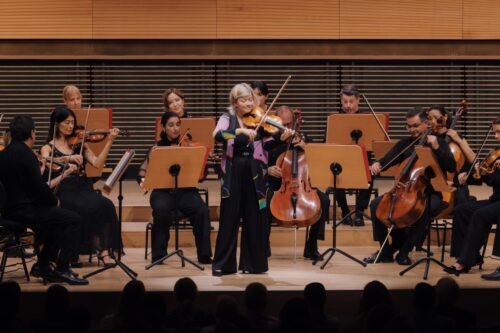
Schnittke – Moz-Art à la Haydn
Mozart – Violin Concerto No.3 in G major, K.216, ‘Strassburg’
Schubert (arr. Mahler) – Death and the Maiden
As part of Lincoln Center’s Summer for the City, the Festival Orchestra of Lincoln Center presented The Play of Fate, a program poised between theatrical mischief and reflections on mortality. With Alina Ibragimova as both violinist and conductor, the evening moved through Schnittke’s playful dismantling of the Classical tradition, Mozart’s graceful assurance and Schubert’s darker intensity.
Schnittke’s Moz-Art à la Haydn unfolded as musical theater. An ensemble of 11 string players, joined by the two soloists – Ibragimova and Festival Orchestra concertmaster Ruggero Allifranchini – began in darkness with soft, disembodied harmonics. As the stage gradually brightened, isolated fragments suggested the outlines of Classical order. The choreography embodied that instability: musicians shifted between rows of music stands, repeatedly falling into and out of formation as the musical fragments similarly coalesced and broke apart. When nearly all the players dispersed, the return to darkness completed the reference to Haydn’s Farewell Symphony. The Classical ensemble took shape, briefly asserted its coherence and vanished.
Mozart’s language appeared not as a secure inheritance but as something imperfectly remembered, reassembled, mocked and momentarily restored. Schnittke’s humor never felt entirely benign: Classical grace repeatedly tilted toward distortion and unease. Ibragimova and Allifranchini gave the fragmented exchanges an animated precision though it was never quite clear whether they were directing the surrounding commotion or helping to provoke it. The players could seem mutinous and the music close to collapse, but the apparent chaos was tightly controlled.
Mozart’s Violin Concerto No.3, written when he was 19, returned the program from Schnittke’s distortions to the Classical language itself. It also recalled the central place Mozart’s music once held in Lincoln Center’s summer programming under the Mostly Mozart banner. Directing from the violin, Ibragimova brought crisp articulation and a distinctly ludic quality to the opening Allegro. Her solo line emerged not as a display set against the orchestra but as part of an animated exchange with it, combining rhythmic buoyancy with supple, singing phrasing. Yet the precision and brightness of her playing left less room for the current of melancholy that occasionally darkens the concerto’s youthful surface.
With flutes replacing the oboes, the Adagio took on a gentler, more veiled sonority. Ibragimova sustained the long solo line with delicacy and control, while the orchestra responded with cohesion and close attention to her phrasing. In the finale, she handled Mozart’s sudden shifts of tempo and character with ease, moving between courtly grace, folk-like playfulness and buoyant rhythmic energy.
After intermission came Schubert’s Death and the Maiden in the string-orchestra arrangement left unfinished by Mahler. The choice raised an obvious question: what can orchestral enlargement add to a work whose intensity depends so heavily on the exposed individuality of four players? The question seemed especially pertinent given Ibragimova’s role as first violin of the Chiaroscuro Quartet, now seated among a much larger body of strings. The expanded ensemble brought greater weight, depth and collective power, while passages reduced to solo strings – at times with doubled violas – briefly recovered the intimacy of the quartet. Yet the arrangement also risked replacing intimate exchanges with a more generalized collective sonority.
The first movement offered the strongest initial justification for the larger forces. Its opening rhythmic unison was brutally concentrated, establishing an atmosphere of immediate tension. Seated in the leader’s chair, Ibragimova sustained a fiercely propulsive momentum. Even the more lyrical second theme, full of desolation and yearning, never fully dispelled the surrounding agitation. Sudden contractions of sound made the music seem to recoil, while the caesuras prolonged the unease before the restless repetitions resumed. By the coda, resistance had given way to mounting desperation.
The Andante con moto formed the performance’s emotional center. Its theme derives from Schubert’s song ‘Death and the Maiden’, in which Death appears not as a violent conqueror but as a gentle, almost consoling presence. Ibragimova preserved that ambiguity: the initial statement was grave without becoming heavy, while the variations moved through tenderness, unease, resistance and explosive force. The most affecting passages were the quietest, when the orchestral body receded and individual voices recovered some of the original quartet’s vulnerability.
The orchestral enlargement proved more persuasive in the final two movements. The Scherzo gained a visceral power beyond the reach of four instruments, its accents biting through a texture that remained rhythmically buoyant, though the full ensemble sometimes sacrificed tonal refinement. In the Presto, Schubert’s tarantella became a collective dance of death, propelled by remarkable coordination and mounting urgency. Ibragimova maintained rhythmic definition through the closing acceleration, where exhilaration and terror became almost indistinguishable.
Edward Sava-Segal