
 United States Aspen Music Festival 2026 [1]: Aspen, Colorado. (HS)
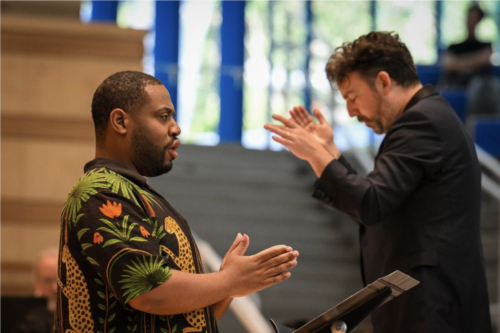
The Aspen Music Festival found an exciting way to celebrate the 250th anniversary of the United States Independence Day: the program on the first weekend explored choices from American symphonic music with exciting, if not the most familiar, pieces delivered by some of America’s best singers. Highlights included works by two of the most-performed opera composers of today – the first performance of a new song cycle by Jake Heggie, commissioned by the Festival, and a collection of scenes from John Adams’s first opera.
Sunday’s concert centered on Adams’s Nixon in China between a rollicking set of variations on ‘America’ by Charles Ives and a glorious performance of Aaron Copland’s Symphony No.3 (the one that is based on Fanfare for the Common Man). It was all terrific, but the Copland was outstanding. Festival music director Robert Spano had a definite idea of what he wanted the music to emphasize, creating long buildups to ecstatic climaxes. He got extraordinarily high-level playing from the Festival Orchestra, an ensemble consisting of section principals from notable orchestras and young musicians from around the world.
Appropriately for a piece inspired by a fanfare, the brass section was of special note. The principals – trumpet Anthony Lemoncelli (Cincinnati Symphony), trombone James Miller (Los Angeles Philharmonic) and horn Erik Ralske (Metropolitan Opera) – welded together a combination of expressive solos and rich sound. When the symphony arrived at the final movement, which began with the woodwinds playing the fanfare music in a soft legato, it made the hairs on the back of my head stand up, and when the brass took over, it could not have been more thrilling. Every gesture by timpanist Edward Stephan played in response to a phrase in the fanfare was so clear that it showcased how Copland had written a different combination each time of the same notes and rhythms.
It has been four decades since Nixon in China debuted at Houston Grand Opera (1987), almost four decades after Copland’s symphony (1946), and it is worth noting that both composers resisted the harsher dissonances and highly intellectual direction of the classical music of the times. Copland gave up his atonal style and Adams, who had adopted minimalism, backed off the repetitions of the minimalist style and developed a more varied musical palette. That mix perfumed these selections from the opera, as Adams sprinkled in Chinese music gestures, especially in percussion in the opening chorus sung by the Colorado-based chorus Kantorei.
The featured scenes focused on President Richard Nixon (sung by baritone Thomas Hampson) and Nixon’s wife Pat (star soprano Renée Fleming) during their 1972 visit to Beijing to open diplomatic relations with China. Hampson’s ‘News has a kind of mystery’ and Fleming’s ‘This is prophetic’ were especially rich in detail. Hampson and Fleming had just returned from a run of the opera in Paris so both music and characters were vivid.
The Ives Variations, in William Schuman’s colorfully expanded orchestration, opened the proceedings with a combination of definition and wry humor.
Heggie’s Earth 2.0 on Friday took a different approach from the great symphonic song cycles of the past which often focused on the vagaries of love or meditations on death – Mahler’s epic Das Lied von der Erde (Song of the Earth), for example, explores our relationship with nature (and each other) from our point of view. Heggie and librettist Anita Amirrezvani imagined a personified Earth’s response to the damage humans have recently inflicted on the planet. Over the course of its 40-odd minutes Heggie’s songs introduced us to Mother Earth through the otherworldly sound of countertenor Key’mon Murrah and distinctive orchestral manifestations of birds, their glorious range of colors and capacity to adapt. Murrah has been dazzling Aspen audiences since 2021 when he was the breakout star of the Aspen Opera Theater and VocalARTS. Last year, he appeared here as the Buddha in the world premiere of Christopher Theofanidis’s opera Siddhartha, She. He has an astonishing range, and Heggie’s music takes advantage of Murrah’s ability to sail high with beauty and agility.
A striking aspect are the jazz idioms incorporated into a classical frame with so much polish that it feels natural. In response to the opening of overlapping bird calls led by the flutes, the music for ‘The Message’ settled into a drowsy blues as Earth learns from the birds that they can no longer find places to land on their migrations. A muted trumpet solo introduced ‘The Artist’, a mini-tone poem to the beauty of skies and rainbows framed with jazz harmonies. Ragtime seemed to influence the third song, ‘The Admirer’, celebrating the physical dexterity of the animals, and the final phrases floated gorgeous high notes from Murrah.
In ‘The Upgrade’, another conversation with birds, Earth suggests that humans might have evolved like the birds who were once dinosaurs and no longer stomp all over the planet. Steady rhythm reflected a sort of optimism. Set to music reminiscent of a Tchaikovsky ballet, ‘Pas de Deux’ recalls how humans used to work in concert with the planet, but by the end of the song the tone turns to despair. In the final song, ‘The Cleanse’, after the climactic melody to the words ‘One day humans will be gone’, the music turned peaceful and quiet. The sound of a lone flute melded with Murrah’s sustained ‘Om’.
Heggie’s highly approachable style and talent for orchestration ended with a well-deserved standing ovation. Kudos to the various soloists, especially principal flute Mark Sparks, principal trumpet Stuart Stephenson and principal horn Andrew Bain, and to idiomatically comfortable conducting.
James Gaffigan’s carefully shaped phrases and vigorous tempos yielded a vivid performance of Beethoven’s Symphony No.7, especially in the third-movement Presto and the full-speed-ahead Allegro con brio. The Allegretto, with its steady tread, blossomed nicely. If the lilt that gave the symphony its nickname, ‘Apotheosis of the Dance’, didn’t quite bounce, the sense of abandon more than made up for it.
The first concert of the season on Wednesday featured pianist Joyce Yang, an Aspen regular. Robert Schumann’s Kreisleriana, her centerpiece, was brilliant in spots, especially in the meditative moments, but it lost details at other times. Much better were the two works by Brahms with Aspen faculty standouts. Yang and violist Victoria Chang caught the wistful tone in ‘Geistliches Wiegenlied’, and soprano Ana Maria Martínez sang with rich tone, especially in robust low notes worthy of a contralto.
Best of all was Brahms’s Piano Trio No.1 in which cellist Darrett Adkins was a marvel in this 35-minute gem, matching Yang’s pulse and melodic flair seamlessly and expanding beautifully when he had the lead. Violinist Kathleen Winkler, a faculty standard for years, took a movement or two to settle into it, but the last two movements came together brilliantly for all three of them.
Harvey Steiman
Featured Image: Baritone Thomas Hampson channels Nixon at Aspen Music Festival © Diego Redel
1.7.2026, Recital: Joyce Yang (piano), Ana María Martínez (soprano), Victoria Chiang (viola), Kathleen Winkler (violin), Darrett Adkins (cello). Harris Concert Hall
Brahms – Two Songs, Op.91; Piano Trio No.1 in B major, Op.8
R, Schumann – Kreisleriana, Op.16
3.7.2026: Key’mon Murrah (countertenor), Chamber Symphony / James Gaffigan (conductor). Klein Music Tent
Jake Heggie – Earth 2.0
Beethoven – Symphony No.7 in A major, Op.92
5.7.2026: Renée Fleming (soprano), Thomas Hampson (baritone), Kantorei (chorus director: Joel M. Rinsema), Festival Orchestra / Robert Spano (conductor). Klein Music Tent
Ives/Schuman – Variations on ‘America’
John Adams – Selections from Nixon in China
Copland – Symphony No.3