
 United States Szymanowski, King Roger: Soloists, Orchestra of Des Moines Metro Opera / David Neely (conductor). Blank Performing Arts Center Pote Theatre, Indianola, 4.7.2026. (ZC)
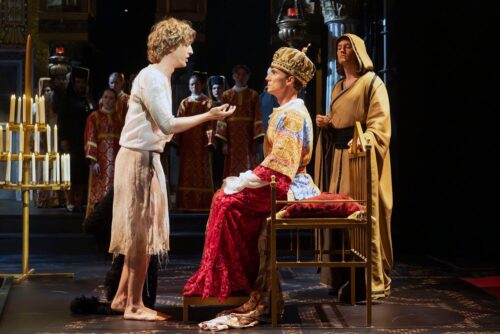
An immense censer hung motionless over the Iowa stage, illuminated by four standing candelabras and suspended above the pit orchestra. The scale of it was unsettling. For a long moment, these were the only visible objects but then, one by one, members of the chorus filed into the Pote Theatre, their stately procession lending the scene a ritual air. The Archbishop released the censer, and it swung ominously over the orchestra like a pendulum. The chorus launched the opening invocation, ‘Holy, holy!’ as King Roger and his wife, Roxana, entered. An altar rose silently and swiftly from beneath the stage, drawing the audience into a world of anxious mystery where certainty begins to lose its grip.
That sense of mystery lies at the heart of King Roger, Karol Szymanowski’s singular masterpiece. It is not a typical opera: premiered in Warsaw in 1926, it focuses on interior transformation rather than external conflict. The plot follows the medieval King Roger after he encounters a mysterious figure moving among his people like a prophet, preaching a gospel of sensuality and liberation. What follows is the king’s slow unraveling: he is horrified by the collapse of his own convictions yet tempted by the stranger’s offer.
Szymanowski refused to call this an opera, preferring ‘mysterium’, a word that hints at its ambiguous nature. The piece lacks a tragic center or moral reckoning: there is no death, no betrayal in the conventional sense, no catastrophe that forces a resolution. Instead, Roger encounters an alternative way of being and finds his certainties crumbling. The work is not only about desire and faith, structure and impulse, it raises the unsettling possibility that the systems we build to protect ourselves may also imprison us. This ‘mysterium’ does not explain its revelation, it simply presents it. Much depends on what an audience brings to it and on how each viewer answers the questions Szymanowski leaves unresolved.
This year marks the centennial of the opera’s premiere. Yet productions remain rare: there are only two confirmed stagings this year, one in Poland and the other here in Indianola, Iowa, at Des Moines Metro Opera (DMMO) in a new production that opened 4 July. The rarity is striking. Still, King Roger has begun, slowly, to appear on more stages. The Des Moines production, directed by Chas Rader-Shieber with sets by Jimmy Stubbs and costumes by Robert Perdziola, shows why the work deserves wider circulation.
DMMO’s production does not try to clarify or rationalize Szymanowski’s vision and makes no attempt to impose a psychological framework or a directorial conceit to explain what the opera ‘really means’. Instead, the production trusts ambiguity and leans into it; it allows the work to retain its essential mystery while giving it vivid visual form. The strategy unfolds across three acts, each distinct in approach. Act I takes place in a lavish, Byzantine-like church, complete with altar, censer and costumes in rich reds and golds. Roger appears as the embodiment of order: robed, formal, secure in his authority. His disturber of the peace, the Shepherd, is clad simply yet with undeniable seduction. Act II abandons the ornate spectacle of divine and stately authority for a more austere stage: a few pieces of furniture, a throne, scaffolding, a wall crumbling at the edges and a gate. The Shepherd reappears in a jeweled cassock, a figure of sensuous transgression. By Act III, nearly everything has been stripped away. Rain falls and only the broken remains of Roger’s throne are left, illuminated at the end by the rise of a new authority.
The progression mirrors Roger’s inner transformation, from structured certainty toward something still undefined, something approaching dissolution. It is a visual argument about loss and possibility, made without explanation or sentiment, and the audience is left to complete the meaning.
But visual strategy alone cannot accomplish this. The transformation must be felt. It must emerge through the shifts of tone and presence that only a skilled cast can provide, and the singers met those demands with sophistication. Alexander Birch Elliott’s Roger was commanding and full-voiced. His baritone had presence, but he allowed it to soften in moments of doubt. Christopher Sokolowski as the Shepherd had a sensuous tenor – smooth, beguiling and inflected with subversive knowledge. The role requires an almost feminine allure, a seductive quality that draws others toward dissolution. Sokolowski seemed to understand that instinctively and moved through the opera with grace, his voice a constant temptation. Lydia Katarina’s Roxana radiated inner turmoil but, alas, the decision to stage much of her famous Act II aria offstage robbed the moment of some of its force. Lucas van Lierop’s Edrisi served as the opera’s voice of reason, his tenor steady and encouraging to the crumbling king. The chorus, prepared by Lisa Hasson, was essential: its mass both clarified and complicated the drama, and the addition of a children’s choir gave the work an added dimension of innocence and loss.
In the pit, David Neely conducted a shapely, colorful account of the score. Szymanowski’s orchestration is luscious, drawing on Debussy and Ravel while maintaining its own modal language. The sound Neely drew from the orchestra tracked Roger’s psychological journey, moving from the grandiose toward something more fragmented and uncertain.
What emerges from this production is neither clear explanation nor neat resolution. Instead, Des Moines Metro Opera offers Szymanowski’s vision intact: a work about a leader whose certainties dissolve, surrounded by an audience left to puzzle over the world that emerges.
Zach Carstensen
Featured Image: DMMO’s production of Szymanowski’s King Roger © Cory Weaver
Production:
Director – Chas Rader-Shieber
Sets – Jimmy Stubbs
Costumes – Robert Perdziola
Choreographer – Isaac Martin Lerner
Chorus director – Lisa Hasson
Cast:
King Roger II – Alexander Birch Elliott
Roxana – Lydia Katarina
Shepherd – Christopher Sokolowski
Edrisi – Lucas van Lierop
Archbishop – Ben Strong
Deaconess – Margaret Macaira Shannon