
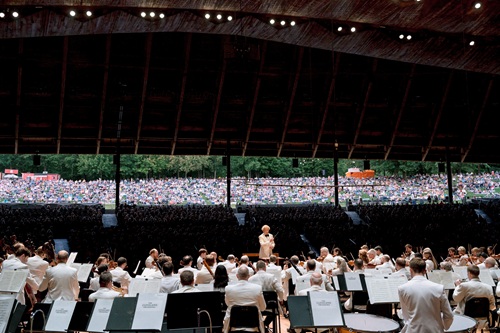
 United States Blossom Music Festival [8] – ‘Summer in Vienna’: Cleveland Orchestra / Franz Welser-Möst (conductor). Blossom Music Center, Cuyahoga Falls, 29.8.2026. (MSJ)
Richard Strauss – Introduction and Finale to Daphne
Mozart – Symphony No.34 in C major, K.338
Johann Strauss, Jr. – Overture and Ballet Music from The Carnival of Rome; Entr’acte from A Night in Venice; Bauern-Polka; Quadrille from The Gypsy Baron
Josef Strauss – Friedenspalmer Walzer
After a stormy summer in northeast Ohio, the weather finally relented for this concert where the only brief thundershower was the one that passes through the Introduction to Richard Strauss’s Daphne. It was the opening work in a lovely evening of Viennese pieces, given as music director Franz Welser-Möst’s farewell to the Blossom Music Festival. He will depart Cleveland at the end of May, having directed the orchestra for twenty-five seasons.
In welcoming Welser-Möst to the stage, the audience attempted to give a standing ovation to the beloved music director, but he was not about to let the event turn into an indulgent affair and turned quickly to the orchestra to get the first piece underway. The Introduction and Finale of Richard Strauss’s escapist 1938 opera Daphne aren’t often heard as instrumental excerpts, but Welser-Möst made a very strong case for the ecstatically pastoral music which ran almost twenty-five minutes in performance. Led by Frank Rosenwein’s unfurling oboe solos, the music proved organically transformative, mirroring Daphne’s magical change by the end of the opera into a tree free of human concerns and tragedies. Welser-Möst was in his element, patiently unfolding this lush music while preventing it from sagging under its own weight. Abetted by additional solos from concertmaster Joel Link, the performance glowed.
Delightfully energetic and brisk, Mozart’s Symphony No.34 came as a bracing contrast. Less familiar than the composer’s most famous symphonies, it nonetheless rivals them in quality, lacking only a nickname for marketing purposes. Welser-Möst kept the outer movements brisk and freshly articulated but characteristically savored the quieter moments, particularly the delicious slow movement which unfolded like an enchantment.
The second half of the concert was devoted to the quintessential Viennese music of Johann Strauss, Jr., and his brother Josef. Welser-Möst’s selection was of less-familiar works, giving him the chance to demonstrate the depth of quality in the Strauss family catalogue. This music demands a light touch and the theatrical flair to snap the closing pages of the works, and Welser-Möst gave the orchestra enough rein to have enormous fun, including some cheerful sing-along passages in the Bauern-Polka. It is worth pointing out that with this kind of music it is just as important to keep an orchestra in top shape as with epic symphonies and modern music. One of Welser-Möst’s smartest choices over the years has been programming the kind of fare that all-too-often gets sloughed off to ‘pops’ concerts: Suppé overtures, suites and dances.
The conductor continued to derail any attempts at grand tributes during the extended curtain call at the end of concert, with the huge Blossom audience cheering. At one point it looked like the orchestra might do a rare refusal to stand, in deference to the conductor, but Welser-Möst would have none of it. He grabbed concertmaster Joel Link’s hand and all but yanked him out of his chair to make him and the orchestra stand. That didn’t prevent the audience from calling Welser-Möst back for numerous curtain calls until the reserved conductor thanked them with hand on heart, a rare public gesture for him.
Mark Sebastian Jordan