
 United Kingdom Day Three of the Presteigne Festival 2026 [3]: (PC)
2pm – ‘Prokofiev Premieres’: Fenella Humphreys (violin) and Jâms Coleman (piano). St Andrew’s Church, Presteigne, 29.8.2026
Ninfea Cruttwell-Reade – Bewegt
Prokofiev – Five Melodies, Op.35b
Electra Perivolaris, Claire Victoria Roberts, Mathilde Wantenaar, Lynne Plowman, Cheryl Frances-Hoad – Five Melodies (world premiere)
Amy Beach – Romance, Op.23
Sally Beamish – Tracing
Lili Boulanger – Nocturne and Cortège
The Presteigne Festival’s third day illustrated the sheer variety of music this event has to offer. New and recent music was at the forefront of well-balanced and satisfying programmes.
An early afternoon recital at St Andrew’s Church, Presteigne featured an enterprising selection of repertory for violin and piano. It began in playful mood with Ninfea Cruttwell-Reade’s Bewegt, which was commissioned by, and premiered at, the festival in 2022. The work offers a droll sequence of different interpretations of the performance direction of the title, which roughly translates as ‘in a lively, animated manner’. In the course of its expressive explorations, the piece was, by turns, arresting, sparkling, sonorous, attacking, sprightly, lithe, jazzy and striding. The calmly insouciant ending was the last of a series of unforeseen strokes. Fenella Humphreys and Jâms Coleman showed keen sensitivity to every shift in mood, not least in the latter’s rendering of the term ‘lumbering’ in one keyboard passage in the score.
There followed an eloquent, sharply characterised account of Prokofiev’s Five Melodies, Op.35a (1925). Originally conceived as a set of five wordless songs, these colourful miniatures retain the lyricism and vibrancy of their original guise, while the composer’s adoption of harmonics, pizzicatos and double stopping shows a thoroughly idiomatic approach to the violin. They received a beautifully moulded and crisply characterised interpretation.
Then came a festival commission entitled Five Melodies after Prokofiev and consisting of a quintet of new works that each followed the outline of one of the Prokofiev miniatures the audience had just heard. The resulting piece was valuable in giving a flavour of the five featured composers’ distinctive creative voices. Electra Perivolaris’s reimagining of the opening Andante heightened the restrained emotions of Prokofiev’s original, resulting in an unsettled, shifting miniature with a broad dynamic sweep that subtly suggested a narrative to be continued, without being in any way insubstantial or incomplete in itself. The Lento ma non troppo by Claire Victoria Roberts started in striking manner with a steely strumming sequence for violin over deadened, subterranean, heavily accented figures pulsating at the keyboard’s lowest register. Folklike material was followed by darker elements before a varied return of the initial material and warmly expressive violin phrases brought the piece to a gentle close. Mathilde Wantenaar’s Variation on a melody by Prokofiev explored the restless, stormy nature of the original Animato, ma non allegro, with impassioned, declamatory waves of melody leading eventually to a mysterious and dreamy, open-ended conclusion. Lynne Plowman’s airily playful Dancing with Prokofiev preserved and celebrated the Allegretto leggero e scherzando prototype’s melodic simplicity and easy charm in tripping pizzicatos and flowing triplets, while Cheryl Frances-Hoad’s Andante non troppo brought the set to a gratifying close with a fluently lyrical miniature that tapped into the nostalgic wistfulness of Prokofiev’s original.
Amy Beach’s lyrical Romance, for violin and piano (1893) received a vividly expressive performance, elevated by the subtle interplay between the two instruments. The music built to a sustained expressive peak before fading away on a delicate, arpeggiated piano chord.
Full of half-lights, faded memories and vague depictions of the subjects of a lost painting, Sally Beamish’s Tracing, for violin and piano (2025) was enigmatic, deft and full of heart. It started with a hesitant and impulsive movement of childlike simplicity, followed by a sturdy passacaglia and ended with a fleeting image of clouds flitting across a moon of uncertain hue. In a nuanced and searching reading, the players embraced wholeheartedly its passing visions and shadowy uncertainty.
The recital closed with a polished account of Lili Boulanger’s Nocturne and Cortège (1911, 1914) that inhabited the stillness of the opening nightscape and ended with the high spirits of a jubilant parade. These two gem-like miniatures topped off a programme of impressive range and contrast, impeccably executed.
4.30pm – ‘Grasses, Bacewicz and Beethoven’: HearAndNow Collective, Amsterdam. Church of St Mary Magdalene, Bleddfa
Grazyna Bacewicz – String Quartet No.3
Robert Peate – String Quartet in E, ‘Grasses’ (Welsh premiere)
Beethoven – String Quartet in F, Op.18, No.1
An attractive late afternoon concert in the parish church of the village of Bleddfa comprised three disparate and substantial string quartets. The Third String Quartet of 1947 by the 20th-century Polish composer Grazyna Bacewicz is a closely argued, self-assured work of energy and substance. In their committed reading, the HearAndNow Collective players captured the outer movements’ taut urgency and rhythmic drive and the central Andante’s refinement and subtlety.
At the heart of the concert was the Welsh premiere of Robert Peate’s String Quartet in E, ‘Grasses’ (2025), which was jointly commissioned by the Presteigne and Romsey Chamber Music Festivals. Inspired by a selection of Charles MacCarthy’s paintings, whose name gives the quartet its subtitle, this attractive and engaging piece contrasted passages of knotty intricacy with music of a more expansive, rustic warmth. The single-movement form began with an expository Prelude, whose opening bars with their key cello phrases provided material for the rest of the work. This was followed by two scherzo-like Dances, the first shadowy, with ecstatic outbursts and the second a traditional Welsh jig (‘The Druid’). The work concluded with a brooding, synoptic Postlude. The musicians relished the work’s various moods, probing and ethereal in the outer sections and hearty and vigorous in the dances, really letting rip in the infectious energy of the jig. This compact and vivid piece was warmly received by a capacity audience.
The programme ended with an authoritative rendering of Beethoven’s String Quartet in F, Op.18, No.1. The players found elegance and directness of expression in the opening movement, giving due dramatic weight to the rests which punctuate the first subject. There was refinement and melancholy in the spacious slow movement, as well as anguish in its closing pages. The coolly restrained Scherzo with its droll, skipping Trio section and the spirited and spacious finale also made their mark in a rounded interpretation that offered depth of feeling as well as high spirits.
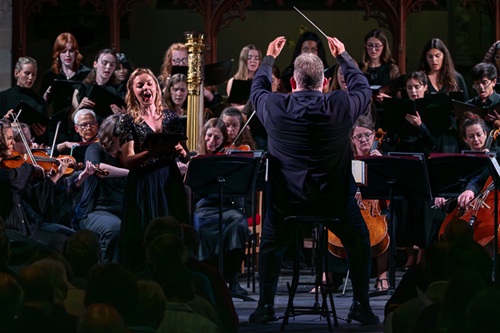
7.30pm – ‘The Dancers’: James Gilchrist (tenor), Rowan Pierce (soprano), Ben Goldscheider (horn), Choir of King’s College, London, Presteigne Festival Orchestra, George Vass (conductor). St Andrew’s Church, Presteigne
Adrian Williams – Concerto for string orchestra
Cameron Biles-Liddell – Erlid (A Chase), for chamber orchestra (world premiere)
Grace Williams – The Dancers
Michael Zev Gordon – The Gleam of Hidden Skies
Cecilia McDowall – Bird of Time
The evening concert of 29 August offered a colourful programme of works, tinged with wistfulness and touched by fantasy, daydreaming and illusion. The Concerto for string orchestra (2019) by Adrian Williams was bright and sinewy, driven by bold, sonorous lines and studded with solo passages. Subtle fluctuations in tempo within the concise, single-movement structure were deftly achieved in a performance of great sweep and attention to detail.
Grace Williams’s The Dancers, for soprano solo, upper-voice chorus, strings and harp (1951) is a haunting piece that inventively sets texts by H. D. (Hilda Doolittle, from Songs from Cyprus), Hilaire Belloc, Thomas Chatterton, May Sarton and Kathleen Raine. The dreamy serenity of the opening movement, ‘Gather for festival’ with its hypnotic falling and rising phrases cast a potent spell, aided by soprano Rowan Pierece’s flexible, beguiling delivery of the solo line and the players’ fluent delivery of the high, trill-strewn string lines. Choir and orchestra made light work of the nostalgic ‘Tarantella’, with its lively beginning and ear-catching slackening of tempo in the closing section. Soprano and chorus were solemnly expressive in the atmospheric central ‘Roundelay’, softly accompanied by doleful, threnody-like, pulsing strings. The poignant ‘Lose the Pain in the Snow’, for chorus and strings, built to a stirring climax before ebbing away to silence in the eloquent closing bars. The final setting of ‘To the Wild Hills’ was graced with a yearningly melancholic theme and the final fading to stillness was affectingly done. This beautiful performance of Grace Williams’s unaccountably neglected choral suite provided a captivating and enduring musical experience.
A festival commission, Cameron Biles-Liddell’s Erlid, for a chamber orchestra (2026) consisted of solo oboe, modest percussion, harp and strings. The title can be vaguely translated as ‘to pursue’ or ‘to chase’ and the work was influenced by the Welsh folk tale of Ceridwen and Gwion. In a frenziedly dynamic musical narrative, a nimble solo oboe line representing a young servant boy, Gwion, was set against a baleful chamber orchestra personifying the vengeful witch, Ceridwen, tracking the boy down. Tension increased as the tale unfolded and the piece ended dramatically with an eleventh hour gesture in the form of a tense, bravura oboe cadenza. Soloist Katie Bennington brought the main protagonist to life. Initially playful and then increasingly fearful, she delivered her virtuosic solo passage with dramatic intensity, while the orchestra gave inexorably rhythmic pursuit. An exhilarating, hectic depiction of a remorseless chase, Erlid closed the concert’s first half in thrilling style.
James Gildchrist and Ben Goldscheider joined the orchestra after the interval for an absorbing performance of Michael Zev Gordon’s The Gleam of Hidden Skies (2013), a setting for tenor, horn and strings of texts by Byron, Larkin, Blake, Isaac Rosenberg and e. e. cummings. Written for the same forces as Britten’s Serenade, it takes the night imagery and dark hues of that seminal piece as a starting point for an uneasy exploration of fluctuating moods and descents into darkness. The composer’s dramatic vocal treatments were constantly alert to the changing mood of the words, with the horn lines sometimes veiled and at other times, stately. The two soloists, sensitively supported by orchestra and conductor, conveyed the character of each setting running the expressive gamut from impassioned ferocity to calm stillness. Despite all this virtuosity, the overriding impression of this thoughtful work was one of simplicity and direct communication.
Rowan Pierce then rejoined chorus and orchestra for the final item on the programme, the premiere performance of a new version of Cecilia McDowall’s 2025 cantata Bird of Time, specially prepared by the composer, for solo soprano, upper-voice chorus and a chamber orchestra consisting of an obligato oboe, harp, percussion and strings. The musicians gave a polished and enticing reading of the score, conveying the poise and fluency of the opening setting of Sarojini Naidu’s poem ‘The Bird of Time’. The central ‘Aubade’ featured an intensely eloquent treatment of a poem by Seán Street that paints a bleak picture of a dwindling avian population. The striking closing moments in which the chorus was reduced to dying whispers were profoundly effective in this rendering. In a complete change of mood, the bright and energetic last movement sets Seán Street’s ‘To be a bird’. The final verse’s affirmation of human inferiority with the withering rebuke, ‘You aspire to be bird? Oh my word – it’s absurd!’ was potently delivered.
Day Four of the Presteigne Festival 2026 [4]: Priory Church, Leominster; St Andrew’s Church, Presteigne 30.8.2026 (PC)
4.30pm: Choir of King’s College, London, Sally Pryce (harp), Patrick Allies (conductor). Priory Church, Leominster
Imogen Holst – Welcome Joy and Welcome Sorrow
Daniel Soley – Kintsugi (You Will Get Through Today) (world premiere)
Elizabeth Poston – An English Day-Book
Judith Weir – We sekyn here rest
Olivia Sparkhall – Lux Aeterna
Gustav Holst – Two Eastern Pictures, H112
On the Presteigne Festival’s fourth day, a late-afternoon recital for upper voices and harp in the inspiring setting of Leominster Priory was especially laudable in its adventurous choice of music.
Imogen Holst’s Welcome Joy and Welcome Sorrow (1951) featured six characterful songs to texts by John Keats. The opening setting of a poem that lends the overall work its title was vibrantly given. The smoothly phrased ‘Teignmouth’ included swelling, thrumming harp tremolos at the mention of ‘bee’ and ‘wasp’ and in the pointed closing bars, the words ‘as the spike end’ struck home sharply. Brief and folksong-like, ‘Over the Hill and over the Dale’ had an irresistible, tripping liveliness. The most searching song in the set, ‘O Sorrow’ was thoughtful and spacious and the gently lilting ‘Lullaby’ was handled with a lightness of touch that extended to the lucid closing setting of ‘Shed no Tear’, enhanced by Sally Pryce’s graceful accompaniment.
Next came a festival commission. Daniel Soley’s Kintsugi (You Will Get Through Today) was a sensitive and deeply considered setting of Erica Hesketh’s Kintsugi. This empathetic recent poem for new mothers uses the language of nature to describe their experiences. It also invokes in its title and text the Japanese art of mending broken objects as part of a philosophy that regards fracture and restoration as part of an object’s ongoing narrative rather than something to be concealed. The musical treatment took its cue from the natural rhythm and structure of the poem’s devotional, incantatory repeated verse openings and refrain. In an inventive and effective approach to scene-setting, the first two verses formed an evocative introduction in which vocalists inhaled, exhaled and freely recited the text, while wooden honey spoons lodged between the harp strings were, by turns, beaten and flicked. The main section was more conventional in its approach, though this did not preclude such imaginative touches as the variously florid harp statements between verses and the halting, gapped delivery of the hushed final statement of the refrain ‘you will get through today’.
Elizabeth Poston’s An English Day-Book (1967) sets various 16th, 17th and 18th century sacred and secular verse in a fluent sequence that captures different aspects of an English day in late Spring. The diverse sequence of songs in this cycle drew imaginative responses from the performers, ranging from the unaccompanied, chant-like unison declamation of Sir Thomas Browne’s ‘Te lucis ante terminum’ (‘Before the ending of the day’) to chattering bird calls in Thomas Nashe’s ‘Running Set: Spring’. The simple, a cappella rendering of ‘Evening Song (The Priest’s Chant)’, with its solemnly tolling and chiming harp postlude, was particularly affecting.
Three shorter works rounded off the recital. In Judith Weir’s We sekyn here rest (2020), a setting of part of the Revelations of Divine Love by the 14th-century mystic, Dame Julian of Norwich, the challenges of the text’s middle-English pronunciation were deftly overcome. Underpinned by resonant harp chords, the fervent performance seemed to take on renewed energy for the closing section’s vigorous counterpoint.
Olivia Sparkhall’s hushed and numinous Lux Aeterna (2018) reimagined in a contemporary context the sounds of Dame Julian of Norwich’s own time. The score required members of the choir to be separated from the other singers, standing behind them, further away from the audience, an arrangement which created opportunities for atmospheric, antiphonal singing. A strikingly versatile harp accompaniment took in shimmering tremolos, chiming harmonics and liquid glissandos.
To close their enterprising programme, the Choir of King’s College, London and conductor Patrick Allies, together with harpist Sally Price performed Gustav Holst’s Two Eastern Pictures, (1911). ‘Spring’ was fresh and flowing, while ‘Summer’ cast a potent spell, with wordless episodes, accompanied by gentle harp rhythms, effectively juxtaposed with sonorous, unaccompanied passages.
7.30pm: HearAndNow Collective, Amsterdam, Clare Hammond (piano). St Andrew’s Church, Presteigne
Michael Zev Gordon – Three Short Pieces for string quartet
Ninfea Cruttwell-Reade – How Clear, How Lovely Bright
Mathilde Wantenaar – Movement for String Quartet
Ravel – String Quartet in F
A chamber music concert held on the evening of the festival’s fourth day offered a chance to experience three scores from the 21st century and one of most frequently played and recorded pieces in the repertoire.
In Michael Zev Gordon’s Three Short Pieces for string quartet (2006), the players brought great energy and precision to the emphatic, heavily accented opening piece. Near the close of the airy central piece, gentle, shuddering figures on low strings ushered in the expansive, hushed final piece that featured a numbed and daringly broadly conceived quotation from J. S. Bach’s Second English Suite and increasingly etiolated closing bars, in which the first violin’s glacial descent almost imperceptibly trailed off into silence. This was a poetic, reactive reading of music written from the heart.
Clare Hammond joined the HearAndNow Collective for the Welsh premiere of Ninfea Cruttwell-Reade’s How clear, how lovely bright, for piano quintet (2026). This elusive, intriguing, single-movement work takes its title from a posthumously published poem by A. E. Houseman and was conceived as a wordless setting of Housman’s three short stanzas. The poem, which can be regarded as an elegy on the passing of time, begins in a mood of hope and possibility, but ends in a lament for unfulfilled potential. The new piano quintet followed closely the narrative arc of the Housman verses. Hence, the music transformed from a withdrawn, glazed quietude to buoyant positivity and yet ultimately, via a gradual darkening of sonorities, descended to a coldly dispirited close. All five players showed great commitment and imagination, capturing the brooding radiance of much of the opening section, conveying the central section’s abrupt swings of mood from loftiness to vitality and then to rapture and maintaining the final section’s stygian gloom right up to the final bars’ receding vision.
Mathilde Wantenaar’s Movement for string quartet, which was premiered in 2022, offered a relaxed sequence of melodies. The work’s principal theme was stated at the outset and recurred in various guises interspersed with other tuneful ideas, lending the piece the form of a loose rondo. The musicians caught the music’s essentially lyrical and carefree character, investing the material with an open-air breeziness.
After the interval, there was just one work: Ravel’s String Quartet of 1903. The players’ assured account commanded attention, from the opening movement’s warmly soaring violin lines to the scherzo’s crisply articulated dancing, folk-like rhythms, the shadowy slow movement’s spontaneous-sounding, fluctuating tensions and the finale’s crackling nervous energy. This fiery, exuberant traversal of a key work of French Impressionism was the crowning glory of a searching and varied recital, splendidly performed.
Paul Conway