
 Germany Landshut Chamber Music Festival 2026: Chamber Soloists, Rathausprunksaal, Landshut, Lower Bavaria, 25-30.8.2026. (MC)
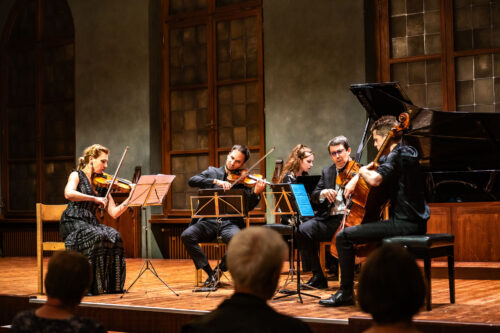
29.8.2026 – Concert Four
Beethoven – Sonata No.10 for Violin and Piano in G major, Op. 96 (1812)
Rebecca Clarke – Piano Trio (1921)
Elgar – Piano Quintet in A minor, Op.84 (1919)
This mouthwatering concert paired Beethoven’s Violin Sonata No.10 with two English works from the early 20th century, composed just two years apart.
In 1812 Beethoven dedicated his tenth and final violin sonata to Archduke Rudolf. In G major this lyrical and attractive four movement score is widely considered his crowning glory in the genre. Violinist Mikhail Pochekin and pianist Eldar Nebolsin took to the stage to perform a work they undoubtedly knew well.
Marked Allegro moderato the opening movement had a blustery yet good-natured character without becoming overly earnest. In the slow movement, Pochekin’s beautifully controlled playing created an air of melancholy, underpinned by a persistent sense of longing. The Scherzo evoked the exuberance of summer, its high spirits never turning too frantic. In the hugely appealing Finale – Allegretto, the players created a mood of contentment, enlivened by a more celebratory central section. Irresistibly, the final pages assumed the character of a fiery folk dance.
Rebecca Clarke initially attended the London’s Royal Academy of Music transferring to study composition at the Royal College of Music as a pupil of Sir Charles Stanford. A professional violist she played with orchestras and several chamber music ensembles. Close on the heels of her successful Viola Sonata (1919) Clarke followed up with a Piano Trio both prize winners in Elizabeth Sprague Coolidge’s Chamber Music competitions.
Scored for piano, violin and cello, the Clarke trio is an inspired, deeply expressive gem that draws the listener in. Providing a well-judged and responsive account Eldar Nebolsin, Luis Suarez and Simon Tetzlaff clearly shared a strong admiration for a score that deserves far wider recognition. The Andante molto semplice stood out for its heartfelt sincerity and passionate intensity, deepened by using muted strings. As the players in the Finale. Allegro vigoroso drove the passion ever higher the music reached an intensity that was almost too hard to bear.
In three movements Elgar scored his piano quintet for two violins, viola, cello and piano. Written in 1918-19, the score emerged from the long, dark shadow cast by the First World War. It is likely that Elgar’s writing was inspired by the beautiful hilly countryside around his cottage at Brinkwells, West Sussex. Performing the quintet were Diana Tishchenko, Luis Suarez, Jano Lisboa, Simon Tetzlaff and Martina Consonni.
As usual, I found the opening movement somewhat mysterious and unsettling, veering between squalls and sudden calm, with tantalising suggestions of a waltz and march played by a salon dance band. In the Adagio, the players provided tenderness and genial warmth over the ardent passion of Elgar’s love music. Marked Andante – Allegro, the finale found the performers entirely at ease with Elgar’s rich and expansive generosity. With controlled passion the players brought the concert to a glowing and triumphant close.
With playing beyond reproach this was a chamber concert deserving high praise.
Mikhail Pochekin (violin), Luis Suarez (violin), Diana Tishchenko (violin), WenXiao Zheng (viola), Jano Lisboa (viola), Simon Tetzlaff (cello), Eldar Nebolsin (piano), Martina Consonni (piano)
30.8. (matinée) – Concert Five – Im Geiste der Oper (In the Spirit of Opera)Mozart – Duo for violin and viola in B flat major, K.424
Paganini – Introduction and Variations on aria Di tanti palpiti for violin and piano (based on the aria Di tanti palpiti, di tante pene from the 1813 opera Tancredi by Rossini)
Liszt – Rigoletto Paraphrase for solo piano, S434 (1859) (based on the act four vocal quartet Bella figlia dell’amore (Beautiful daughter of love) between Rigoletto, Gilda, the Duke and Maddalena from Verdi’s opera Rigoletto)
Guillaume Connesson – Disco Toccata for clarinet and cello (2002)
Svante Henryson – Off Pist for clarinet and cello (1996)
Gluck – Melody – Dance of the Blessed Spirits for clarinet and piano from act 2 of opera Orfeo ed Euridice (1762)
Debussy – Beau soir (mélodie arranged for clarinet and piano)
Bizet – Carmen Fantasy based on themes from opera Carmen arranged by Nicolas Baldeyrou for clarinet and piano (1875).
A lunchtime concert, the fifth in the series was titled Im Geiste der Oper (In the Spirit of Opera). After opening with a performance of Mozart’s Duo in B-flat major, K.424, the programme featured four arrangements of operatic music by Rossini, Verdi, Gluck and Bizet. These paraphrases recast familiar arias for performance beyond the opera house, particularly in concert halls and private salons. The form was popularised in the 19th century by virtuoso composer-performers such as Franz Liszt and Niccolò Paganini. In a programme that comprised eight works clarinettist Pablo Barragán featured in five of them.
The concert opened with Mozart’s Duo for violin and viola in B flat major, K.424. Mozart’s friend Michael Haydn fell ill after completing only four of the six duos for violin and viola that Archbishop Colloredo had commissioned. To assist Haydn in an act of generosity Mozart wrote the final two Duos: the G major, K.423, and the B-flat major, K.424. Stepping onto the stage were Yuki Serino and WenXiao Zheng who made an outstanding partnership. In the opening movement Adagio – Allegro it felt as if the violin and viola were engaged in an enthusiastic yet cordial dialogue. Standing out in the middle movement Andante was the ravishing cantabile love theme. Conspicuous was the splendid intonation from both violin and viola.
Italian virtuoso violinist Niccolo Paganini adapted for violin and piano the melody from Tancredi’s cavatina Di tanti palpiti, di tante pene (After such beating of the heart, such torment) a trouser role from Rossini’s grand opera Tancredi. Looking so assured Ivan Pochekin displayed a range of steadfast virtuosity whilst well matched partner Martina Consonni provided sensitive and elegant accompaniment on her Steinway Grand.
Next, we heard Martina Consonni play the Liszt Rigoletto Paraphrase for solo piano, S434. From Verdi’s opera Rigoletto it is based on the third-act vocal quartet Bella figlia dell’amore (Beautiful daughter of love) between Rigoletto, Gilda, the Duke and Maddalena. This was a special performance by pianist Consonni who excelled in this glittering yet challenging virtuoso work.
In the first of five works it was clarinettist Pablo Barragán’s time to shine. Barragán with Simon Tetzleff introduced what was a new work to me Guillaume Connesson’s Disco Toccata for clarinet and cello from 2002. A very short work Disco Toccata has rapid changes of meter and, as one might expect, was played with fast-moving excitement. Barragán and Tetzleff turned to Off Pist for clarinet and cello written by Svante Henryson in 1996. A short work influenced by Henryson’s passion for off-piste skiing, Barragán dispatched the fiendishly difficult clarinet part with real aplomb.
Hard to beat is the beautiful mélodie (Dance of the Blessed Spirits) from Gluck’s opera Orfeo ed Euridice. For this haunting melody Barragán now joined by Martina Consonni made a fruitful alliance. Debussy’s French art song Beau soir (Beautiful Evening) is a favourite work of mine. It is no surprise that such a beautiful mélodie has attracted several arrangements. Without doubt in the hands of Barragán and Consonni this delightful arrangement for clarinet and piano worked so well. Rich in memorable melodies, Bizet’s celebrated French opera Carmen inspired the Spanish violin virtuoso Pablo de Sarasate to create his own Carmen Fantasy, arranging themes from the opera for violin and piano. French clarinettist Nicolas Baldeyrou then adapted Sarasate’s work for clarinet and piano. Here the talented duo Barragán and Consonni captured both its sultry passion and the sunny, colourful atmosphere of Seville.
This concert was the lightest of the Landshut chamber series but no worse for that. The appeal of such melody laden works plus the excellence of the performers resulted in a truly engaging concert.
Ivan Pochekin (violin), Yuki Serino (violin), WenXiao Zheng (viola), Simon Tetzleff (cello), Martina Consonni (piano), Pablo Barragán (clarinet)
30.8. (evening) – Concert Six
Haydn – Piano Trio No.43 in C major, Hob XV:27 (pub. 1797)
Mozart – Horn Quintet in E-flat major, K. 407 (1782)
Schubert – Octet in F major, D. 803 (1824)
Closing the chamber music festival was the sixth concert comprising a work each by Viennese master composers Haydn, Mozart and Schubert. The standard of performance at this Landshut Festival was so excellent the prospect of hearing the final concert of the series was irresistible.
Opening the programme was Schubert’s much-admired Octet, which took just over an hour to perform here, is scored for clarinet, horn, bassoon, two violins, viola, cello and double bass. With its important clarinet part this six-movement score was it seems written in 1824, a commission from Count Ferdinand von Troyer an amateur clarinettist and official at the court of Archduke Rudolf. Evidently Troyer stipulated that the score should be modelled on Beethoven’s 1799 Septet, Op.20 then highly popular in Vienna.
The Octet is a sun-lit work that I have heard in performance on several occasions, and I admit once or twice the work has outstayed its welcome. Not the case here as the performance from Pablo Barragán, Pablo Neva Collazo, Esteban Wiart, Ivan Pochekin, Yuki Serino, WenXiao Zheng, Yuya Okamoto and Omar Bishara was both magnificent and compelling.
This assuredly unified playing didn’t come at the expense of exhibiting character which set it apart from previous accounts I have heard. Such an engagingly exuberant performance with an irresistible appeal the audience responded enthusiastically, with many on their feet, applauding. As a change from the printed programme the Octet was played to open the concert and not to close it. With its jubilant ending the work would surely have benefited from concluding both the concert and the series.
After the interval the concert resumed with Joseph Haydn’s Piano Trio No.43 in C major, written in 1797. It was refreshing to hear a Haydn trio other than the familiar No.39 in G major, the Gypsy Rondo Trio. The C major work is notable for its demanding piano part and, for its time, the unusually equal roles assigned to the three instruments.
Martina Consonni (piano), Yuki Serino (violin) and Simon Tetzlaff (cello) undoubtedly relished the C major Trio, playing with all the freshness of a new discovery. Their engaging performance was technically beyond reproach and artistically pristine.
A work I seldom encounter in concert, Mozart’s Horn Quintet in E-flat major from 1782 was especially rewarding to hear. Composed around the time of his opera Die Entführung aus dem Serail, Mozart wrote the three-movement score for his close friend the renowned horn player Joseph Leutgeb.
Horn player Pablo Neva Collazo performed the E-flat major Quintet with Mikhail Pochekin (violin), WenXiao Zheng (viola), Ruby Shirres (viola) and Yuya Okamoto (cello). As usual, my ears took a little time to adjust to the horn’s distinctive timbre, but once they did, I could fully appreciate this glorious work. The lyrical Andante made a particular impression through its tender sense of longing, and I savoured the refined, ever-shifting interplay among the instruments. In this sunlit, summery music, Collazo’s instrument produced a warm, often mellow tone.
Throughout this series of six chamber concerts, I admit being bowled over by the exceptional collective talent of the nineteen performers. The consistently elevated standard of playing and the choice of easily accessible works could hardly have failed to delight.
A debt of gratitude is owed to the Landshut Festival’s co-founders, Peter Haarpaintner, president of the Landshut Friends of Music, and artistic director Mikhail Pochekin, for their sterling organisational work.
Mikhail Pochekin (violin), Ivan Pochekin (violin), Yuki Serino (violin), Jano Lisboa (viola), WenXiao Zheng (viola), Ruby Shirres (viola), Simon Tetzlaff (cello), Yuya Okamoto (cello), Pablo Barragán (clarinet), Pablo Neva Collazo (horn), Esteban Wiart (bassoon), Omar Bishara (double bass), Martina Consonni (piano)
Michael Cookson