 United States Various – ‘United in Sound: America at 250’: Ensemble Connect / Marin Alsop (conductor). Carnegie Hall, New York, 31.1.2026. (DS)
Jessie Montgomery – ‘Strum’
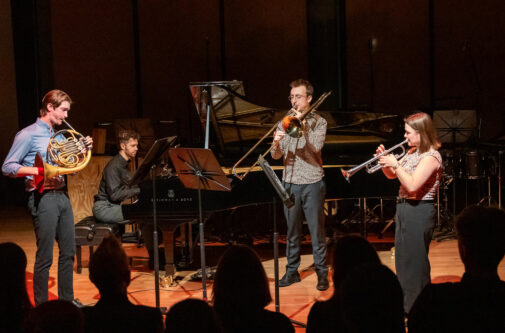
Emma Lou Diemer – Quartet for Trumpet, Horn, Trombone and Piano
Jennifer Higdon – Book of Brass
Christopher Rouse – Rotae Passionis
As part of Carnegie Hall’s ‘United in Sound: America at 250’ festival, the audience rode an elevator up to the tenth floor of the iconic building and were greeted (happily, on this below-freezing night) by a free-food-or-drink ticket to facilitate a relaxed ambiance leading up to the concert.
A refreshing, fairly-new space (since 2014), the Resnick Education Wing offers a studio-like experience with excellent sound and more contemporary possibilities for lighting design. Audience members sit as close to the players as one would at a master class or in a recording session. Even Marin Alsop grabbed a seat in the second row to listen to the first three works before conducting the last, adding to the evening’s sense of musical intimacy. She was so accessible that several fans (myself, included) approached her for a quick selfie. Alsop more than gladly complied.
The program, which ran without intermission, offered relatively recent American works that, the host told us, would shift from absolutely orderly to truly disorderly. The opening work by Jessie Montgomery, ‘Strum’ for string quartet, was performed with infectious enthusiasm by smiling players; easy to grasp folk sounds rolled into slippery sliding notes while robust pizzicato gave the work a brisk pace. Midway through, a gem of a slow passage hovered amidst the rapid material. The audience roared at the end in applause.
The next two works were for brass. Emma Lou Diemer’s Quartet for Trumpet, Horn, Trombone and Piano drew inspiration from the Broadway days of Cole Porter without falling either too far into nostalgia or too deeply into imitation. Rather, it rang with originality mixed with a wistful air – easy to follow with short melodic exchanges between players and reliable returns to luscious thematic material.
As the evening moved on to Jennifer Higdon’s Book of Brass, the lack of order (at least in sound – not in form) began to rear its head. This complex work pushed the envelope for brass rhythmic technic and required finesse by players of these inherently loud instruments. The performers made a valiant effort that was certainly praiseworthy even with a few muddled parts which were easily overlooked, given the sense of disjunction Higdon’s work was meant to evoke. The ending, however, rang solidly in a memorable fanfare.
Alsop, who is known for fostering the careers of young musicians like those performing in Ensemble Connect, left her seat in the audience to come to the podium in a bright pink fleece vest that gave a nod to the casual atmosphere of the evening. Her attire, I expect, put the audience at ease lest her acclaimed presence shift the evening’s mood.
Alsop told us about the Mahler hammer that the pianist, Joseph Vaz, would have to play in Christopher Rouse’s Rotae Passionis while also solemnly pointing out the allegorical aspects of the work’s subject matter: Christ’s suffering on the cross as a metaphor for modern day perpetrations of injustice.
Although the program had now moved into its promise of greater disorder – at least in the harmonic sense – it also brought with it an exquisite clarity. Anoush Pogossian played three different clarinets (and doubled on many percussion instruments) with soaring extroversion. Oliver Xu kept a steady serenity with the myriad percussion instruments he was required to play, sometimes without even a pause between. Rotae Passionis was full of moody dialogue – angry, curious, sorrowful and contemplative – and an emotionally jarring section of gradually intensifying wood-like sounds lingers with me. To the very end, the ensemble covered the work’s harrowing demands with uninhibited perfection, and I am sure I was not the only one left with a case of goosebumps.
Daniele Sahr
Featured Image: Marin Alsop conducts members of Ensemble Connect © Stephanie Berger
I too had the privilege of meeting the Maestro and watching her work with The Philharmonia Orchestra in London on Sunday 8th February 2026 The space themed concert which followed paired Star Wars Suite for full orchestra and Holst’s The Planets It really was out of this world I hope the Marin Alsop realises how loved and respected she is in the UK for the breadth of her repertoire and her outstanding musicianship
How wonderful! I agree.