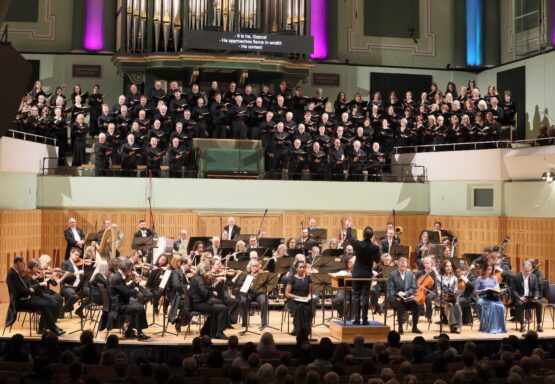
 Ireland R. Schumann: Das Paradies und die Peri: Soloists, National Symphony Chorus Ireland (chorus director: David Young), National Symphony Orchestra Ireland / Alexander Shelley (conductor). National Concert Hall, Dublin, 13.2.2026. (RB)
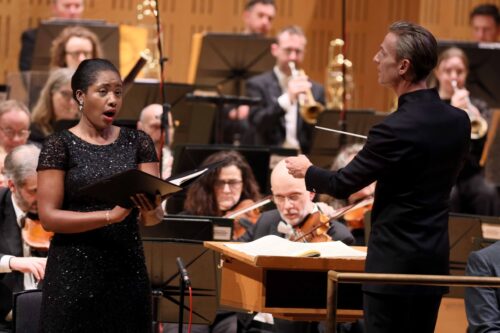
Soloists:
Nardus Williams – The Peri
Anna Devin – The Maiden / Soprano Solo
Rihab Chaieb – The Angel / Alto Solo
Robin Tritschler – The Young Man / Narrator / Tenor Solo
Mark Stone – Gazna / The Man / Baritone Solo
Eiméar Harper – Soprano
Emma Power – Mezzo-soprano
This concert marked Alexander Shelley’s first concert as Principal Conductor Designate of the National Symphony Orchestra Ireland (NSOI). They were joined by a distinguished group of soloists and the National Symphony Chorus Ireland (NSCI) for a performance of Robert Schumann’s secular oratorio and concert hall rarity Das Paradies und die Peri.
Schumann wrote Das Paradies und die Peri in 1843 and it was his most popular work during his lifetime. The libretto is based on Paradise and the Peri, one of the four narrative poems from Thomas Moore’s Lalla-Rookh. The Peri of the title is a creature from Persian mythology which is the offspring of a fallen angel and a mortal. She has been expelled from Paradise, and to regain entry she must bring the gift that is most dear to heaven. On the first attempt she brings the blood of a young warrior fighting for liberty; on the second the final sigh of a maiden who dies of grief for her lover who has been taken by plague; and on the third she brings the tear of a repentant criminal moved by the sight of a child praying. On this third attempt she is successful. Thomas Moore was a very close friend of Robert Emett who was one of the leaders of the Irish Rebellion of 1798, and his poem is often seen as a veiled allegory of that rebellion.
The work is divided into three parts which track the Peri’s three journeys to India (the struggle for liberty), Egypt (the sacrifice of love) and Syria (the power of repentance). It is very difficult to categorise this work as it is part oratorio, part opera, part orchestral song cycle. Schumann decided to discard the traditional recitative and aria structure from traditional oratorio. Instead, he allows the music to flow seamlessly foreshadowing the through-composed style of later Romantic operas.
Das Paradies und die Peri is a masterpiece and it is difficult to understand why it has been neglected for so long. It fell out of favour partly because of a fatigue with Orientalism and the sentimentality of the text and partly because it does not neatly slot into any defined musical category. It was also used by Joseph Goebbels during the Second World War for propaganda purposes, which led to musicians avoiding it after the war. (Schumann had very liberal views and would no doubt have been appalled to see his composition used in this way.) Fortunately, there has been a revival of the work in recent years with Rattle, Harnoncourt and Gardiner leading the charge.
From the sinuous string entries which opened this work, it was clear that Shelley was on top of every detail in Schumann’s score. He did a superb job in bringing the shifting dramatic tableau to life as we moved from rousing battle scenes to moments of suffocating intimacy, ethereal delicacy and a final explosion of euphoric joy. Shelley’s pacing of the material and the transitions between the movements were well-managed. He coaxed a wide and impressive range of dynamics from the assembled forces as we moved from the rousing battle scenes of the first part to the very soft inward scenes of the second. There were minor balance issues in the first part of the piece between the orchestra and the soloists although these were resolved as the work progressed. Shelley ensured the entries were tightly coordinated and orchestra, chorus and soloists remained on track.
Nardus Williams was impressive in the technically demanding role of the Peri. She captured the ethereal, otherworldly quality of the character to perfection and moved seamlessly from the moments of Lied-like intimacy to barnstorming operatic set piece numbers. In the opening section her tone was a little uneven and the diction could have been clearer. However, Williams more than made up for this in the big set piece numbers. She brought a wonderful sense of intimacy and tenderness to the lullaby ‘Schlaf’ nun und ruhe in Träumen’. The finale, ‘Freud’, ew’ge Freude’ was a virtuoso tour de force – Williams was wonderful in soaring to the top of the vocal register while injecting dynamism and a sense of unbridled rapture into the vocal line.
Robin Tritschler took on the role of the narrator and gave a sensitive and lyrical performance. He allowed Schumann’s arioso lines to flow and bloom. He doubled up as the young man in the second part and successfully conveyed the weakness and fragility of the character, although I would have liked to him to project more in the very soft sections of the work. Rihab Chaieb was hugely impressive in the role of the Angel. She brought an expressive beauty to the vocal line while maintaining depth of sound. She was very strong at the bottom of the vocal register and delivered the low notes with perfect intonation and clarity. Anna Devin conveyed the maiden’s sense of desperation and fragility in the second part. She sang with enormous lyricism and conveyed the intimacy of the scene and the unwavering devotion of the character. Mark Stone displayed his Wagnerian credentials by bringing enormous vocal heft and dark colouring to the role of Gazna. His diction was superb throughout and he sang with great power and authority.
The NSCI were firing on all cylinders for this performance. The rousing battle scenes were delivered with explosive power and rhythmic dynamism, and I was particularly impressed that the diction remained so clear during these scenes. By way of complete contrast, the chorus brought an elfin Mendelssohnian lightness to the Chorus of the Nile Spirits and a playfulness and delicacy to the Chorus of the Houris. The voicing in the fugal sections of the work was exemplary and once again the diction was superb.
The NSOI succeeded in debunking the myth that Robert Schumann was a clumsy orchestrator. The orchestral textures had a chamber music transparency and the shifting combinations of instruments conjured up a kaleidoscope of Romantic colour. The orchestra shifted from declamatory heroic clarion calls in the battle scenes to episodes of extraordinary delicacy. The NSOI also most effectively conjured up the exotic Oriental colours in the score. There were a few insecure notes from the brass in the latter part of the work although this did not detract from the overall quality of the performance.
Sir Simon Rattle famously described Das Paradies und die Peri as ‘the great masterpiece you’ve never heard’. It is good to see it finally beginning to get the recognition and attention it deserves. I applaud Alexander Shelley’s decision to perform it in his inaugural concert as Principal Conductor Designate and I hope he and the NSOI will return to it again.
Robert Beattie
Featured Image: Conductor Alexander Shelley, Soloists, National Symphony Chorus and Orchestra © Mark Stedman