 Germany Rossini, Il viaggio a Reims: Soloists and Chorus of Bremen Theatre, Bremen Philharmonic / Sasha Yankevych (conductor). Bremen Theatre, 19.2.2026. (DM-D)
Rossini composed Il viaggio a Reims in 1825 predominantly as a showcase for the most famous opera singers of his day, which is the reason that it has a total of ten major roles. After three performances on the occasion of its composition, the coronation of French King Charles X, it was intentionally abandoned and not revived until the late 20th century.
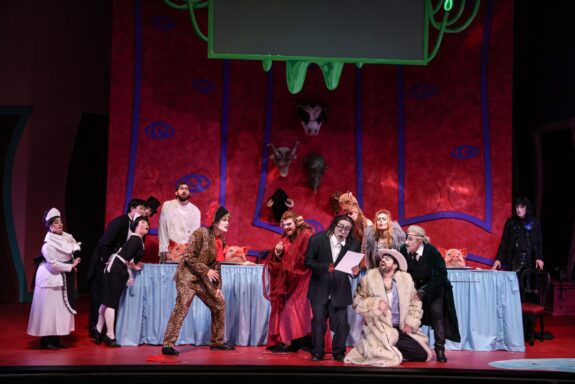
In the original, there is not much of a plot: an international group of travellers on their journey to the coronation are stranded in a hotel; while waiting, they decide to celebrate on their own. At Bremen Theatre, director Anne Weber and her team developed a new version of the opera: existing musical material was rearranged in sequence, some omitted, some material added from other works by the composer, and the text was altered to fit the new context and plot – a crime comedy. Ten years ago, a group of singers were on their way to a major competition. They were stranded in a hotel, where their mutual rivalry led to the poisoning of the singer Corinna. She survived, unknown to the others, but her career came to an end. Now, ten years later, Corinna is planning her revenge. She is spending a great deal of money on hiring hotel owner Madame Cortese to invite the competition contestants from ten years ago to her hotel with an invitation to serve as important jurors for a highly prestigious competition. The hotel has been prepared for the occasion, both to look like the hotel of the events ten years ago, and with many special features and weird incidents to scare current visitors. The hotel staff are in on the plan. Memories of the events a decade ago come up, the boundaries of past and present are increasingly blurred, and in the end, to music of Rossini’s Stabat Mater, Corinna reveals herself and poisons the guests. While much of this new plot for the opera came across as very funny indeed, the ending presented an unexpectedly serious and sinister shift.
Stella Lennert created an intriguing set for the hotel interior, possibly inspired by the surreal shapes of Salvador Dalí, with weirdly asymmetrical corridors with concave sliding doors. The orchestra pit became the hotel’s outdoor swimming pool, in which some unseen device or shark (?) ripped off the hand of one of the guests.
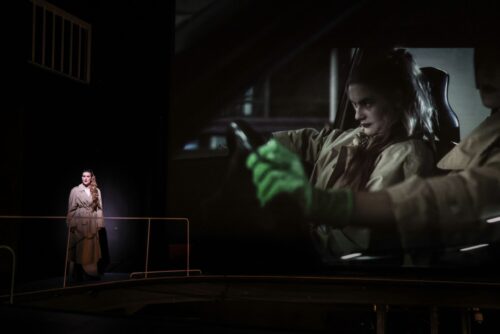
Video material, both recorded (Cantufan Klose and Lio Klose) and created with live camera (Lio Klose) helped the audience follow the plot, if not in detail, then at least in essence. The production managed to tell a new, original story, and did so meaningfully and with much attention to nuance and detail. It was entertaining, and it actually supported the appreciation of the singing – the many arias and duets, and the fewer ensemble pieces, were well integrated into the action, rather than the new plot obstructing the enjoyment of the singing on offer.
With ten major roles, almost all soloists of the resident company were involved. For the minor roles, chorus members took on solo parts. Elisa Birkenheier sang the central character, Corinna. Her showpiece, an eight-minute aria accompanied by solo harp (a major achievement in its own right by Amandine Carbuccia) opened the evening. She entered the stage from the wings to the left, stood in her spotlight, close to the orchestra pit, with a banister in front of her. A brief look at the audience, followed by a look into the pit to the conductor and the music started playing: a look into the distance, a visible moment of focusing on the role and the music, a deep intake of breath and the aria began. Birkenheier’s voice was ever so delicate, yet firm, flexible in the coloratura, silvery in nature, secure and well-rounded in the very top register, with strong breath control enabling her to sustain long arcs.
Adele Lorenzi was the hotel owner, the person hired by Corinna to stage her revenge. The music for the role emphasised the lower soprano range, on the verge of mezzo-soprano, and although Lorenzi was assured and secure with the occasional high notes of her role, her lower register was particularly strong. She was able to present her character’s gleefully scheming nature, the wicked enjoyment of engaging with Corinna’s brief. Nathalie Mittelbach’s role as the Marquise Melibea was composed for the borderline low mezzo-soprano/alto range; she delivered an impassioned portrayal, her voice resounding and richly beautiful. Diana Schnürpel recently joined the resident Bremen opera company. One of her signature roles has been the Queen of the Night in Mozart’s Die Zauberflöte. For her role in Il viaggio a Reims (Countess Folleville), her robust, strong coloratura soprano was most suitable, providing a good contrast to Birkenheier’s lighter voice.
Fabian Düberg impressed as Belfiore with a light, sweet, lyrical, well focused and very melodious tenor, which adapted well to the Rossini idiom. As Count Liebenskof the heavier voice of Oliver Sewell provided a good contrast to Düberg, with a ringing top range. Baritones Arvid Fagerfjäll (Lord Sidney) and Elias Gyungseok Han (Don Profondo), and basses Christoph Heinrich (Baron Trombonok) and Jasin Rammal-Rykala (Don Prudenzio) were each captivating in their own right, contributing well-developed character studies. Completing the ensemble guest singers María Martín Gonzaléz and Sunwoong Park fitted in well with the resident cast members, as did chorus members Daniel Ratchev, Yoona Jang and Jörg Sändig. Sasha Yankevych conducted the Bremen Philharmonic in a spirited, refined and playfully lively rendering of Rossini’s score.
Daniel Meyer-Dinkgräfe
Featured Image: Bremen Theatre’s Il viaggio a Reims © Jörg Landsberg
Production:
Director – Anne Weber
Set design – Stella Lennert
Costume design – Hanna Rode
Lighting design – Joachim Grindel
Video – Cantufan Klose, Lio Klose
Live camera – Lio Klose
Chorus director – Karl Bernewitz
Dramaturgy – Pia Syrbe
Cast:
Corinna – Elisa Birkenheier
Marquise Melibea – Nathalie Mittelbach
Countess Folleville – Diana Schnürpel
Madame Cortese – Adele Lorenzi
Belfiore – Fabian Düberg
Count Liebenskof – Oliver Sewell
Lord Sidney – Arvid Fagerfjäll
Don Profondo – Elias Gyungseok Han
Baron Trombonok – Christoph Heinrich
Don Alvaro – Daniel Ratchev
Don Prudenzio – Jasin Rammal-Rykala
Modestina – Yoona Jang
Maddalena – María Martín Gonzaléz
Zefirino – Sunwoong Park
Antonio – Jörg Sändig