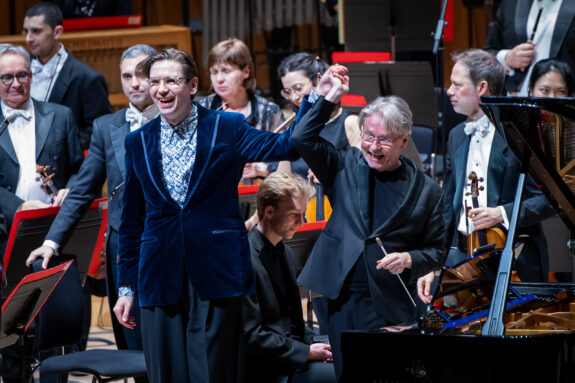
 United Kingdom J. Adams, Ravel: Vikingur Ólafsson (piano), Philharmonia Chorus and Orchestra / Esa-Pekka Salonen (conductor). Royal Festival Hall, London, 25.2.2026. (AV-E)
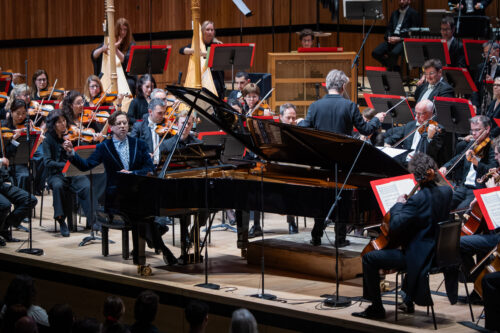
John Adams – Piano Concerto After the Fall (London premiere 2024)
Ravel – Daphnis et Chloé (complete ballet 1909-1912)
The title of John Adams’s third Piano Concerto, After the Fall, came to him after hearing the piano concerto No Such Spring by his son, Samuel Carl Adams, as Adams Snr recalls: ‘I was so overwhelmed by it that I really didn’t think I could ever write another piano concerto. So the title is partly a tip of the hat to Sam’s piece: there is no such spring after the fall.’
It was written for Vikingur Ólafsson who gave us the illusion that he was improvising it on the spot, so immediate was his intuitive playing. This was not your conventional ‘showcase’ piano concerto in that it eschewed the role of the ‘star soloist’ since the piano was immersed integrated into the percussion section as all voices being equal.
The orchestral lucidity and limpidity of the opening, with its celesta, glockenspiel and harps, had close echoes of Bartók, Debussy and Ravel, and, further on, the romantic string segment reminded me of those Sentimental Strings LPs of Mantovani, but done ‘all in the best possible taste’, as Kenny Everett would say.
The Glassian repetitious rhythmic figurations had eternal echoes of Bach; as Adams confessed: ‘Something of Bach was bound to leak into my piece, I guess.’ In fact, it was far more a cascading waterfall of Bach that gave us a good soaking – and yet his score was steadfastly the distinctive and distinguished voice of Adams who here we hear has transformed his ‘minimalism’ into ‘maximalism’.
In the final section, we heard a calibrated kaleidoscope of Bach’s Prelude in C minor virtuosically ‘voiced’ by ventriloquist Ólafsson who knows his Bach backward, as echoed by his encore arrangement of ‘Air on a G String’ which was exquisitely executed and trenchantly touching.
Under Esa-Pekka Salonen’s, dispassionate direction, Ravel’s Daphnis et Chloé was somewhat of an anticlimax, and, served up as our main course of the evening, was tailored made for vegetarians rather than for meat-eaters, if you get my meaning. From the opening to the ending it was leaden and never really caught fire being devoid of erotic charge and orgasmic rapture and reminded me of the title of that terrible 1973 film: No Sex Please, We’re British.
Throughout, Salonen’s conducting was four-square: mechanical, mannered and manicured with his players sounding too plush and too harsh all at the same time which was weird. The strings were pristine and polished, rather than rapturous and intoxicated (as they had sounded recently under Lawrence Renes in the Bruckner’s Eighth which was one of the greatest I had ever heard in concert).
The only memorable moments were played by Samuel Coles (flute) and Rebecca Kozam (cor anglais); and not forgetting the Philharmonia Chorus who were ‘ethereal-erotic’ throughout: luminous and voluptuous. However, the concluding Danse générale was just loud and brash which nevertheless was guaranteed to bring the (packed) house down: and it did with an ecstatic aplomb!
Alexander Verney-Elliott
Featured Image: Pianist Vikingur Ólafsson and conductor Esa-Pekka Salonen © PO/Marc Gascoigne