
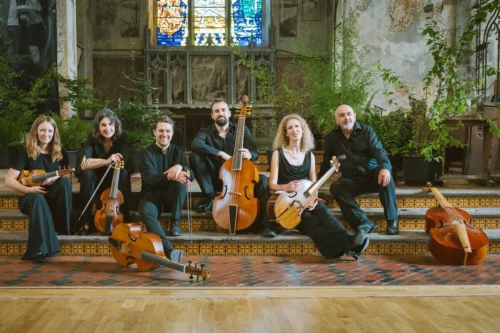
 United Kingdom Dowland, Williams: Fretwork (Emilia Benjamin, Joanna Levine, Jonathan Rees, Sam Stadlen, Richard Boothby [viols]; Elizabeth Kenny [lute]). Turner Sims Concert Hall, Southampton, 22.2.2026. (CK)
John Dowland – Dances (selection); Semper Dowland semper Dolens; Lachrimae, or Seaven Teares
Adrian Williams – Teares to Dreams
What a pleasure to welcome Fretwork to the Turner Sims, commemorating the 400th anniversary of John Dowland’s death – without mentioning, self-effacingly, that it is also their own 40th anniversary. Of course, they are a different group of players from those who recorded their wonderful album Heart’s Ease in 1986: apart from Richard Boothby, whose bass viol still anchors the group now as it did then.
It was a particular delight for me, as my only previous experience of their playing was at a late-night BBC Prom in 1998, when they took part in John Harle’s opera Angel Magick, about the sixteenth century alchemist (and possible model for Shakespeare’s Prospero) John Dee.
The main business of the evening was a performance of Dowland’s Lachrimae, his half-hour chain of seven Pavans, springing from his phenomenally popular song Flow my Teares (from which Harrison Birtwistle borrowed a phrase as the title of his 2004 orchestral piece Night’s Black Bird). Before the interval we were treated to a varied display of Dowland’s dances, dedicated to a variety of long-forgotten people who are thus vouchsafed a tenuous immortality: M. Giles Hoby his Galiard, M. George Whitehead his Almand and so on. There is the occasional famous name (The Earle of Essex’s Galiard); and an apparently infamous one – Captaine Digorie Piper his Galiard (a notorious pirate).
The first half of the concert ended appropriately with Dowland’s expansive and punningly titled Semper Dowland semper Dolens (miserable) – music which may seem to us a foretaste of Purcell’s music for the funeral of Queen Mary at the other end of the 17th century, and a reminder that Dowland, despite his fame across Europe as a lutenist, was apparently a melancholic man, and a difficult one.
After the interval, Lachrimae was preceded by Teares to Dreames, written in 2004 by Adrian Williams. It is no pastiche: Williams writes ‘Rather than make a conscious attempt to base my piece on a specific aspect of Dowland’s pieces, I preferred to immerse myself in the Lachrimae for a few months before quietly moving from it into my own piece.’ The result is beautiful and compelling, the smooth contours of Dowland’s music refracted through an edgier 21st-century sensibility.
And so to Lachrimae: seven Pavans, seven slow, mournful dances. On the face of it they might become monotonous: but of course they are nothing of the sort. Dowland wrote to Queen Anne of Denmark, the dedicatee: ‘and though the title doth promise teares, unfit guests in these ioyfull times, yet no doubt pleasant are the teares which Musicke weeps, neither are teares shed always in sorrow, but sometime in ioy and gladnesse.’
Perhaps it is easier for our post-Romantic sensibilities to perceive them as a narrative, a slow, hypnotic journey through melancholy without – apparently – finding a way out. The sad, falling four-note figure which begins each piece, differently scored in each case, encourages us to see them as connected, almost a set of variations. Whether or not we do this, the constant invention of the music within a continuity of mood is its own justification: it is a musical world with a restrained beauty like no other. The gentle buzzing of Fretwork’s viols, weaving in and out of each other, created a glowing texture in which the plucked notes of Elizabeth Kenny’s lute glinted elegantly and expressively. It is a musical experience that continues to resonate in the mind long after the physical sounds cease.
Chris Kettle