
 United Kingdom Beethoven, Widmann, Mendelssohn: Veronika Eberle (violin), Royal Scottish National Orchestra / Jörg Widmann (conductor), Usher Hall, Edinburgh, 27.2.2026. (SRT)
Beethoven – Violin Concerto
Widmann – Con brio
Mendelssohn – Symphony No 5 ‘Reformation’
First, the good news. It is a rare treat to hear a composer conducting his own work and, whatever you may think of Jörg Widmann’s music, it has traction. This must be the sixth or seventh time I have heard Con brio in a concert hall, a target that most contemporary composers can only dream of, so it is fascinating to hear what he does with it; how he brings to life its explosive bursts of colour and eerie whispers, and shapes its overall course from blast to whimper. In truth, it has never been a work I have loved, but you have to take your hat off to any living composer whose music can get this much exposure.
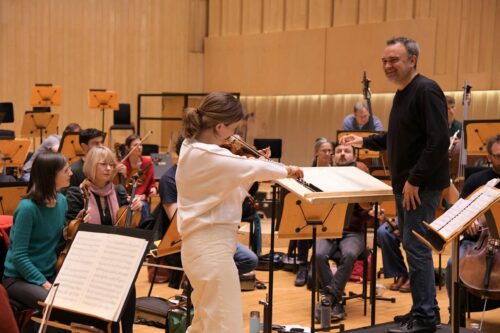
The second piece of good news was violinist Veronika Eberle, a new name to me, here making her debut with the Royal Scottish National Orchestra and an almighty impression on the Edinburgh audience. Eberle’s playing is a thing of beauty. She gives her violin a singing quality that not many can match, but there is variety and twinkling drama to it, too. In Beethoven’s Violin Concerto, her playing ranged from prayerful beauty in the slow movement, to freewheeling ease in the finale, or tentative searching in a first movement whose recapitulation preparation was nail-bitingly intense. True, she played the whole concerto staring at the floor, which might have been an indication of either focus or detachment, but she nevertheless had a sense of command that gave an improvisatory freedom to her playing.
She could get away with that: the orchestra couldn’t, and that is where Widmann’s conducting came a cropper. His shaping of Beethoven’s musical paragraphs was often downright bizarre, with distended phrasing, lumpy pacing and weirdly elongated rests that played havoc with the sense of line. In fact, the orchestra consistently gave the impression that they were half a beat behind him and, often, of each other. Maybe, just maybe, it was a consequence of where I was sitting, in a part of the Usher Hall that I don’t usually sit, much closer to the orchestra than I am used to, where maybe the blend isn’t so good and you are closer to the lapses in ensemble. Still, the first movement in particular felt orchestrally messy, and Eberle’s independence might have made that worse.
One thing that was undeniably enjoyable, however, was the cadenzas that Widmann had written for Eberle, anarchic masterpieces of craziness, duets with double bass (Nikita Naumov) and timpani (Emmanuel Joste) that made it sound like Beethoven’s music was melting before your ears and re-forming as Southern jazz or foot-stamping folk.
And in fairness to everyone, Mendelssohn’s Reformation Symphony made for an exhilarating end to the concert, the composer’s hard-edged drama softened with glowing violins in a delectably mysterious Dresden Amen and, via a quicksilver slow movement with a touch of the fairies to it, an uplifting finale where everything satisfyingly coalesced.
Simon Thompson
Always dangerous to use the words ‘undeniably enjoyable’. As regards the cadenzas, they were completely inappropriate and in no way complemented the notes Beethoven composed. They also added nearly 10 minutes to the running time. They were verging on the offensive in my opinion.
Agreed!
The RSNO are a delight and rarely put a foot wrong. But letting Widmann conduct was a giant mis-step. The Beethoven itself was as unpleasant an experience as the reviewer describes, with the interjections of Widmann’s cadenzas jarringly so.
Con Brio was mercifully brief.
I didn’t think it would be possible to butcher the Mendelssohn, but the conducting and interpretation failings persisted, with zero lyricism to contrast. The amount of ff he elicited felt like being shouted at for most of the piece. Remember the advice ‘never look encouragingly at the brass’!
The RSNO (and its audience) are used to far better.
It’s quite surprising to read such a review of the soloist; it seems to me that, unfortunately, you were really sitting in the wrong place.
In any high-level orchestra, you can easily find violinists of a higher class — and the musicians’ expressions in the orchestra clearly showed their disapproval of her playing. You don’t even need to be a professional violinist (which I am) to notice: wavering intonation, uneven rhythm, frivolous stretching of phrases, lack of true musical will, scale, or intellect of a soloist who doesn’t just produce sounds — the list could go on endlessly.
Her parents are huge music enthusiasts — praise them for that — but one can play for oneself without forcing others to listen to all of this! It seems she is simply not very gifted — but vanity and connections apparently matter more. That’s why the Beethoven concerto was unsuccessful: Maestro Widmann had to carry this ‘troubled’ soloist, who played however she pleased — and, alas, it showed in the result; everything fell apart. Fortunately, there was Mendelssohn and his music, unburdened, where one could truly relax and enjoy!