
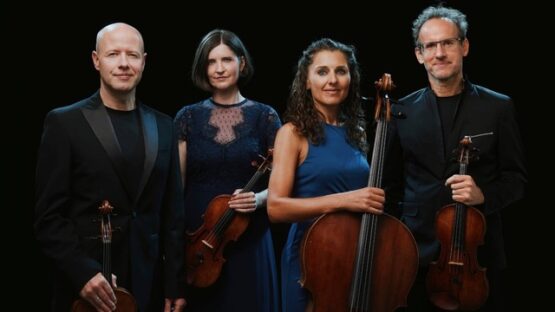
 United Kingdom Glass, Lamagna, Reich: Carducci Quartet (Matthew Denton, Michelle Fleming [violins], Eoin Schmidt-Martin [viola], Emma Denton [cello]). RWCMD, Cardiff, 5.3.2026. (LJ)
Glass – String Quartet No. 3 ‘Mishima’ (1985)
Vincenzo Lamagna – Intelligenza Animale (world premiere, 2026)
Reich – Different Trains (1988)
Next year, Philip Glass and Steve Reich will each turn 90 and the Carducci Quartet will mark both composers’ birthdays with a major project (yet to be announced). So, this concert, which featured music by Glass, Reich, and a newly commissioned work by Vincenzo Lamagna, was a taste of what is to come. With playing so irresistibly precise, moving, and intelligent, this ‘taster’ left all at Cardiff’s Royal Welsh College of Music and Drama wanting more.
The Carducci Quartet’s members – Matthew Denton (violin), Michelle Flemming (violin), Eoin Schmidt-Martin (viola), and Emma Denton (cello) – have a stellar reputation as both performers and educators, with the Carducci Music Trust established to inspire future musicians and enable more children to experience live music in schools. As a quartet, the Carduccis are well known for their recordings of Shostakovich and Glass. In 2010 they released a recording of Glass’s first four string quartets with Naxos. This CD includes ‘Mishima’ (No. 3), which was the first piece of the evening. In 2021, they performed this string quartet live and it was reviewed for Seen and Heard International by Colin Clarke who praised them for ‘sustaining Glass’s unique world so perfectly’ as to create a ‘microcosm’ of sound.
At this performance of ‘Mishima’, music that is centred on personal and political tragedy, this so-called microcosm was agonisingly beautiful. This piece is titled after the Japanese writer Yoko Mishima who inspired Paul Schrader’s 1985 biopic Mishima: A Life in Four Chapters, for which Glass wrote the soundtrack. Mishima devoted and even sacrificed his life to Japanese traditional heritage, driving a dagger into his abdomen in 1970 in defiance against what he perceived the violation of his country’s dignity through consumerism and globalisation. With such a range of emotion to express – pride, love, fear, defeat – a musical interpretation of this biography risks sounding cluttered. For the Carduccis this was not the case. They proved themselves to be masterful at giving each movement a distinctive shape and unifying all six of Glass’s movements with an underlying sense of quiet desperation.
The Carduccis are unparalleled in creating atmosphere. This is not only due to dynamics and being unafraid to play so quietly that the tone they each create nearly frays, but it is also due to exact timing. When beginning each movement, there was a sense that the Carduccis were taking the notes from the air around them as if picking fruit in unison. As a result, the quietude of the second movement (‘November 25: Ichigaya’) was stunning.
Whereas Glass sees himself as a composer for film and theatre, Lamanga is connected to the world of contemporary dance and ballet. The Carduccis performed the world premiere of Lamanga’s Intelligenza Animale which consists of a combination of pre-recorded sound and live performance. For this piece (and the Reich that followed), the instrumentalists each wore a single earphone. Lasting in the region of 18 minutes, Intelligenza Animale offers a hypnotic soundscape where electronic sounds of the sea, bass beats, and narration complemented and interrupted the musicians who largely repeated the same four descending notes. After twenty-one (if my counting is correct) atonal chords, the piece moved towards its more harmonious conclusion. Its atmosphere can be summed up by the pre-recorded poetic refrain that was played approximately a third of the way through: ‘for the daughters, for the sons, lost in the violence of greed, one day we’ll meet again and we’ll dance in the light of the sun’.
The concert came to its conclusion with Reich’s Different Trains – a masterful piece that combines pre-recorded tape with the string quartet. It is a work of personal, geographical, and temporal tension. It begins by representing Reich’s childhood train journeys between Los Angeles and New York, which he took to visit his separated parents. It then envisions how, as a young Jew, Reich would have been on an altogether more sinister and tragic train journey had he been brought up in Europe during the Second World War. With the words ‘and the war was over’, the piece moves to the present day by playing recorded testimonies of child-survivors of the Holocaust.
Throughout each section of this piece, the pattern of recorded speech is mirrored in the rhythm and pitch of the instrumental lines. As listeners, we must also contend with the whistle of the train and the heavy context of ‘those cattle wagons […] loaded with people’. With the Carduccis’ textured and deeply empathic playing, listening to Reich’s Different Trains was transformative. I felt as if I was part of an immersive theatrical performance rather than merely listening from my seat in the auditorium.
The Carduccis are a well-oiled quartet. There is a communication between the musicians that cannot be manufactured or taught; it is innate, instinctive, and seems, like wine, to get better over time.
Lucy Jeffery