
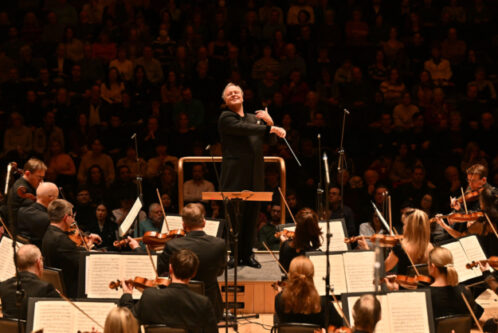
 United Kingdom R. Strauss, Saint-Saens, Brahms: Bertrand Chamayou (piano). BBC Symphony Orchestra / Sakari Oramo (conductor). Barbican Hall, London, 6.3.2026. (CC)
Richard Strauss – Don Juan, Op.20 (1888/89)
Saint-Saëns – Piano Concerto No.5 in F, Op.105, ‘Egyptian’ (1896)
Brahms – Symphony No. 2 in D, Op. 73 (1877)
It is fascinating that these three works were written within 20 years of each other: the swashbuckling, height-of-Romanicism music of Richard Strauss, the effervescence of Saint-Saëns, the sunny D major of Brahms’s Second Symphony. Three very different worlds.
Strauss’s tone poem Don Juan, inspired by Nikolaus Lenau’s unfinished verse-drama (published 19851). Still in his mid-twenties, Strauss had energy to spare, and it spills over into this exuberant score. The opening is notorious: a rapid violin ascent starting on an off-beat, well managed here. Oramo was conducting the outer works of the evening by memory and illuminated detail after detail in the Strauss. Especially impressive were the lower registers, which can easily muddy or become lost in Strauss’s opulent scoring. The solo violin contributions, from leader Igor Yusefovich, were impressive, his tone containing just the right amount of edge, but it was the oboe solo of Tom Blomfield that melts the heart. Some sterling horn playing, too, including the great unison moment (no bumper, although there was in the Brahms, oddly). Some fine stopping effects, too, from the horns (properly hand-stopped – I could not see any stopping mutes). It was Oramo’s interpretation that held it all together, though, allowing the music space as required without losing any of the narrative thread,
Nearly 18 months ago, Betrand Chamayou and the BBC SO, then under Dinis Souza, impressed in Bartók’s Third Piano Concerto (review here); here, it was Saint-Saëns’s Fifth, the so-called ‘Egyptian’. And while Stephen Hough’s Hyperion complete set of that composer’s five concertos has held sway for many a year, Chamayou himself has recorded the Fifth (coupled with the Second, Emmanuel Krivine conducting the Orchestra National de France). And beautiful though that recording is, his BBC SO performance held more immediacy, more overt excitement. His concerto was written in Luxor on 1896 (after a gap of some 20 years from its predecessor). True, the woodwind might not have been entirely in tune at the opening but Chamayou’s touch was so perfect, his tone well-rounded and yet capable of beautiful lyricism. It was Chamayou’s legerdemain that was so stunning, though; elsewhere, Lisztian octaves reminded us of the composer as virtuoso. Oramo was with Chamayou 100% and how impressive the way both piano and orchestra calibrate the composer’s dynamic swells so the volume rose and died at exactly the same rate. But it is the fingerwork of Chamayou that is so remarkable, especially if one compares it with the composer’s own recordings (try that of his improvised cadenza for the 1904 Africa Fantasy, or indeed that of the solo excerpt from the Second Concerto, both of which appeared on an APR disc (Piano G & T’s, Volume Three – that is Gramophone and Typewriter!).
No missing the Egyptian feel to the opening of the second movement with the BBC SO in the Barbican Hall. There was so much energy at the movement’s opening and it provided the perfect contrast to the simple statements of themes later on. And how perfectly Chamayou projected the left-hand melody, itself so ideally ‘echoed’ by the BBC SO’s strings. Whispered passages underpinned by rolling timpani were extraordinary, a reminder of Saint-Saëns’ ingenuity (and, indeed, genius). That left-hand melody, by the way, is embroidered by right-hand decoration that seemed to link to the cimbalom aspect of Chamayou’s encore (see below); a lot of thought went into this concert. The second movement includes a Nubian love song heard on the Nile; the finale is Saint-Saëns through and through in its beautifully hectic writing for piano; the music still references Egypt through, a paddle-steamer at the opening and some well-chosen ‘exotic’ scales. Those piano and orchestra ‘swells’ of the first movement returned, just as perfect; and, balancing the exoticism, how impeccably French the light chordal theme for piano. Chamayou was preternaturally accurate here, the whole leading to a simply crazy end. Magnificent; and, listening to the recorded version afterwards, it is the BBC SO performance that seems truer to the composer’s spirit.
The lovely encore was the Etude, Op.111/4, ‘Les cloches de Las Palmas” (once past its introduction, this is not a million miles from Liszt’s admittedly more expansive ‘Les cloches de Genève’ (Years of Travel, First Year: Switzerland, S.160), and what could is surely a cymbalom reference certainly links the two composers here. Chamayou was spellbinding, his tone perfect, his fingerwork just as magical as in the concerto.
Launching into the glorious opening of Brahms’s Second Symphony post-interval was like listening to one long exhale. There was so much to admire here, most regularly the woodwind contributions, plus the horn solos of BBC Principal Nicholas Korth. Again, detail was to the fore, with Oramo ensuring the lower regions maintained clarity once more. The lower string (viola/cello) second subject was a joy, just the right amount of warmth, while brass blazed impressively in the movement’s final bars. One conducting question: I wonder why Oramo conducted some bars in two (the movement is in three)? Specifically, those where Brahms does indeed cut across the beat (so, six quavers to the bar, and instead of 2+2+2, he notates 3+3 without changing time signature). The whole point is the cut across the beat; if you conduct it as two groups of three, you negate that, and the effect is lessened.
Strings were just warm enough for the Adagio non troppo (Korth again superb later in his tricky solo). There was a sense of dignity here, perhaps nudging Robert Schumann’s ‘Rhenish’ at times. Blomfield’s oboe launched the Allegretto grazioso (quasi andantino) most fetchingly, with Oramo’s tempo the perfect reflection of Brahms’s ask. Intriguingly, Oramo achieved a proper feel of a German dance, more than any other performance I can remember; delightful.
It was the maintenance of quiet at the beginning of the finale which enabled the first outburst to work so well; Oramo is clearly a fine structuralist, something that showed again in his capturing of his movement’s more nocturnal moments (especially around the pre-echo of Mahler 1). A blazing conclusion, though: standard repertoire this might be, but this was no standard performance.
A very musically satisfying evening. If it is the piano concerto that has seared itself into the memory, those performances around it are certainly worthy of praise.
Colin Clarke