
 Germany Charles Wuorinen, Brokeback Mountain: Soloists, Opernchor des Theaters Erfurt, Philharmonisches Orchester Erfurt / Hermes Helfricht (conductor). Theater Erfurt, 28.3.2026. (AB)
Charles Wuorinen’s Brokeback Mountain, which had its world premiere in Madrid in 2014, remains one of the more unusual works in the contemporary operatic repertoire: an opera drawn from Annie Proulx’s short story of two cowboys who fall in love, a story later transformed by Ang Lee’s film into one of cinema’s defining romantic tragedies of its time. Yet anyone coming to the performance in search of a lyrically cushioned operatic equivalent of that film will be surprised, and it was thus a very daring and courageous decision for Theater Erfurt to put on a production of the work.
Wuorinen’s opera offers something far more austere than the film, and, for precisely that reason, more unsettling and more serious: not a sentimental romance, but a concentrated music drama about the love between Ennis and Jack, deformed from the outset by homophobia, emotional repression and social coercion. That severity is rooted in the work itself. Proulx’s libretto, written by the author for the opera, is crucial to its effect. She does not sentimentalise her own material or expand it into operatic rhetoric. The language remains spare, dry and sharply economical, while Wuorinen’s score takes on the burden of exposing what the text leaves unsaid: the emotional pressure, the vastness and hostility of the landscape, and the inner damage carried by the protagonists.
Wuorinen’s post-tonal and post-serial musical language is dense, rhythmically exact and thoroughly contrapuntal, propelled by sharply etched lines, abrupt changes of register and a constant inner unrest. Those expecting broad melodic arcs or anything resembling cinematic emotional uplift will find little of either. Wuorinen does not write for immediate appeal, but for structural pressure. Yet the score is anything but abstract and cold. On the contrary, it creates a sonic world that is at once psychological and topographical. In this way, Brokeback Mountain does not merely serve as a backdrop to the action. Rather, it becomes an active presence, the place where openness and threat, freedom and fracture, desire and fear exist side by side.
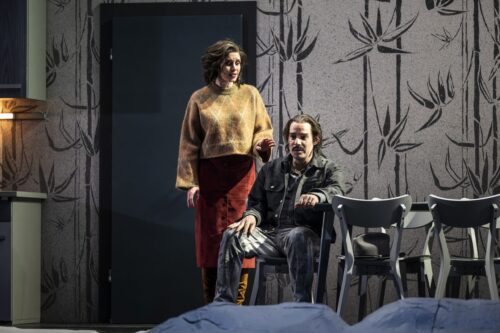
In Erfurt, Director Jakob Peters-Messer placed exactly that quality at the centre of his interpretation. For him, the mountain ‘breathes, speaks, moans’, and wisely, he did not compete with the film’s visual legacy, nor did he seek to soften the opera’s hard edges with scenic lushness. In the same vein, Pascal Seibicke’s stage design presented an icy, reduced and bleak environment in which the mountain is less a realistic landscape than a condition of existence. Particularly effective is the way the production allowed places to emerge out of this hostile emptiness. Scenes rise from the ground itself: interiors, workspaces and fragments of Ennis’s and Jack’s domestic, difficult lives appear as if pushed up from beneath the mountain’s surface, only to sink back into it.
Peters-Messer’s strongest decision, however, was his refusal to sentimentalise the relationship between Ennis and Jack. The production shows them as men already marked by the world they inhabit long before the tragedy runs its course. Their intimacy on Brokeback Mountain is not treated as uncomplicated liberation, but as a brief and precarious opening in lives otherwise structured by silence, fear and retreat.
At the centre of the evening stood Máté Sólyom-Nagy as Ennis and Michael Smallwood as Jack. Sólyom-Nagy gave Ennis exactly the inward concentration the role demands, singing with firmness and intelligence and making the character’s reserve feel like a lifelong discipline of emotional self-erasure. Smallwood’s Jack was more outwardly urgent, more visibly hungry for a life that neither man can quite imagine how to claim. Their scenes were incredibly touching and had all the awkwardness, tension and suppressed force you would imagine, even – or perhaps especially – when their relationship cools.
The supporting cast mirrored the extraordinary efforts of the lead singers and is testimony to the excellent ensemble Erfurt has at its disposal. Daniela Gerstenmeyer was captivating as Alma Beers, Ennis’s wife, whose little world is falling apart bit by bit, and who is as unable to escape her destiny as her husband is, even when they finally divorce. Marlene Gaßner as Lureen (Jack’s wife) was equally moving, as was Jörg Rathmann as Jack’s father, who hands the ashes of his son to Ennis for them to be scattered on Brokeback Mountain.
Hermes Helfricht led the Philharmonisches Orchester Erfurt masterfully through Wuorinen’s complex score, giving it space to breathe and letting the complex structures shine through while keeping everyone emotionally on edge. He led the singers through their fiendishly difficult vocal lines with supreme ease that brought the best out of the entire cast.
This Brokeback Mountain was an unmitigated success in terms of singing, music and production. It was therefore a crying shame that only about half of the seats at Theater Erfurt were occupied on the evening of its premiere, and sales for future performances do not look promising either. For those who were there, though, the evening was a triumph and has made a strong case for this work to remain in the repertoire.
Andreas Bücker
Featured Image: Michael Smallwood (Jack) and Máté Sólyom-Nagy (Ennis) © Lutz Edelhoff
Production:
Direction – Jakob Peters-Messer
Set designs & Costumes – Pascal Seibicke
Lighting – Thomas Spangenberg
Choir director – Markus Baisch
Dramaturgy – Bartholomäus Pakulski
Cast:
Ennis del Mar – Máté Sólyom-Nagy
Jack Twist – Michael Smallwood
Aguirre – Yevhenii Dunduk
Alma Beers – Daniela Gerstenmeyer
Mrs Beers / Mrs Twist – Katja Bildt
Lureen – Marlene Gaßner
Hogboy – Kakhaber Shavidze
John Twist Senior – Jörg Rathmann
Barkeeper, Shop assistant – Luzia Ostermann
Bill Jones – Dork Biedritzky
Cowboy – Richard Johnson
Francine del Mar – Johanna Führ
Alma Jr. del Mar – Esmée Panzer