
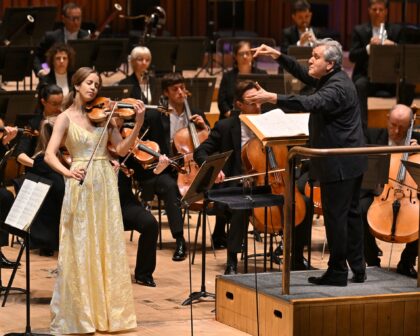
 United Kingdom Imogen Holst, Korngold, Shostakovich: Vilde Frang (violin), London Symphony Orchestra / Sir Antonio Pappano (conductor). Barbican Hall, London, 16.4.2026. (AV-E)
Imogen Holst – Persephone (1929)
Korngold – Violin Concerto in G (1929-1931)
Shostakovich – Symphony No.5 in E minor (1888)
Sir Antonio Pappano led the London Symphony Orchestra in an evocative equilibrium of piquant programming. Opening with Imogen Holst’s spring-poem, Persephone, the orchestra captured the glistening, Ravelian textures of the score with pristine precision, making direct reference to Daphnis et Chloé as it drifted through its opalescent orchestral ordinance.
Pappano’s decisive direction was fleetingly fluid, allowing the woodwind whimpers to bloom with bayoneted buoyant blood that brooded beautifully bright. While the strings summoned an ancient, subterranean stifled stillness — a sensation of a nonplus nocturnal nowhere — this rediscovered evanescent emerald emerged from the archival ashes with a piercing, radiant relevance; it is a scintillating score that demands a permanent place in the concert halls.
The venue then veered towards veridical Vilde Frang for Korngold’s Violin Concerto in D. The work remains an obtuse paradox of original pastiche, often dismissively derided as ‘schlocky schmaltz’ — it is nothing of the kind. The score is a minefield of complex markings and shifting textures, which Frang navigated with immense verve and aplomb.
In the first movement, marked Moderato nobile, she launched into the soaring themes with a nimble nerve that eschewed the ‘syrupy’ sloughs many soloists fall into. Fraternising Frang let-it-all-hang-out, playing her fiddle with the tastelessly-tasteful rugged refinement of a peasant-princess: couthly-uncouth and frantically-frail, her rhapsodic runs were liquid light, weaving through Pappano’s sweeping orchestral onslaught support.
In the central Romance, frantic Frang periodically dispensed with vibrato, unmasking the sarcastic score’s expressionistic edge — the strangeness and spikiness of a Vienna Korngold had been forced to flee. This was the perfume of the performance, possessing a desolate, dislocated depth that felt like a half-remembered dry dream. In the final pages, Frang navigated a staggering sequence of hairpin dynamics – culminating in a morendo that drifted from G to E – with such microscopic precision that the sound seemed to evaporate. I have never heard a violin played so quietly; it was as if she were drawing sound from the very edge of silence itself.
Fragrant Frang flavoured the helter-skelter Allegro assai vivace finale with an appropriate vulnerary-vulgarity; the interplay became electric, brimming with a rhythmic wit that brought the house down. The tone she drew from her 1734 ‘Rode’ Guarneri del Gesù had the tactile depth and delicate tone of ‘crushed velvet’ (as the eminent critic Rob Pennock aptly put it to me); for her incony tone was spun silk caught in a spring breeze.
The coupling of Korngold with Shostakovich was overtly apparent in their shared expression of Mikhail Bakhtin’s ’Carnivalesque.’ This is known as ‘grotesque realism’ — an abrasive mixed-cocktail of pastiche, irony, parody, and sarcasm — served as the vital connective tissue of the evening. Korngold’s sumptuous scores, particularly Die tote Stadt, utilize many Bakhtinian tropes, blending high art with low farce. This same subversive spirit was salient as a ferocious fermented force in Shostakovich’s Fifth Symphony.
In the opening Moderato, Pappano magnificently marshalled a strenuous, meandering mood; he allowed the strings to breathe through the initial jagged canon with a serenely sad intensity that never became mannered or laboured. This sensitive ensemble provided a canvas of silver-grey desolation, while the harp added a chilling, skeletal punctuation — plucked droplets of ice that shivered against the texture.
It was a measured ferment that eventually curdled into a menacing melodrama barked by the brass and punctuated by the percussion. Amidst this gloom, the woodwinds revealed their broad and intense palette of feeling — providing moments of lyrical relief that quickly shifted into shrill panic. Juliana Koch and Rosie Jenkins offered poignantly expressive oboe lines that felt like solitary voices in a violent storm.
In the lamenting Largo, Pappano and the orchestra conjured a gaunt, ashen suspension that felt like a collective, gasping intake of breath. This was a psychological unmasking — an internal exile where solo woodwinds wandered through a stark, skeletal void. The LSO strings played with a serene sensitivity, avoiding even a hindering hint of Mahlerian, sickly saccharine sentimentality; instead, they succinctly sustained a moribund mood of desolate dread.
The oboes of Koch and Jenkins offered a linear grief, while Gareth Davies’s flute provided a hauntingly fragile monologue against the shimmering, divided strings. The movement reached its psychological peak with the lonely candle of Patricia Moynihan’s piccolo, a tiny, flickering point of light in a vast, icy expanse.
The finale erupted with a predatory, percussive pounce, instantly dismantling the ashen suspension of the Largo. Pappano’s superlative structural control was evident in a calculated long-range bombardment — a relentless, mechanised grind of tightening dread and claustrophobic anticipation.
As the climax approached, the percussion arrived with a hard, dry, and malevolent malice; the timpani and bass drum were beautifully brutal, providing a succession of pitiless, militaristic thuds that anchored the brass’s grandiloquent fanfares.
Debate still rages on over this coda: is it a ‘fervid victory’ or a ‘feigned victory’? The ‘slow school’ (Kurt Masur and Kurt Sanderling) argues for an agonisingly much broader pace, where the repetitive As in the strings and the crushing blows of the percussion represent one being steadily beaten into a pulp of petrified pleasure — a hollowed out happiness. Yet, Pappano’s propulsive pacing sounded successfully hollow and bombastic, as it should.
It was a pulverising performance that left the audiophonic-audience in a steadfast state of exuberant exhilaration — a captivating conclusion captured for medici.TV.
Alexander Verney-Elliott