 United Kingdom Beethoven, Mozart, Haydn, Schubert: David Blackadder (trumpet), The Hanover Band / Leon Bosch (director). Cadogan Hall, London, 21.9.2026. (AV-E)
Beethoven – Coriolan Overture in C minor, Op.62
Mozart– Symphony No.5 in B-flat, K 22
Haydn –Trumpet Concerto in E-flat major
Schubert – Symphony No.9 in C, ‘The Great’, D 944
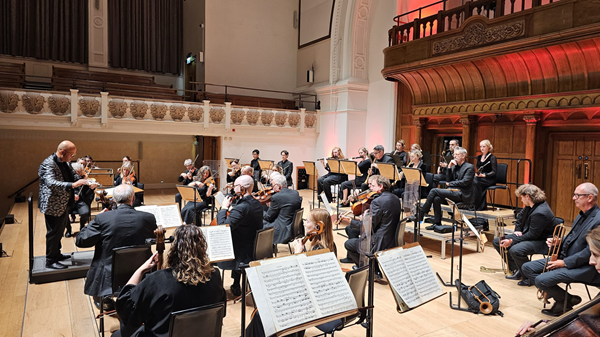
Cadogan Hall’s acoustically exceptional interior, among the finest spaces in Britain for classical music, transformed The Hanover Band’s relatively small forces, lending the performance an almost chamber-like intimacy while allowing extraordinary depth, richness and presence to emerge from the sound. Founded in London by Caroline Brown in 1980, The Hanover Band was one of Britain’s pioneering period-instrument ensembles, and this perfectly balanced programme allowed the distinctive character of the orchestra to emerge across Beethoven, Mozart, Haydn and Schubert.
Ostensibly, I had just come to hear Beethoven’s Coriolan Overture. It is arguably the hardest of Beethoven’s overtures to conduct: its compressed dramatic argument demanding absolute control of rhythm, dynamics, pacing and structural tension. Carlos Kleiber remains, for me, the only conductor who has pulled it off. I was therefore pleasantly surprised by just how extremely well Leon Bosch conducted it, immediately demonstrating that this was a first-rate conductor with a commanding grasp of Beethoven’s idiosyncratic architecture and an exceptional instinct for dramatic pacing and a powerful ability to build and sustain tension.
The opening chords were delivered with impressive severity, the strings attacking with a lean, grainy edge that gave the music physical urgency without exaggerated weight. Bosch established the rhythmic tension immediately, allowing the silences between gestures to become part of the drama. Hearing the hard-stick timpani cut through with nailing intensity, every stroke landing with uncompromising force and precision, was essential to the performance’s visceral impact.
The winds brought pungent character to the lyrical material, while Bosch kept the development taut and cumulative, never rushing but allowing Beethoven’s repetitions to acquire increasing psychological pressure. The final pages had an impressive inevitability. The only reservation I had was that the two double basses did not provide sufficient depth and weight required for such dark and dramatic music.
Mozart’s Symphony No.5, written in 1765 when the composer was only nine, came across as ‘mature’ Mozart rather than the exercise of a precocious child.
The opening Allegro was animated and incisive, the strings producing a light, clean attack while the winds added colour and character. Bosch kept the phrasing supple and alert, the small forces lending the music a particularly clear, conversational quality.
The Andante was the most expressive movement, bringing greater warmth and tenderness. The period strings produced a softer, more intimate sonority, while Bosch avoided over-romanticising the music. There was considerable affection in the phrasing, and the music seemed remarkably self-possessed for something written at such an early age.
The finale (Allegro molto) restored the youthful sparkle. Bosch kept it buoyant and sharply articulated, the orchestra responding with admirable precision to its quicksilver changes of character. The music scampered without becoming breathless, ending with the same freshness and vitality that had animated its opening.
David Blackadder’s characterful performance of Haydn’s Trumpet Concerto brought an entirely different soundworld. Playing a replica of the keyed trumpet for which Haydn wrote the concerto, Blackadder produced a rustic, rugged sound with an earthy directness that suited the music remarkably well. There was a jazz-like expressivity to his approach: gruff, bawdy and rhythmically free, with a rough-edged quality that gave the solo part an unusually physical presence.
The opening Allegro immediately established the swaggering persona of the performance. Blackadder negotiated the virtuosic writing with impressive fluency, but there was nothing prim or polished about the sound. His phrasing had a loose, improvisatory quality, while Bosch maintained a responsive orchestral partnership. The exchanges between trumpet and ensemble had a distinctly conversational quality, the orchestra responding to the soloist rather than merely accompanying him.
The Andante brought a striking change of temperature. Blackadder found considerable lyricism without losing the instrument’s distinctive tonal grain, while The Hanover Band’s transparent accompaniment allowed the solo line to emerge naturally from the texture. Even here, the sound retained something earthy and human rather than becoming conventionally polished.
The finale (Allegro) restored the concerto’s wit and brilliance. Blackadder attacked the rapid writing with swagger and panache, his gruff, bawdy manner giving the movement a jazz-like liquidity and vitality. Bosch kept the movement buoyant and sharply articulated, and Haydn’s ingenious writing for the keyed trumpet emerged as vivid, mischievous and remarkably inventive.
Schubert’s Great C major Symphony was the evening’s revelation, for despite having heard it countless times before, this was the first time I had truly heard the work because every single timpani stroke registered with such clarity and intensity that an utterly essential dimension of the symphony emerged, giving it a radical resonance and intense impact that had previously been missing. Even in recent historically informed performances, I have never heard every timpani stroke register so clearly; I know of no recording that captures it either. The vivacious timpanist Tom Lee played with muscular rhythmic agility and nailing intensity, providing a firm rhythmic backbone beneath Schubert’s long paragraphs and making the timpani an essential part of the symphony’s architecture. The effect was uncannily akin to Beethoven’s Seventh, where the timpani likewise stitch together the structure of the symphony. If you do not hear every timpani stroke, you do not hear the Great C-major Symphony as Schubert scored it — as he intended it to be heard.
The Andante – Allegro ma non troppo immediately established the distinctive character of Bosch’s Schubert. The opening sombre horn call emerged with unusual melancholy, answered by winds of remarkable clarity before the strings gathered the music into its expansive Allegro. The relatively small forces gave the textures an almost chamber-like transparency, yet the performance never lacked weight. Strings, woodwind, brass and hard-stick timpani were tightly integrated, with Lee’s playing lending the movement a firm rhythmic foundation. Bosch allowed the music to unfold with considerable breadth without losing its forward momentum, balancing lyricism with a muscular rhythmic drive that made the movement feel less monumental than physically alive.
The Andante con moto opened in a dark, march-like atmosphere, its measured tread carrying an unmistakable military severity. At the major dramatic climax, Lee unleashed the score’s fff timpani cannonade with a hard thwack of startling intensity. I have never heard that thwack in any other performance, yet it is absolutely essential to be heard. The grainy earthy cellos then reasserted the movement’s sombre tread.
The Scherzo: Allegro vivace had a rustic, spring-heeled buoyancy, Bosch letting the rhythm flex rather than locking it into a metronomic gait. Strings and winds had plenty of bite, with Lee’s hard-stick playing punching through the texture and giving the movement a distinctly physical edge. The Trio changed the air completely: the woodwind brought a more relaxed, singing quality, allowing the music to breathe before the Scherzo came crashing back. Its return had a rougher, more earthy energy, the rhythm pushed forward with a freedom that kept the movement vividly alive.
The finale (Allegro vivace) brought the symphony to an expansive and exhilarating close. Bosch sustained powerful forward momentum without turning the movement into a race, while the strings drove the music onwards, the woodwind maintained clarity and the brass supplied the blaze. The hard-stick timpani were again strikingly forceful, giving the closing pages a mesmerising muscularity. Thankfully, this was neither an unvarnished nor an upholstered Schubert 9: lean in its period sonority yet richly weighted, with every rhythmic fibre exposed.
My only criticism is that the Great C major really required four double basses rather than just two. The documented 1839 complement of the Gewandhaus Orchestra comprised four double basses; the work received its first public performance at the Gewandhaus under Felix Mendelssohn on 21 March 1839. It is reasonable to presume, therefore, that Mendelssohn had four basses at his disposal. In the present performance, the two basses were simply too few and too thin for such a colossal work, depriving the lower strings of the weight and depth needed to support Schubert’s immense orchestral conception.
Leon Bosch, who is himself a double bassist, is certainly a conductor to watch out for, possessing the rare ability to make period performance sound not merely historically informed but contemporarily relevant, rhythmically electrifying and viscerally thrilling.
It was a crying shame that Cadogan Hall was only half full; yet the appreciative applause that greeted this outstanding performance was so sustained and enthusiastic that it sounded like a packed house.
Alexander Verney-Elliott