
 United Kingdom Debussy: Lucy Parham (piano), Sir Simon Russell Beale (narrator). Wigmore Hall, London, 28.10.2026. (CSa)
Debussy – Rěverie: Danse bohémienne; Arabesque No.1; Estampes: II. La soirée dans Grenades, I. Pagodes, III. Jardins sous la pluie La fille aux cheveux de lin, Des pas sur la neige from Préludes Book 1; Reflets dans l’eau from Images, Series 1; III. Poissons d’or from Images Series 2; VI. Golliwogg’s Cake-Walk from Children’s Corner; III. Clair de lune from Suite bergamasque; Pour les huit doigts from Etudes Book 1; L’isle joyeuse
Lucy Parham’s Rêverie: The Life and Loves of Claude Debussy – an illuminating compilation of his writings, correspondence and piano music – raises one of the oldest and most uncomfortable questions about creative genius: how can someone possess extraordinary sensitivity in their art while showing remarkably little sensitivity to those who love them, and can we properly draw a distinction between the greatness of the artist and the character of the man?
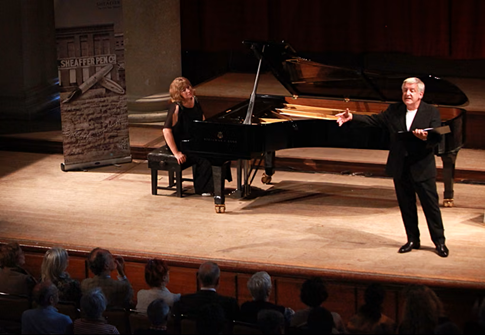
Revisiting their collaboration on Rêverie almost a decade earlier, Parham gave luminous voice to Debussy’s piano works entirely from memory. Meanwhile Simon Russell Beale, seated and reading the narrative from the page with neither French accent nor prop, languorously brought Debussy to life. Paradoxically, our first encounter with the composer in 1917, aged just 54, finds him ravaged by cancer, already in the shadow of death. Charting the course of his artistic and personal fortunes and coloured by the knowledge that his end was near, Debussy gives a frank, charming and at times poignant retrospective account. His journey, albeit not strictly chronological, charted the evolution of his compositional style, recalled the exhilarations and disappointments of his career, and unflinchingly revisited the marriages and infidelities that marked his private life. A notorious and self-confessed philanderer, and cursed with a roving eye, Debussy himself wrote defensively to his abandoned first wife Lily Texier in 1904 after the breakdown of their marriage ‘An artist is in short, a wretched indoors man and perhaps even a wretched husband. Besides, the reverse, a perfect husband often produces a contemptible artist…it’s a vicious circle.’
Debussy was a childhood musical phenomenon who in 1872 entered the Paris Conservatoire to begin his formal musical training at the tender age of 10. Shortly thereafter he won the prestigious Prix de Rome. He later met and worked for the fabulously wealthy Mdme Nadezhda von Meck, who arranged for one of his early manuscripts – Danse Bohémienne – to be reviewed by her friend and protégé Tchaikovsky. The great Russian’s response was cool. ‘It’s a very nice piece, but it is much too short. Not a single thought is developed to the end, the form is extremely messy and it lacks unity.’ Listening to Lucy Parham play it, one could hardly accuse Tchaikovsky of having been unduly harsh in his assessment.
Parham and Russell Beale then went on to span nearly 20 years of Debussy’s creative life and offered a gentle musical and biographical progression which reflected his changing imagination: from the graceful ornamental world of the young composer to the daring, highly individual soundworld of his mature years. In the first half Arabesque No.1 (written in around 1890) unfurled delicately. It was followed by two pieces from Estampes: the sensual La soirée dans Grenade, a Moorish infused habanera triggered by a brief visit to San Sebastián in 1903. It was followed by Pagodes (Pagodas), whose quivering bell-like textures were inspired by a Javanese gamelan orchestra Debussy had heard at the Paris Exposition. Jardins sous la pluie (written in the same year) suggests a garden lashed by rain in a rushing torrent of notes which Parham dispatched with dazzling agility.
After Lily’s very publicly attempted suicide in 1904 – she shot herself in the chest with a revolver in the Place de la Concorde – and for Debussy, a sustained period of public opprobrium – he met, eloped with and married Emma Bardac. No matter that she was at the time the mistress of his friend Gabriel Fauré. This comparatively settled period of his life was expressed in a series of Préludes – miniatures like the sunny La fille aux cheveux de lin (The Girl with the Flaxen Hair), played here with beguiling tenderness.
There was a distinct change of mood in the second half of the recital. Des pas sur la niege (Footsteps on the Snow) from the first book of Préludes, suggestive of an austere, almost desolate landscape was evoked by Parham with extraordinary economy. By contrast, pieces such as the glinting, fleeting Poissons d’or (Golden Fish), and the technically challenging Pour les huit doigts (For the Eight Fingers) displayed Parham’s pianistic skills at their intricate best. Golliwog’s Cake-Walk, the jaunty syncopated finale of Children’s Corner, composed for Debussy and Emma’s daughter Chouchou, and the dreamlike Clair de lune which offered a moment of exquisite intimacy, brought the recital almost to its conclusion. It was though L’Isle joyeuse (The Joyous Island), an intoxicating blend of colour, rhythm and sensual pleasure inspired by a painting by Watteau, which provided a fitting end to the evening, and ensured that it was the brilliance of Debussy’s art, rather than the unbecoming aspects of his private life, that lingered.
Chris Sallon