
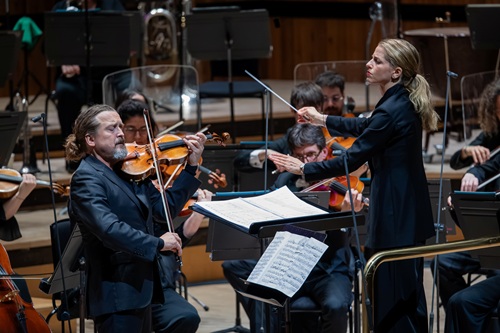
 United Kingdom Elgar, Fujikura, Beethoven: Christian Tetzlaff (violin), London Philharmonic Orchestra / Karina Canellakis (conductor), Royal Festival Hall, London, 4.11.2026. (AV-E)
Elgar – Violin Concerto in B minor, Op.61
Dai Fujikura – Radiance (UK premiere)
Beethoven – Symphony No.5 in C minor, Op.67
The charismatic Christian Tetzlaff offered an unusually inwardly introverted and restrained reading of Elgar’s Violin Concerto, its passion kept close to the heart rather than worn on the sleeve. Rather than projecting the familiar Edwardian sweep, he drew out the music’s more private emotional world through subtle inflections, finely judged phrasing and a remarkable sensitivity to its shifting shades of sheening sensations. The planetarium playing was nuanced and deeply expressive, never resorting to meretricious displays of virtuosity.
The opening orchestral paragraphs had breadth and presence, Karina Canellakis allowing Elgar’s shifting sonorities to unfold clearly before Christian Tetzlaff entered not as a conquering soloist but as a voice joining an existing conversation. His playing gave the first movement’s contrasting themes a searching, almost private intensity; the lyrical material was tender without sentimentality, while the animated passages retained a tensile line. The rapport between Tetzlaff, Canellakis and the London Philharmonic Orchestra was palpable, the orchestral responses full-bodied and exuberant, complementing the robust violin line rather than smothering and concealing it.
The Andante was the performance’s still centre. Tetzlaff traced its long lines with disarming simplicity, and its gradual intensification felt wholly organic. At its close, soloist and orchestra seemed to merge into Elgar’s hushed reverie. The finale brought greater volatility and brilliance, its shifts between athletic passagework and lyrical reflection sharply characterised. The one reservation concerned in the remarkable Cadenza accompagnata, Elgar’s unusually conceived accompanied cadenza. As the violin recalls earlier themes, the strings provide an uncanny shimmer through pizzicato tremolando. Elgar told Ernest Newman that the effect should be ‘a distant Aeolian harp fluttering under and over the solo’. Here, that ethereal, suspended sonority never quite ignited. It was a localised shortfall in an otherwise absorbing account. The closing pages were splendidly exuberant, Tetzlaff’s violin soaring above the orchestra, whose blazing brass and vigorous strings gave the music a swaggering brilliance as it swept to its crowning conclusion, greeted by ecstatic applause.
The obligatory encore, Bach’s Andante from the A minor Sonata, proved a ponderous postscript. After the emotional intensity of the Elgar, it was entirely unnecessary, its clinical manner coming across as cold and bland. It felt as though the soloist who had inhabited the concerto so completely had disappeared, leaving only the notes behind.
Fujikura’s Radiance, receiving its UK premiere, proved a deeply disappointing interlude. In his programme note, the composer describes what he calls a ‘shadow-process’: taking a recording of a movement from a Beethoven symphony (he declines to identify which) and stretching it to around five times its original length, creating a ‘slow, heavy, low-frequency landscape’. He then composed directly ‘on top’ of this sound. Once the work had taken shape, he removed the recording, leaving music shaped by what he calls the ‘shadow-process that generated it’.
Fujikura describes this pathetic pastiche as beginning in a high register, as though light were emerging from the disappearance of its heavy foundation. But the promised transformation remained elusive and offered neither a convincing sense of light nor any discernible trace of the shadow-process that was supposed to have shaped it.
In the muzak itself, the supposed ‘shadow’ left no discernible trace, nor did the promised radiance emerge. There was no convincing transformation, architecture or developing argument, merely disconnected orchestral gestures and shifting sonorities, with no discernible sense of direction or development. Ideas appeared and disappeared without purpose or expressive consequence. The result had neither the coherence of a properly conceived orchestral work nor the narrative momentum one might expect of an effective film score. It came across as a crude cut-and-paste job, lacking inventive originality, structural integrity and expressive trajectory.
To place Radiance alongside Beethoven’s Fifth was, at best, a misjudgement; at worst, an act of considerable hubris. The uncomfortable comparison was inescapable and hardly flattering. Although Radiance was shorter in actual duration than Beethoven’s Fifth, its static, concentrated and compressed musical material made it seem interminable. Beethoven’s momentum and cumulative drive, by contrast, made time fly. I have heard AI produce more coherent and imaginatively developed compositions than this work of human intelligence.
If Fujikura’s Radiance remained resolutely elusive, Beethoven’s Fifth, which followed, was truly radiant. In Canellakis’s hands, the symphony was a masterclass in architecture, clarity and cumulative energy, its light hard-won through tension, struggle and ultimate triumph.
Canellakis’s revelatory reading combined structural grasp with dramatic drive, broad in conception and urgent in momentum, weighty in its grandeur yet light on its feet, forceful without sacrificing classical poise. Every movement contributed to a single cumulative argument; the pacing and transitions shaped with exceptional precision and control.
The opening Allegro con brio had incisive bite, tremendous attack and dramatic urgency. The four-note motto was incisively delivered, its rhythmic insistence immediately establishing a sense of confrontation and forward momentum. Canellakis relished the music’s sudden contrasts, driving the development with fierce energy while maintaining remarkable clarity; the second subject brought welcome breadth without dissipating the tension. The movement’s turbulent coda was thrillingly propelled, its drama never becoming heavy-handed. The Andante con moto was warm and spacious, its variations carefully differentiated. Particularly memorable were the pointed woodwind contributions, especially the fresh, poised flute solos. Throughout the symphony, timpanist Simon Carrington was outstanding, his powerful playing providing a formidable rhythmic backbone and adding essential weight and sharp definition to the orchestral argument.
The Scherzo balanced mystery and muscularity, its stealthy returns finely controlled, and the fugal Trio lucidly voiced. The transition to the finale was a masterclass in sustained tension. Over the held strings, the timpani’s ominous, hard-stick strokes were sharply articulated by Carrington, their measured insistence intensifying the suspense and driving the crescendo forward. The release into C major was exhilarating.
The transition from the Scherzo to the finale was a masterclass in the measured accumulation of tension. Canellakis controlled the long crescendo with extraordinary patience, allowing the suspense to gather almost imperceptibly before the exhilarating release into C major. In the finale, expanded brass and woodwind blazed, yet the texture remained clear; its momentum was sustained throughout, leading to a final build that was intense, cumulative and perfectly judged. Canellakis showed herself to be a Beethoven conductor of the first rank, a distinction rarely encountered today.
The LPO played magnificently throughout, displaying precision, virtuosity and character, while responding instinctively and incisively to Canellakis’s complete command of orchestral balance. This was a performance of monumental scale and thrilling vitality, lucid in every strand and compelling in its cumulative power. The packed audience rose in a prolonged standing ovation as Canellakis acknowledged individual players, with the woodwind and timpanist receiving especially rapturous applause. Fortunately, this concert was recorded for BBC Radio 3, where it will be broadcast on 19 January 2027.
Alexander Verney-Elliott