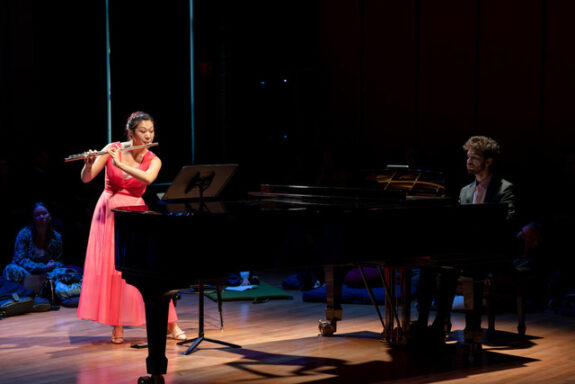
 United States Various: [1] Matthias Goerne (baritone), Daniil Trifonov (piano); [2] Annie Wu (flute), Joseph Vaz (piano). Carnegie Hall, New York, 19.10.2025. (RP)
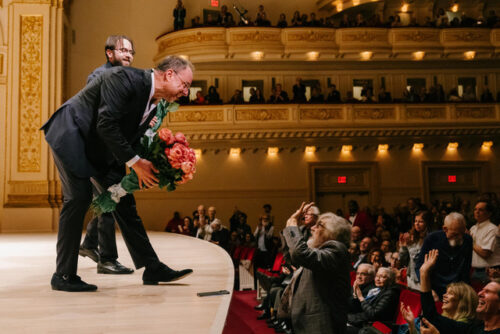
Master storytellers appeared at Carnegie Hall in two concerts on a perfect Sunday afternoon in autumn. It is a sign of the transformative power of music that there were full houses on such a day for both baritone Matthias Goerne and pianist Daniil Trifonov performing Schubert’s Die Schöne Müllerin, and for flutist Annie Wu and pianist Joseph Vaz in ‘Not Too Sweet – A Well-Being Concert’. The formats could not have been more different, but the goal of the four artists was the same, as was their profound effect on the audiences.
Now 58, Matthias Goerne has long been a dominant figure among Lieder specialists. His teachers included the legendary baritone Dietrich Fischer-Dieskau and soprano Elizabeth Schwarzkopf. Goerne has a penchant for performing with solo pianists rather than those who self-identify as collaborative pianists. Daniil Trifonov is just one in a long line that has included Alfred Brendel, Vladimir Ashkenazy, Jan Lisiecki and Seong-Jin Cho.
Goerne’s voice retains all of its remarkable warmth, depth and expressiveness. Vocal heft was never in his toolbox, hardly a necessary attribute for a song specialist or in the select number of operatic roles that he undertook. He can bark out a forceful high note, but it is in the long, beautifully shaped, lyrical phrases where he is at his finest. The vocal colors and textures that he summons are extraordinary, as is his ability to use them to reveal the meaning of each word and emotion they convey.
The baritone has always had a disconcerting stage presence, including a tendency to glare at the audience. Age has softened that to a large extent, as Goerne now has a distinctly professorial look and wears eyeglasses. Nonetheless, he still stalks the stage or suddenly looks skyward in mid-phrase, as if transported by a thought or jolted by a sudden dramatic impulse. He does not create a unique world for a song but rather lives it without inhibition.
Goerne began Die Schöne Müllerin, as one would expect, in a lusty, robust voice for ‘Das Wandern’, singing of the joys of an itinerant miller. He weighed the intentions of the young woman who had caught the miller’s eye with warm sound and intense feeling in ‘Der Neugierige’. Later, in ‘Morgengruss’, Goerne expressed the young man’s growing uncertainty over whether she does indeed love him with heartbreakingly tentative tones. In ‘Mein!’, the miller’s exultation that his heart’s desire has been granted was tinged with wonder, not boastfulness.
With the Miller’s dreams of love and happiness dashed, Goerne probed the prospect of death in ‘Trockne Blumen’ through an interior monologue tinged equally with pain and triumph. The monologue evolved into a conversation in ‘Der Müller und der Bach’, with the miller’s voice haunting and despair-laden and the brook’s comforting utterances filled with a sense of the supernatural.
Trifonov brought unsurpassable lyricism and fiery passion in equal measure to the songs. In ‘Das Wandern’, he played with a rhythmic acuteness and forward propulsion that captured both the miller’s restless spirit and the mill wheel’s ceaseless movement. In ‘Wohin?’, Trifonov played with glistening transparency that captured in sound the spirit and sparkle of the wood nymphs of which Goerne sang. In the strophic songs, beginning with ‘Das Wandern’, Trifonov highlighted music details in each verse that caught the emotional current of each.
‘Ungeduld’ was fast and loud, as was ‘Eifersucht und Stolz’, with the former expressing impatience and joy, and the latter fury. Balance suffered but not the impact of the songs. Silence followed the final chord of ‘Der Müller und der Bach’, with Goerne and Trifonov revealing the soothing depth of emotions through intimacy and simplicity in the final song, ‘Des Baches Wiegenlied’. The short postlude that ends the cycle was sublime with its mingling of infinite sadness, acceptance and wonder.
Rather than in the cream, gilt and red splendor of the Isaac Stern Auditorium where Goerne and Trifonov performed, Annie Wu and Joseph Vaz appeared in the Resnick Education Wing, a multi-use performance space atop Carnegie Hall. The room was encircled by mats with cushions for reclining, overstuffed pillows and chairs: ideal for a relaxed, immersive, nurturing experience, which is the intent of Carnegie Hall’s Well-Being Concerts.
‘Not Too Sweet’ epitomized Carnegie Hall’s twin goals of combining first-class musical performances with elements of self-care and mindfulness. It is common wisdom that music helps people heal and thrive, and Wu is as compelling in the self-help and inspiration departments as she is as a musician. To help put things into perspective, Wu was born in 1996, the same year Goerne made his New York recital debut.
Multi-faceted might have been coined to describe Wu, who graduated magna cum laude from Harvard University with a degree in comparative literature and holds a master’s degree from New England Conservatory. This summer, she led a music appreciation course through the lens of other art forms at the Juilliard Extension Division. Food is also important to Wu. Her mushroom-themed concert-dinner and a dessert-inspired album have over 3 million streams. And, of course, she has appeared in recital and as a soloist with symphony orchestras in the US and Europe.
Wu explained that the title of the program came from the Chinese phrase for the perfect dessert. Interwoven between stories from her childhood and of the personal challenges she has encountered, some stemming from the pandemic, Wu and Vaz performed bonbons from the flute repertoire as well as some tarter, more reflective pieces to get the right, not-too-sweet touch. Vaz, who studied piano and mathematics, joins Carnegie Hall’s Ensemble Connect as their 2025-2027 pianist fellow and definitely falls into the collaborative pianist camp.
The bonbons were undeniably two pieces by Philippe Gaubert, his Nocturne et Allegro Scherzando and Madrigal for Flute and Piano, and Jules Mouquet’s Flute Sonata, with their soothing melodies and Impressionist sensibilities. Poulenc’s Les Chemins de l’amour added the requisite sophistication, while Sibelius’s ‘War es ein Traum?’ drew the most dramatic and incisive playing from Wu and Vaz. For pure sentimentality, nothing bested their emotion-laden and rich-sounding rendition of Dvořák’s ‘Songs My Mother Taught Me’. The slow movement from Bach’s Flute Sonata in E minor was the spiritual heart of the program.
As Wu and Vaz performed Fauré’s mercurial Fantaisie for Flute and Piano, the curtain rose to reveal expansive views of the city at twilight. Then dessert was served: the real thing, not just the musical sort.
Rick Perdian
Featured Image: Annie Wu (flute) and Joseph Vaz (piano) © Fadi Kheir
[1] Schubert – Die Schöne Müllerin
Matthias Goerne (baritone) & Daniil Trifonov (piano)
[2] Not Too Sweet: A Well-Being Concert
Annie Wu (flute) & Joseph Vaz (piano)
Philippe Gaubert – Nocturne et Allegro Scherzando, Madrigal for Flute and Piano
Jules Mouquet – Flute Sonata, Op.15
Poulenc – Les Chemins de l’amour
Sibelius – ‘War es ein Traum?’, Op.37 No.4
Dario Marinelli – ‘Liz on Top of the World’ (arr. Emily Mussio Marquez)
Joe Hisaishi – ‘Merry-Go-Round of Life’ from Howl’s Moving Castle
Bach – Adagio ma non tanto from Flute Sonata in E minor, BWV1034
Dvořák – ‘Songs My Mother Taught Me’, Op.55 No.4
Fauré – Fantaisie for Flute and Piano, Op.79