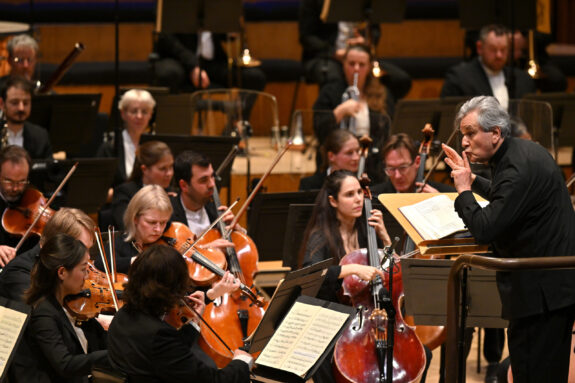
 United Kingdom Musgrave, Walton, Vaughan Williams: Antoine Tamestit (viola), London Symphony Orchestra / Sir Antonio Pappano (conductor). Barbican Hall, London, 11.12.2025. (JR)

Musgrave – Phoenix Rising
Walton – Viola Concerto
Vaughan Williams – Symphony No.2 (‘London Symphony’)
97-year-old Scottish composer Thea Musgrave is, remarkably, said to be still composing, at her home in the United States: her work Phoenix Rising which opened this continuing series of concerts featuring British Music hails back to 1996-7 and is in the form of an extended single movement, progressing from darkness to light as the mystical phoenix rises from the ashes as the promise of hope and rebirth. Sir Antonio Pappano took the microphone at the outset to introduce the work. Is this the start of the American predilection for spoken introductions? I do hope not – we can all read the programme, in advance or even during the performance, especially when they are given out generously, free of charge.
(Allow me to digress. I once attended an unforgettable performance of Alfred Schnittke’s riotous First Symphony in Moscow many decades ago – the jovial conductor, Gennady Rozhdesventsky, gave a clearly entertaining and informative 45-minute introduction to the work, taking up the entire first half of the concert – the audience listened attentively throughout and laughed frequently – I understood not a word).
Pappano chose to dedicate this concert to the memory of Sir Andrew Davis, who did so much to champion British music. The centrepiece of Thea Musgrave’s large-scale orchestral work, Pappano explained, is the moment when the phoenix rises, a luminous chord of pitched percussion, played by marimba, vibraphone, xylophone and glockenspiel. Before that, after a bleak opening, there is stormy violence leading to a section of despair, cor anglais emphasising the gloomy mood. The second half of the work, in contrast, builds to a romantic climax and a serene coda to conclude the work.
The timpanist represents the force of darkness, and the solo horn, at first offstage, the voice of hope. Percussion is placed in ‘stations’ round the back of the stage to underline the drama. Having said all that, the piece is not particularly easy listening. It is written in Musgrave’s ‘dramatic-abstract’ style, depicting often violent confrontations between instruments (much as in Schnittke’s First Symphony). It is more of a soundscape than a tone poem, often dissonant, often seemingly aimless. In the very noisy sections, the work brought to mind elements of The Rite of Spring, and I also heard Walton (who we would hear next). The performance was well received. It was supported by the Royal Philharmonic Society and a grant from the RPS Thea Musgrave Fund.
Walton’s Viola Concerto established Walton as a substantial figure in British music, until then he rather had the reputation as an enfant terrible (witty Façade and jaunty Portsmouth Point). Towards the end of 1928, when Walton was in his late-twenties, Sir Thomas Beecham suggested that Walton compose a viola concerto for the violist Lionel Tertis, who initially rejected the work as being too modern. In stepped German composer and violist Paul Hindemith (who himself is one of the few composers to have written a concerto for viola) – Tertis then realised his mistake at the premiere and soon took it up.
Pappano and French violist Antoine Tamestit chose to perform the work in the composer’s 1961-2 version, where Walton had thinned the orchestration. Tamestit made his instrument sing, often gracefully, making the firm case that the viola should never be viewed as a purely ensemble instrument. The faster middle section of the first movement Andante commodo, brought parts of Walton’s magnificent First Symphony to mind. The syncopated rhythms of the joyous and exuberant second movement Vivo, con molto preciso kept the string section of the orchestra on their toes. Tamestit was the master of double-stopping, often with the very lightest of touch. The warm applause of the audience was rewarded with a nonchalant yet charming encore, Capriccio by Henri Vieuxtemps (dedicated to Paganini).
Vaughan Williams composed his ‘London Symphony’ in 1912 (the composer did not designate that name for the work but based it on a symphonic poem he had devised about London), dedicating it to his friend George Butterworth. The work was revised several times, this performance brought us the 1920 version, which became the published version, rather than the 1936 revised version which is apparently more often played and the one the composer wanted to exist for posterity.
I always conjure up Monet’s image of Big Ben from a foggy Embankment as the symphony begins, the harp chiming the ‘bells’ through the mist. The city awakes slowly and then bursts into noisy sound. The programme note suggested the work is Mahlerian in nature, and I agree: it is ‘like the world, embracing everything’. It is a gorgeous work and in Pappano’s hands, with the orchestra playing like a dream, Pappano showed us what a true masterpiece it is. The opening movement was simply glorious, played with tenderness, fondness and joy. The work then becomes more reflective in the two inner movements. The string playing was exemplary throughout, emphasising the grandeur of the piece and of the city. Walton used the viola to add warmth, principal Eivind Ringstad making a fine solo contribution, supposedly a lavender-seller’s cry in a Bloomsbury square on a grey November afternoon. The finale was initially shattering, before, as the symphony closed, we drifted along with the grey, flowing Thames into the December night. It was a performance of recording quality – and thankfully it was recorded by Marquee TV for future broadcast and for future release on LSO Live – not to be missed.
John Rhodes
Featured Image: Sir Antonio Pappano conducts the London Symphony Orchestra © Mark Allan