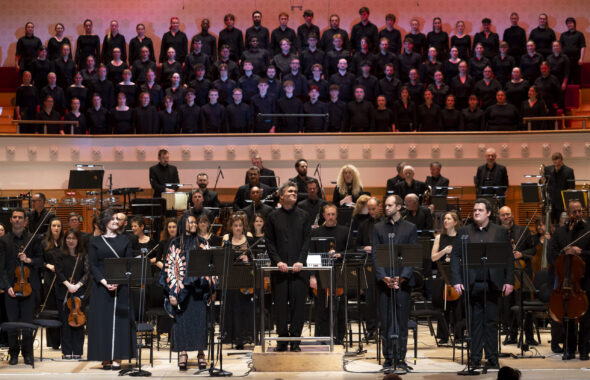
 United Kingdom Grieg, Tippett, Witter-Johnson: Sir Steven Hough (pianist), Pumeza Matshikiza (soprano), Beth Taylor (alto), John Findon (tenor), Ashley Riches (bass), National Youth Choir of Scotland (director: Christopher Bell), BBC Scottish Symphony Orchestra / Ryan Wigglesworth (conductor). City Halls Glasgow, 4.12.2025. (GT)

Ayanna Witter-Johnson – Bacchanale (world premiere)
Grieg – Piano Concerto in A, Op.16
Tippett – A Child of Our Time
This concert marked the 90th anniversary of the BBC Scottish Symphony Orchestra (once known as the BBC Scottish Orchestra). Throughout the 2025-26 season, the founding of the orchestra is being celebrated with the type of innovative programmes for which the orchestra has been renowned. Many a composer in Scotland has had their first orchestral pieces performed here in Glasgow, among them Thea Musgrave, John MacLeod, Eddie McGuire, John Maxwell Geddes, and many more. The BBC SSO has also proved a platform for young musicians. Sir Simon Rattle started his career here, as did Sir James MacMillan, both as a composer and conductor.
New music has always been at the heart of this orchestra’s concerts and broadcasting, and it was significant that the evening opened with an English composer’s piece, Bacchanale. The London-born, with Jamaican roots, Ayanna Witter-Johnson is a musician who embraces diverse trends from reggae and jazz to classical genres. She also sings and plays the cello in her concerts. The commissioned piece is, as she says, ‘a musical ode to joy, movement and community … a celebration of life in full sound. […] The piece embodies my continuing journey to weave classical tradition with the sounds and sensibilities of my Caribbean heritage – celebrating how these worlds can meet, play, and uplift one another.’ Certainly, the work’s buoyant mood gives hope that the work has a future. The swiftly transitory episodes were bereft of invention, and the few themes were repetitive, yet were well orchestrated. This was an occasion that would have been better served by a new work by a Scottish composer.
It was Grieg’s Piano Concerto that featured in the BBC SSO’s early publicity; this ever-popular piece invokes all the colourful Nordic romanticism of this great composer. There is much in common with Scotland’s romanticism in the music’s beautiful northern harmonies and orchestral colours. Sir Steven Hough has long enjoyed a relationship with the orchestra, and he has been an equally-long marvellous interpreter of the Grieg concerto. His playing on this evening was accessible with individualism at its core, and the relationship with the conductor and orchestra was very much one of the orchestra following the soloist. The arpeggios on the piano following the grand opening cascade were brilliant in their splendour, and the affinity of the work with Robert Schumann’s own concerto was prescient, especially in the colourful second idea before the sparkling cadenza. At the heart of the slow movement was an enchantingly beautiful folk theme which Hough took up with great repose and mastery. The expressive individuality of the pianist emerged powerfully in the finale, most notably in the apotheosis embellished by the opulence of the arpeggios through to the glorious final bars. Hough’s encore of Chopin’s Nocturne in E-flat major, Op.9, No.2 was nevertheless a magical moment, despite a broken piano string.
Sir Michael Tippett was a composer who reflected on the world around us through many of his compositions, and his social conscience was reflected most powerfully in his wartime oratorio, which has become one of his finest works. Tippett’s A Child of our Time was motivated by the assassination by a young Jewish man of a German diplomat, which led to the genocide of Kristallnacht in the occupied German territories. The composer portrays the universal oppression of discriminated peoples by the inclusion of spirituals instead of using Lutheran chorales of the Bach Passions and the Messiah. He altered the harmonies to serve as moments of repose between the other sections of the work.
In the opening, which describes ‘pogroms in the east, lynchings in the West’, there is later a beautiful quotation from one of the spirituals, ‘Go Down, Moses’, by the chorus. The work is daunting in its opening bars heard on the low brass of the orchestra, and the strings play a sequence of a lament softly as if in grieving for the dead of war. Again, the brass announces a harmony of grieving, before the chorus sings in an almost mystical harmony, and gradually rises in emotional appeal. The overwhelmingly powerful impression is not only a protest against the brutality of war but also against injustice and the cruelty of humankind in today’s world, as real now as it was when this immensely moving work was composed. Tlppett wrote, ‘When I wrote the work, I was so engulfed in the actions of the period, I never considered its prophetic quality.’ The four soloists were magnificent both in voice and characterisation of the tragic events, with the National Youth Chorus of Scotland especially moving in their singing of these desperately tragic texts, which remain relevant in today’s world.
In all, this was almost a very memorable concert programme for this orchestra, however, it would have been fitting to have heard a piece by a Scottish composer, but nevertheless this was an entertaining evening in which the orchestra showed their best qualities led by their outstanding Chief Conductor Ryan Wigglesworth and the standards auger well for the remainder of their 90th anniversary season.
Gregor Tassie
Featured Image: A Child of Our Time – soloists, conductor Ryan Wigglesworth, National Youth Choir of Scotland and the BBC SSO © Martin Shields